You’ve cleared immigration, collected your bags, and walked out into the arrivals hall at Incheon (ICN). Now: how do you actually get into Seoul? There are three real options — the AREX train, the limousine bus, and a taxi — and the right one depends on where you’re staying, how much luggage you have, and what time it is. This guide walks through each one step by step, with the small rules that trip first-timers up.
First, the basics: Incheon Airport sits about 50 km west of central Seoul — roughly 60 km by road to Seoul Station — so however you travel, plan on anywhere from 45 minutes to about 90 minutes to get downtown.
New to Korea? Start with our full Incheon Airport arrival guide for entry rules, transit cards, and the apps you actually need — then come back here for the Seoul Station details.
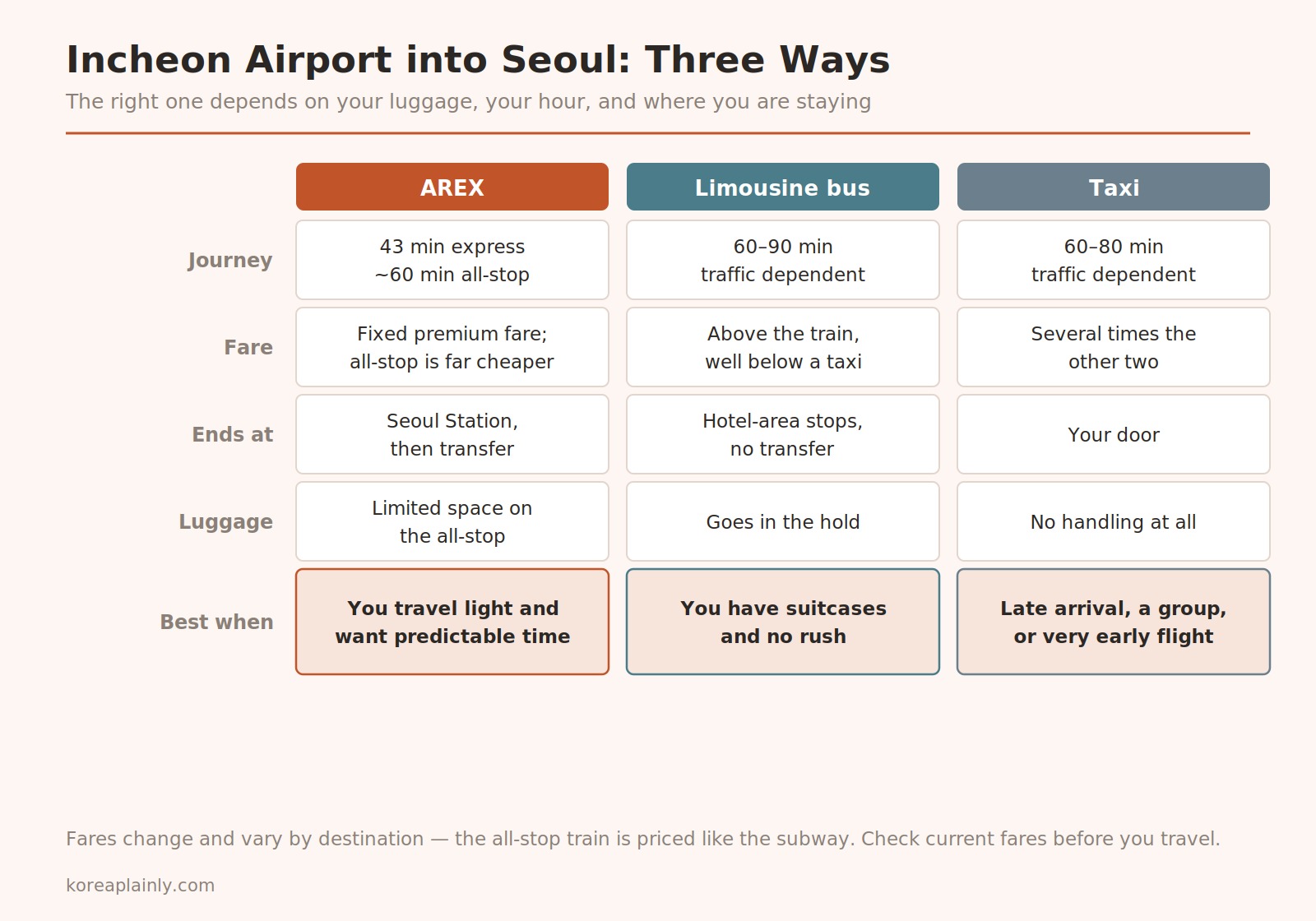
Short answer: Near a subway line? Take the AREX train. Heavy suitcases or a hotel far from the subway? Take the limousine bus. Late night, a group, or want door-to-door? Take a taxi.
First: three things to do before you leave the airport
A few minutes here saves a lot of confusion later.
1. Know which terminal you’re at. Incheon has two — Terminal 1 and Terminal 2 — and they’re far apart, with slightly different boarding points for trains and buses. Your airline decides which one you land at (note that Asiana moved to Terminal 2 in January 2026). The signs will tell you, but knowing in advance helps.
2. Sort out how you’ll pay for transit. This is the big one: a foreign credit or debit card can’t be tapped directly on Korean subways and buses. The simplest fix is a T-money card — buy one at any convenience store in the arrivals hall (CU, GS25, 7-Eleven) for roughly 4,000–5,000 won empty, then load it with cash (20,000 won is a sensible start). T-money works on the All-Stop train, the subway, city buses, and some taxis — but not the AREX Express. Tourist cards like WOWPASS and NAMANE do the same job and double as spending cards; you can pick those up at airport CU stores too. One catch: T-money balances top up with cash only.
3. Get online and set up an app or two. The airport has free Wi-Fi. Install Kakao T (for taxis) and a maps app before you head out. If you get stuck anywhere, the Korea Travel Helpline on 1330 has English-speaking staff.
Option 1: AREX train — cheapest and most predictable
The AREX (Airport Railroad Express) runs from both terminals into the city, and because it’s a train, traffic can’t touch it. There are two services on the same tracks, and telling them apart is what confuses people:
- Express train (orange gates): a flat 13,000 won, a reserved seat, and a nonstop run to Seoul Station — about 43 minutes from Terminal 1, 51 from Terminal 2. Your T-money card does not work here — you buy a separate ticket (you can now use a foreign credit card at the machine) and go through the orange gates.
- All-Stop train (blue gates): priced like the subway — roughly 4,150–5,350 won depending on your terminal and stop — and takes about an hour, stopping at 14 stations including Hongik University (Hongdae) and Digital Media City. Here you just tap your T-money card at the blue gate and board. No reservation.
Step by step: follow the signs for “Train” / “Airport Railroad” down to the Transit Center (B1). Decide Express or All-Stop. Either buy a ticket at the machine or tap your transit card, go through the matching gate, and board. Ride to your stop and tap out (if you bought a single All-Stop ticket, reclaim your small deposit at the refund machine on the way out). For your departure day, note that Seoul Station has a City Airport Terminal where some airlines let you check bags and print boarding passes before you ride back.
Option 2: Limousine bus — easiest with heavy luggage
The bus from Incheon Airport to Seoul — officially the airport limousine bus — trades a little speed for real simplicity: you sit once, your bags ride in the hold, and you don’t touch them until your stop — no stairs, no transfers.
Step by step: in the arrivals hall, find the limousine bus ticket counter or self-service kiosk and buy your ticket first — you cannot tap T-money to board at the airport. The kiosks take foreign cards and switch to English, Chinese, or Japanese. Each destination has a route number; find yours and the right boarding bay using the official route finder at airport.kr or the screens by the doors (Terminal 1 buses board just outside on the 1st floor; Terminal 2 from the B1 bus level). Hand your suitcases to the driver, keep the small claim tag he gives you, and board. There’s free Wi-Fi, stops are announced in English and Korean, and you press the red stop button when yours is called. (No toilet onboard — use the airport restroom first.)
Standard buses cost 17,000 won; premium KAL limousines (route numbers in the 67xx range) are 18,000 won; children 6–12 around 11,000. The main downside is traffic — a clear run is under an hour, but a Friday afternoon can add 30–60 minutes. After the trains stop, night buses (routes N6000, N6001, N6002) keep running, less often.
Option 3: Taxi — most convenient, most expensive
A taxi is door-to-door with no thinking required. Expect roughly 65,000–100,000 won to central Seoul depending on the class of taxi and traffic, plus a bridge toll, with the trip taking about 60–90 minutes. A standard taxi seats four but really fits about two large suitcases; for more, book a Jumbo or Deluxe.
Use the official taxi stands just outside the arrivals halls — and never follow anyone inside the terminal quietly offering a “taxi,” as legitimate drivers wait by their cars outside. The locals’ app is Kakao T: it works in English, shows a fare estimate, and lets you pay by card — set it up on the airport Wi-Fi first. If you’d rather lock in a price, the official International Taxi service offers fixed fares and English-speaking drivers (book at the airport info desk or intltaxi.co.kr). A late-night surcharge applies in the small hours, so the meter climbs faster then.
Arriving late at night?
The AREX Express stops around 22:40, with the All-Stop running a little later. If you clear the airport after that, your choices are a night limousine bus (N6000, N6001, N6002), which runs every 40–50 minutes and still needs a kiosk ticket, or a taxi, which is always there but carries the late-night surcharge. If you land in the small hours and just want to sleep, an airport-area hotel for the first night is worth considering.
Quick comparison
| Option | Fare (approx.) | Time | Best for |
|---|---|---|---|
| AREX All-Stop train | 4,150–5,350 won | ~60 min | Budget; stops like Hongdae |
| AREX Express train | 13,000 won | ~43–51 min | Speed to Seoul Station |
| Limousine bus | 17,000–18,000 won | 60–90 min | Heavy luggage; hotel areas |
| Taxi | 65,000–100,000 won | 60–90 min | Late night, groups, door-to-door |
Frequently asked questions
Can I just tap my own credit card on the train or bus? No — foreign cards can’t tap Korean transit gates directly. Buy a T-money (or WOWPASS/NAMANE) card, or buy an AREX single ticket with your card.
How far is Incheon Airport from Seoul? About 50 km from central Seoul — roughly 60 km by road to Seoul Station. Door to door, that’s 45 to 90 minutes depending on which option you take.
How long does it take to get from Incheon Airport to Seoul? The AREX Express reaches Seoul Station in about 43 minutes from Terminal 1 (51 from Terminal 2); the All-Stop train takes about an hour; limousine buses and taxis run 60–90 minutes depending on traffic.
Can I use T-money on the Express train? No. T-money works on the All-Stop train and everywhere else, but the Express needs its own ticket.
Is there a bus from Incheon Airport to Seoul? Yes — frequent airport limousine buses run from both terminals to hotels and neighborhoods across the city for 17,000–18,000 won. Buy your ticket at the arrivals-hall counter or kiosk before you board.
Where do I buy the limousine bus ticket? At the counter or kiosk in the arrivals hall, before you go to the bus — you can’t pay at the door when leaving the airport.
I land after midnight — what do I do? Take a night bus (N6000/N6001/N6002) or a taxi. The regular trains have stopped.
Which is cheapest? Fastest? Easiest with bags? Cheapest is the All-Stop train; fastest to Seoul Station is the Express; easiest with heavy luggage is the bus or a taxi.
Fares, schedules, and boarding points here were cross-checked against current 2026 sources at the time of writing, but they change. Confirm the latest details on the official Incheon Airport site (airport.kr) and the AREX and bus operators before you rely on them.