You’ve fallen down the K-pop rabbit hole, you’re finally into it — and then you open a fan forum and someone writes, “my ult bias wrecked me during the comeback stage, I’m such a delulu.” You understand every word individually, but the sentence makes no sense. Welcome to K-pop fandom vocabulary: a whole language of its own, part Korean, part English, with its own internal logic. Here’s a beginner’s glossary of the terms you’ll run into most, grouped so they actually make sense.
Picking your favorites
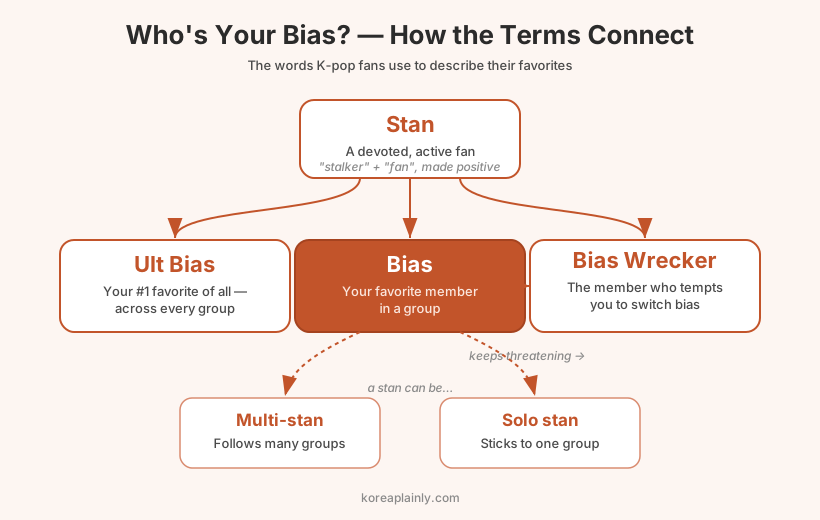
- Bias — your favorite member of a group. If someone asks “who’s your bias?”, they want a name. It’s the single most-used word in the fandom.
- Bias wrecker — the member who keeps threatening to steal your bias spot with an unexpectedly charming moment. “She’s my bias, but the maknae is such a bias wrecker.”
- Ult (ultimate bias) — your all-time number-one, across every group.
- Stan — to be a devoted, active fan (from “stalker” + “fan,” but reclaimed as positive). A “multi-stan” follows many groups; a “solo stan” sticks to one.
The people in a group
- Idol — a K-pop star, trained and debuted through an entertainment agency.
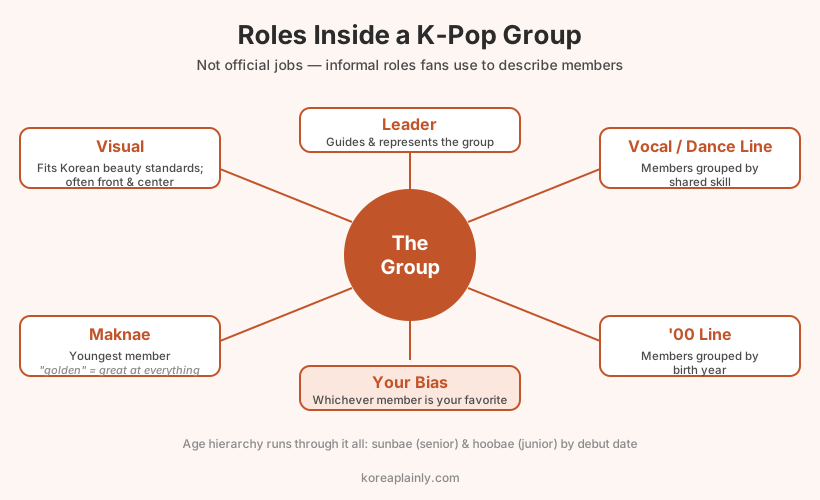
- Maknae — the youngest member of a group. Rooted in Korea’s age-based hierarchy, the maknae is often both babied and expected to be charming. A golden maknae is a youngest member who’s brilliant at everything (singing, dancing, visuals).
- Visual — the member considered to best fit Korean beauty standards, often featured front-and-center in photos.
- Leader — the member responsible for guiding and representing the group.
- Bias line / ‘00 line — “line” groups members by a shared trait, like birth year (‘00 line = members born in 2000) or role (vocal line, dance line).
- Sunbae / hoobae — senior / junior, by debut seniority. A group that debuted earlier is a sunbae to newer groups.
Music and promotions
- Comeback — not a return from a long break, but simply a group releasing new music. Because idols release music several times a year, each comeback brings a whole new “concept”: new styling, choreography, teasers, and photoshoots.
- Concept — the theme and aesthetic of a particular release (cute, dark, retro, etc.).
- Debut — an idol or group’s first official release.
- Trainee — an aspiring idol in the years of rigorous training before debut.
- Title track — the lead single a comeback promotes.
- All-kill — when a song hits number one on all major music charts at once.
At concerts and events
- Lightstick — a group’s official glowing concert accessory, each with a unique design (BTS’s ARMY Bomb, BLACKPINK’s Bi-Ping-Bong). Many sync to the music via Bluetooth to create arena-wide color effects.
- Fanchant — the synchronized chant fans shout at precise moments in a song — usually the members’ names — timed to not overlap the vocals. Agencies often release official fanchant guides.
- Fancam — a close-up video that follows one member throughout a performance.
- Fansign — an intimate event where fans meet idols and get albums signed (tickets usually won through album purchases).
Fan culture and collecting
- Fandom — the official collective name for a group’s fans (BTS = ARMY, BLACKPINK = BLINK, SEVENTEEN = CARAT).
- Photocard (PC) — small collectible cards of idols included in albums and heavily traded.
- Selca — a selfie (from “self-camera”).
- Aegyo — “acting cute”: the cute, baby-like gestures, expressions, and voice idols perform for fans.
The words with a warning
- Sasaeng — an obsessive fan who crosses into stalking: tracking idols, buying their private info, showing up at their homes. This is harmful, illegal behavior, universally condemned in the fandom — not a badge of honor. (From Korean sa “private” + saeng “life.”)
- Anti (anti-fan) — someone who actively dislikes a group and spends real energy criticizing or mocking it.
- Delulu — short for “delusional,” a light-hearted (or mocking) term for a fan who over-invests in fantasies about an idol.
Once you know these, that forum sentence decodes instantly — and you can jump into the conversation. K-pop fandom has its own language because it’s a genuine global community, and learning the vocabulary is the first step to belonging in it.