Before you book anything else, one question needs a clear answer: what do you actually need to enter Korea? The good news for most travelers in 2026 is not much — but there’s a moving part that trips people up, an expiry date you need to know, and one mandatory step that even visa-free visitors miss. Here’s exactly where things stand.
The short answer for 2026
For most Western tourists, entering Korea in 2026 requires no visa and no K-ETA — just a valid passport and a quick arrival form. That’s because Korea has a temporary K-ETA exemption in place, and it covers the countries most visitors come from.
But “K-ETA” confuses people because it isn’t a visa — it’s a separate travel-authorization step that normally sits on top of visa-free entry. So let’s untangle the three things that can apply.
Visa vs K-ETA vs e-Arrival Card
- Visa — most Western tourists don’t need one. Korea allows visa-free short stays (typically up to 90 days) for citizens of many countries, for tourism and visiting family.
- K-ETA (Korea Electronic Travel Authorization) — an online pre-screening that normally applies to visa-free travelers. Think of it as a digital permission slip you’d usually get before flying. In 2026 it’s temporarily waived for exempt countries.
- e-Arrival Card — a mandatory arrival form that applies to almost everyone, including K-ETA-exempt travelers. This is the one people forget.
Do you need the K-ETA? (2026 status)
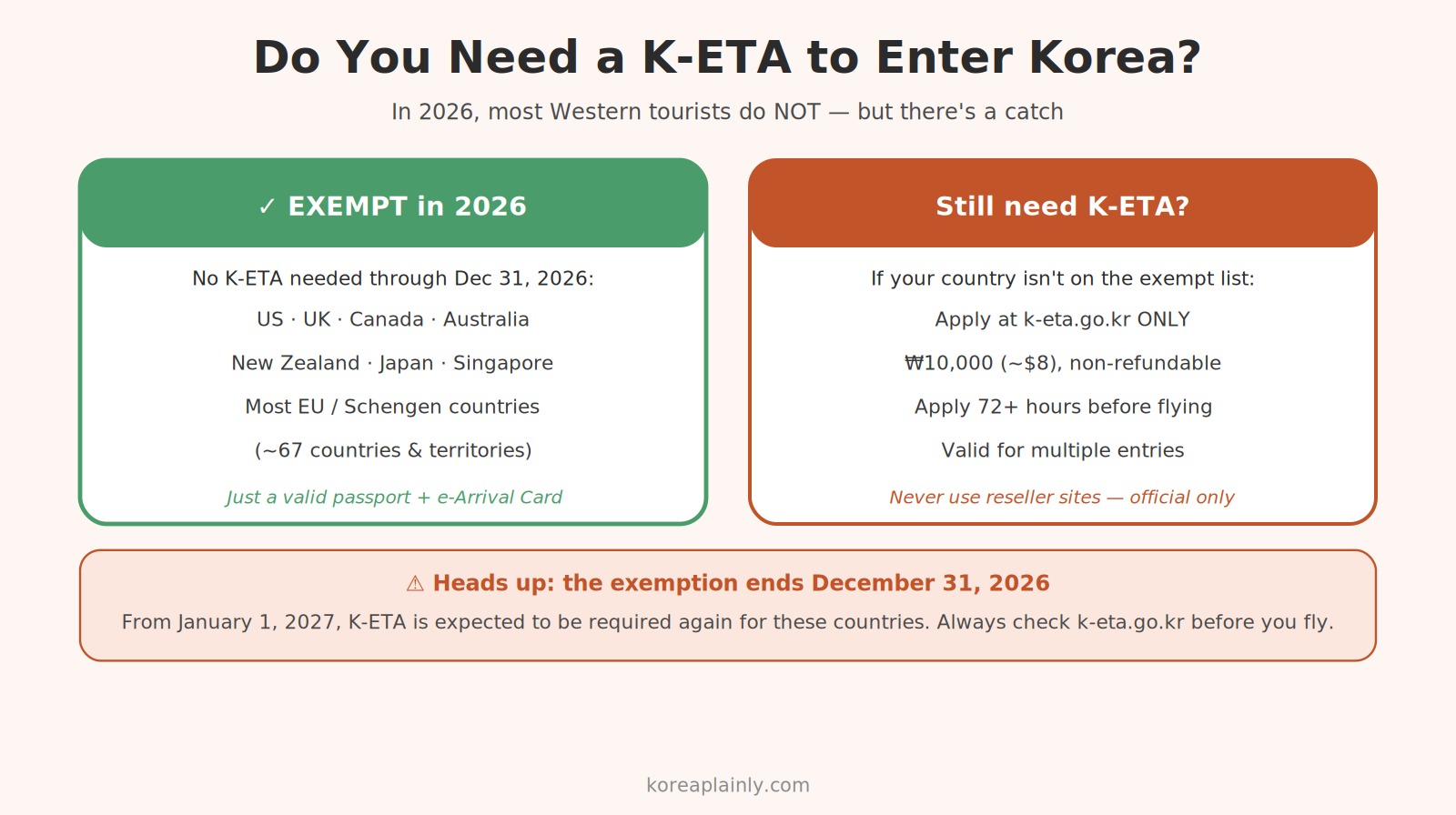
Right now, through December 31, 2026, citizens of roughly 67 countries and territories are exempt from the K-ETA requirement — including the United States, United Kingdom, Canada, Australia, New Zealand, Japan, Singapore, and most EU/Schengen countries. If you hold one of those passports, you can fly to Korea and clear immigration with just your valid passport and the e-Arrival Card. No K-ETA application, no fee.
There are also age-based exemptions: travelers aged 17 and under, or 65 and over, are exempt from K-ETA regardless of nationality.
If your country isn’t on the exempt list, you do need a K-ETA. Apply only at the official site — k-eta.go.kr — never through a reseller that inflates the price. It costs ₩10,000 (about $8), is non-refundable, should be submitted at least 72 hours before departure, and once approved covers multiple entries for its validity period.
One nuance even exempt travelers should know: you can choose to apply for a K-ETA anyway. The perk is that holding a valid K-ETA lets you skip the e-Arrival Card on entry. For most people the exemption is simpler, but if you’ll visit Korea several times, a K-ETA can be convenient.
The catch: the exemption ends December 31, 2026
This is the part to circle. The K-ETA exemption is temporary, currently set to expire at the end of 2026. From January 1, 2027, the K-ETA is expected to be required again for these countries unless the government extends the waiver once more.
Practically: if your trip is in 2026, you’re almost certainly fine without a K-ETA. If your trip is in 2027 or later — or straddles the New Year — check k-eta.go.kr before you fly and apply in advance if needed. Entry rules here change periodically, and this is not a step you can do at the airport.
The step nobody should skip: e-Arrival Card
Even if you’re K-ETA-exempt, you almost certainly need the e-Arrival Card — Korea’s mandatory arrival declaration. You can complete it online before you land (which saves time) or fill it in on arrival. You’ll need basic trip details including your first accommodation’s address, so have that handy.
Your actual entry checklist
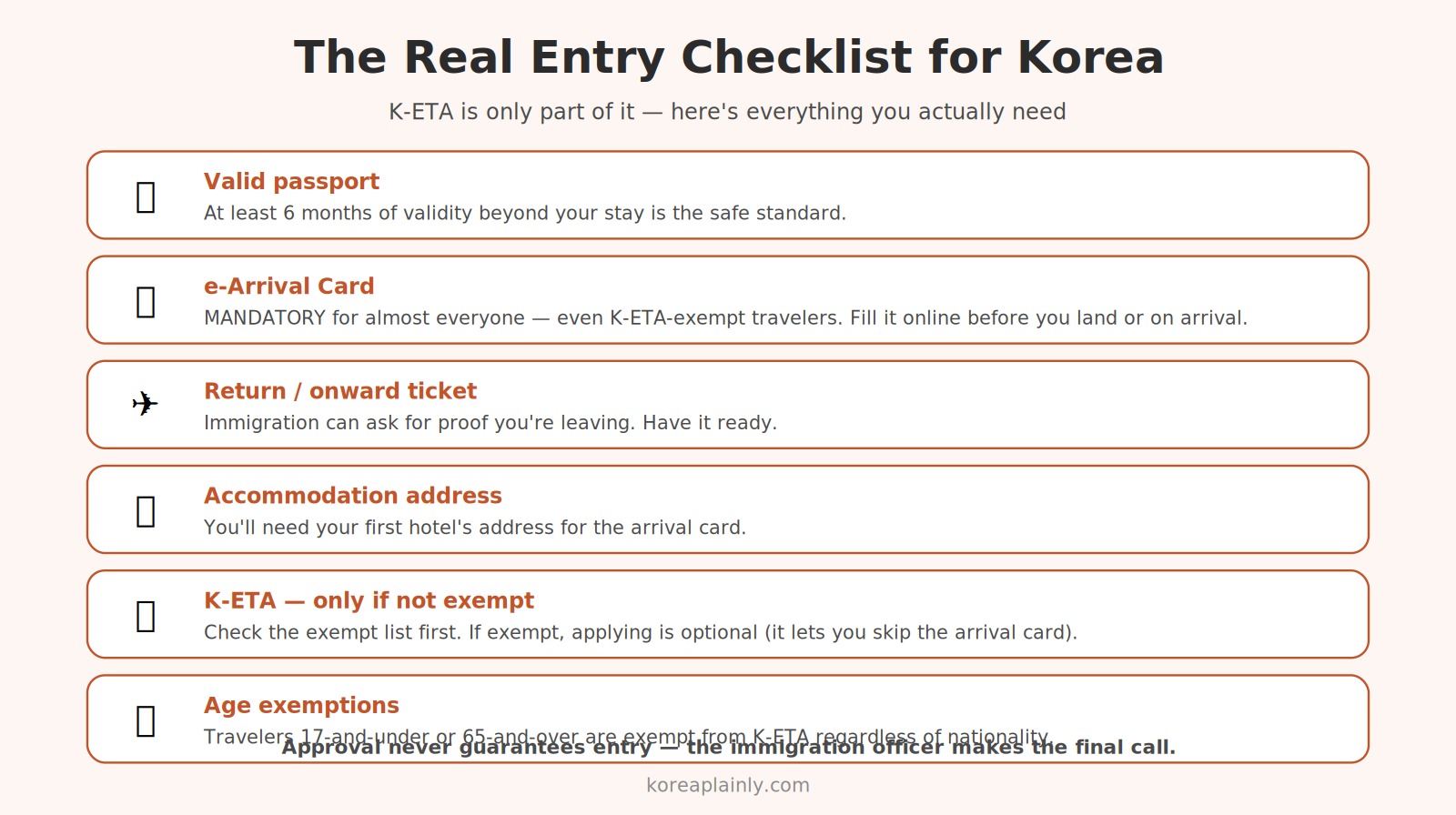
Pulling it together, here’s what you truly need:
- A valid passport — at least six months of validity beyond your stay is the safe standard.
- The e-Arrival Card — mandatory for almost everyone; do it online in advance.
- A K-ETA — only if your country isn’t exempt (or you’re not in the exempt age groups). Check the list first.
- Proof of onward travel and your accommodation address — immigration can ask.
And one reality check: neither a K-ETA nor visa-free status guarantees entry. The final decision is always made by the immigration officer at the border — approval just gets you to the desk.
For the overwhelming majority of 2026 travelers, though, it comes down to this: bring a valid passport, fill in the e-Arrival Card, and you’re set. Just double-check k-eta.go.kr close to your trip in case the rules shift — especially if you’re traveling in 2027.