Is Korea expensive? Less than most people expect. It’s a world-class destination with superb infrastructure, incredible food, and iconic experiences — yet it costs a fraction of Japan, Western Europe, or Australia. The free attractions are genuinely world-class, the food is exceptional at modest prices, and the transport network is priced for everyday local use. The trick isn’t just knowing the daily number — it’s knowing where your money goes and where it’s worth spending. Here’s what to actually budget in 2026, per person per day (flights not included).
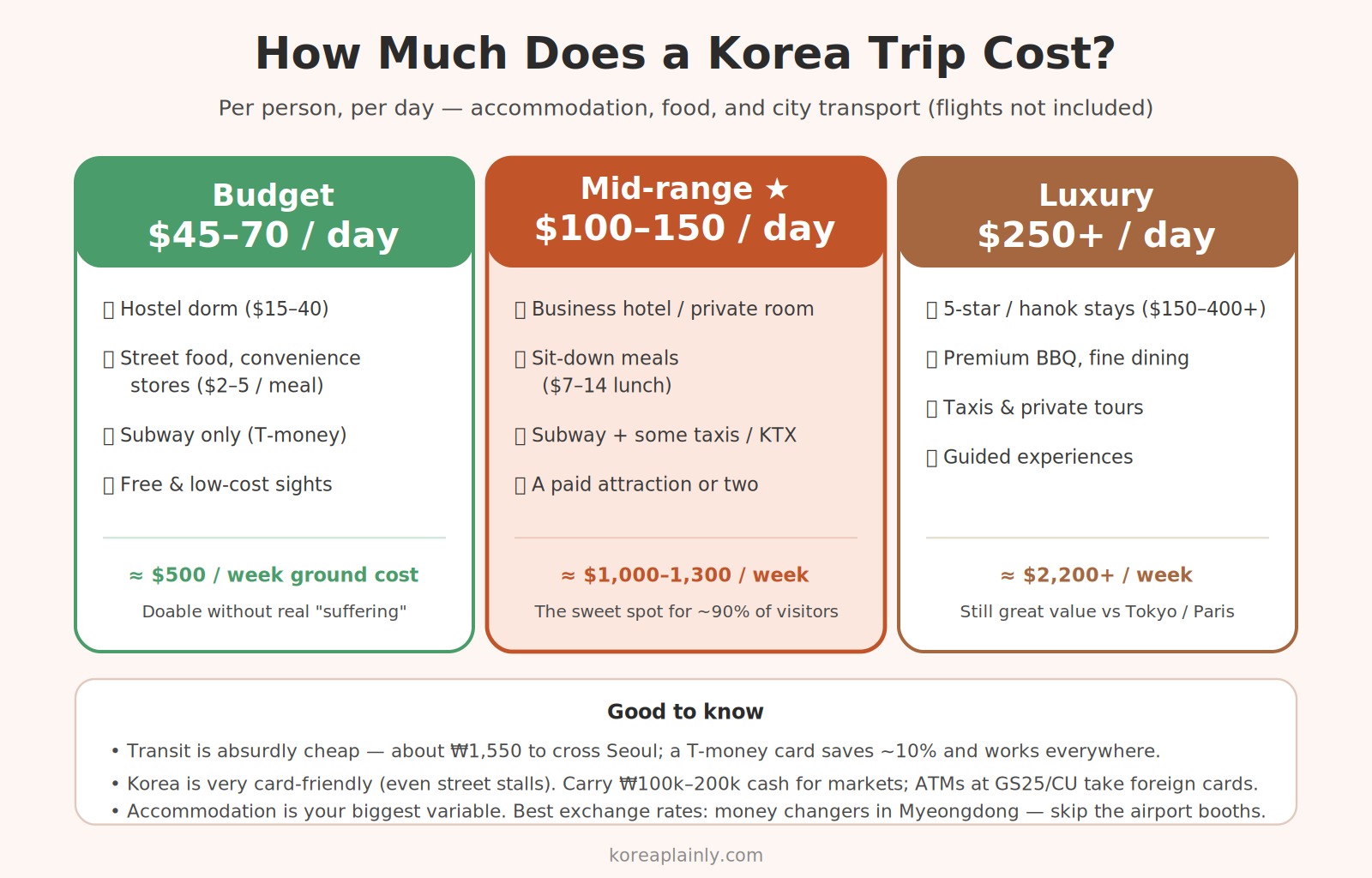
Budget: about $45–70 a day
Backpacker style: a hostel dorm ($15–40 a night), meals from convenience stores and street food ($2–5 each), subway-only travel on a T-money card, and free or low-cost attractions. This works across Seoul, Busan, Gyeongju, and Jeonju without real hardship — roughly $500 a week in ground costs. The main variable is accommodation: the moment you want a private room, you move up a tier.
Mid-range: about $100–150 a day
The sweet spot for most independent travelers. A business hotel or private room, two sit-down restaurant meals a day (a great lunch runs $7–14), subway plus the occasional taxi or KTX trip, and a paid attraction or two. Figure roughly $1,000–1,300 a week in ground costs — comfortable, unhurried, with room to be spontaneous.
Luxury: about $250+ a day
Five-star hotels or hanok stays ($150–400+ a night), premium Korean BBQ and fine dining, taxis everywhere, and private tours. Around $2,200+ a week — and even here, Korea delivers remarkable value: a week of five-star living in Seoul would be far pricier at the same quality in Tokyo or Paris.
Where your money goes
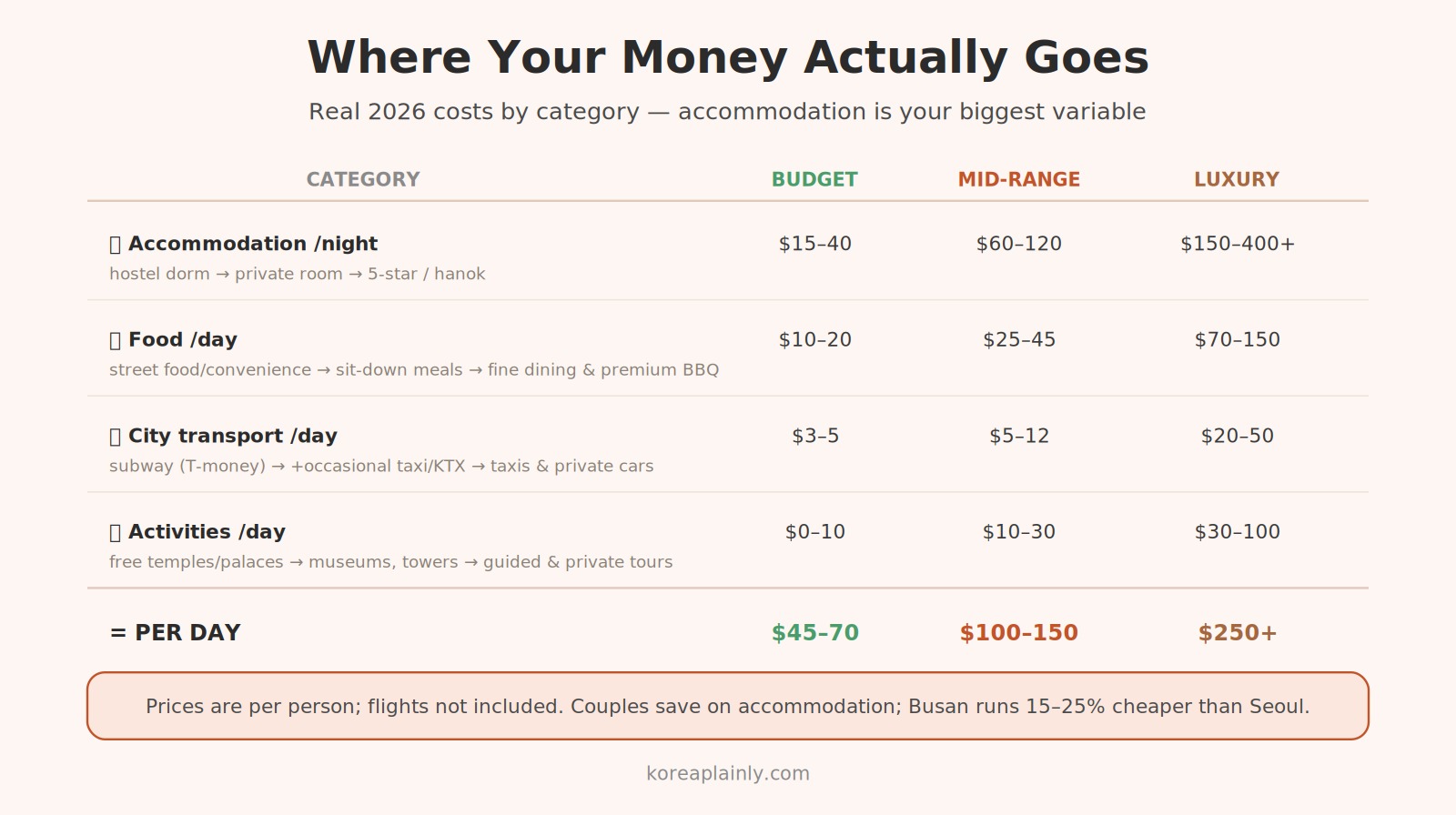
Accommodation is your biggest and most flexible cost — the gap between a hostel dorm and a luxury hotel is enormous, and it’s the single line that most changes your daily total. Food is genuinely great value at every tier: quality far exceeds the price compared to Western countries, so you can eat well without eating expensively. Transport is almost absurdly cheap — around ₩1,550 to cross Seoul, and a T-money card saves about 10% and works on every subway and bus. Activities range from free (many palaces, temples, and parks) to paid tours at the top end. Note that Busan runs about 15–25% cheaper than Seoul across the board.
Where to save, where to splurge
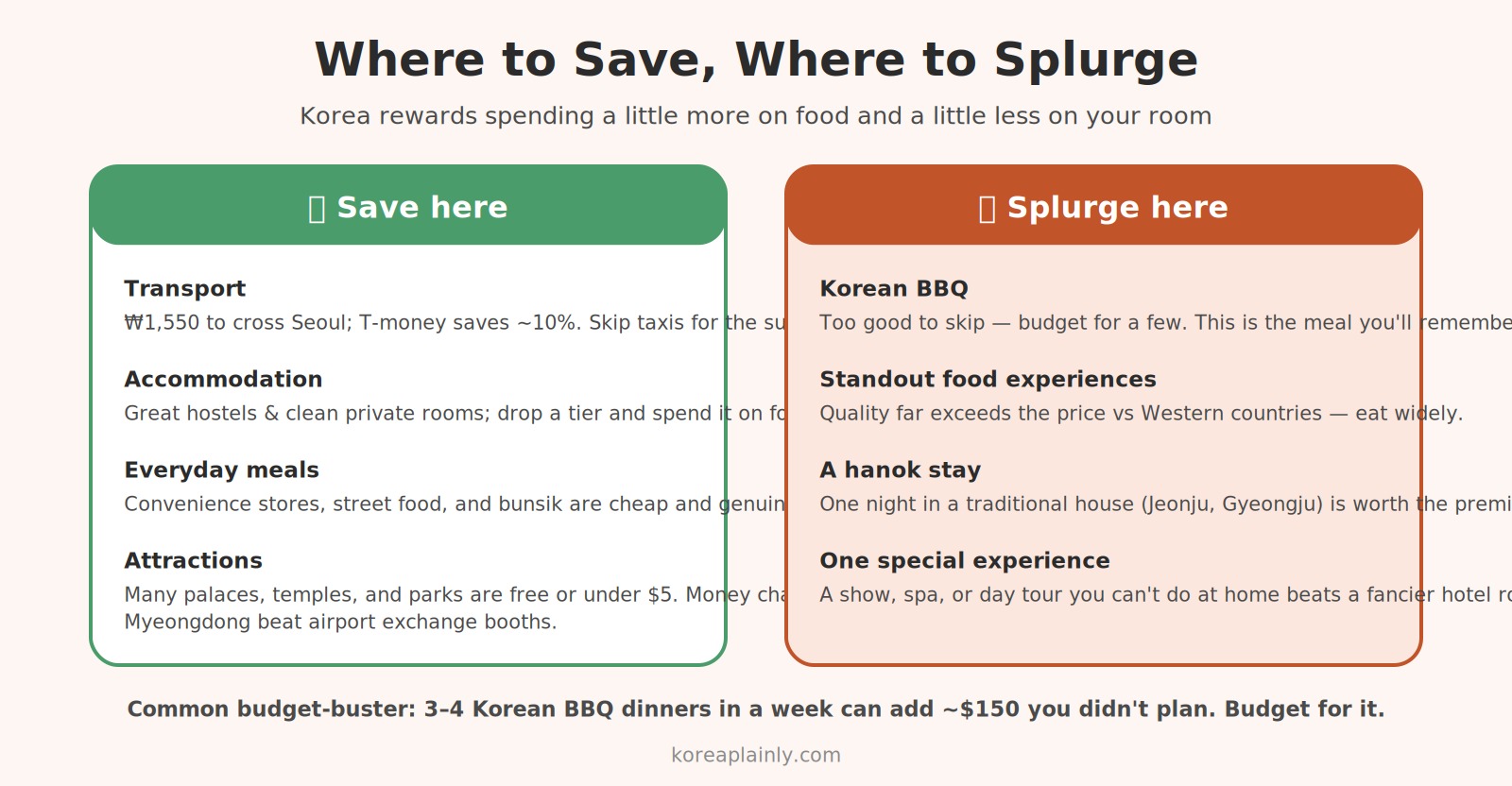
Korea rewards a specific strategy: spend a little more on food and a little less on your room. Save on transport (the subway is unbeatable value), on accommodation (drop a tier — the hostels and budget rooms are clean and central), and on everyday meals (convenience stores and bunsik are cheap and genuinely good). Then splurge where Korea shines: Korean BBQ is too good to skip, standout food experiences beat a fancier hotel, and one night in a traditional hanok or one special tour will outlast the memory of a nicer room. One common budget-buster to plan for: three or four Korean BBQ dinners in a week can quietly add about $150 you didn’t budget — so budget for it.
Money tips
- Korea is one of the most card-friendly countries on Earth — even street stalls and tiny convenience stores take cards. Carry ₩100,000–200,000 in cash for markets and small shops; ATMs at GS25 and CU accept foreign cards.
- The best exchange rates are at money changers in Myeongdong or Dongdaemun — skip the airport exchange booths.
- Traveling in the shoulder or low season can cut accommodation costs significantly.
For most travelers, a realistic target is around $1,000–1,300 in ground costs for a week, plus flights. Korea rewards spending a little more on food and a little less on a fancy room — that’s where the real experience is.