Every country has a cut of meat it eats more than the rest. Korea’s is pork belly, and the gap is not close — samgyeopsal (삼겹살) is grilled at office dinners, on Friday nights, at family gatherings, and on 3 March every year, which Koreans half-jokingly call Samgyeopsal Day for the way the date reads.
The name means “three-layered flesh,” describing the bands of meat and fat running through the cut. What follows is why this particular piece of pig became the centre of Korean social life, which is a more interesting question than it first appears.
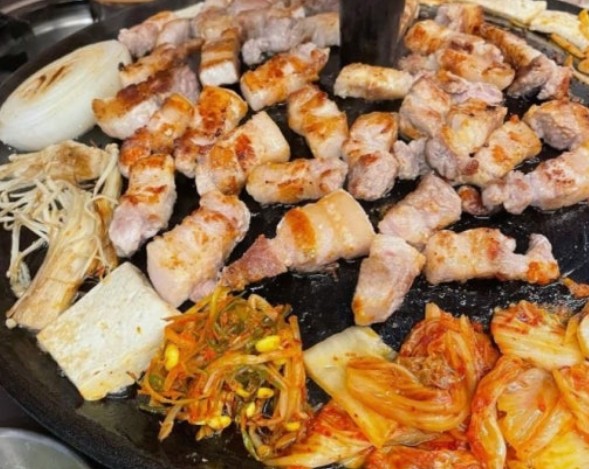
The cut itself
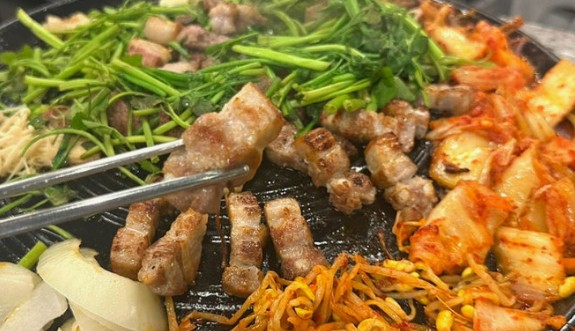
Pork belly, cut into strips and grilled at your table over a burner set into the middle of it. No marinade in the standard version, which is called saeng-samgyeopsal (생삼겹살) — raw pork belly. Salt, pepper, sesame oil, and the fat itself do the work.
Thickness matters more than visitors expect. Thin-cut cooks fast and crisps; thick-cut takes longer and stays juicy in the middle. Most restaurants specialise in one or the other, and Koreans have opinions about which they prefer in the way people elsewhere have opinions about steak doneness.
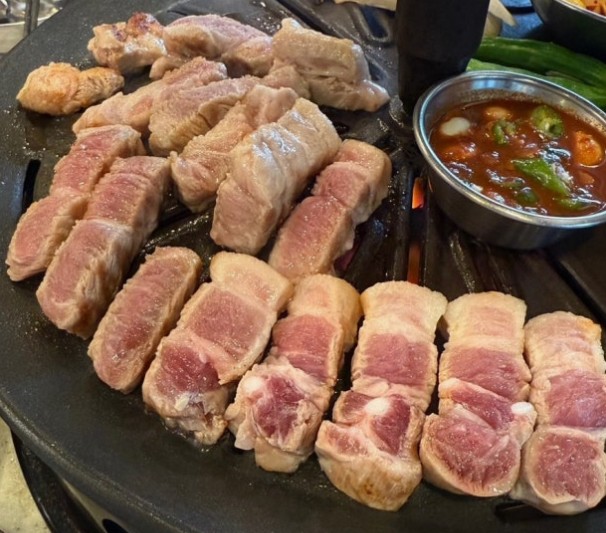
Charcoal — sutbul (숯불) — is the upgrade. Gas burners are more common and perfectly fine, but charcoal adds a smokiness you can taste immediately, and restaurants advertise it on the sign because it justifies a higher price.
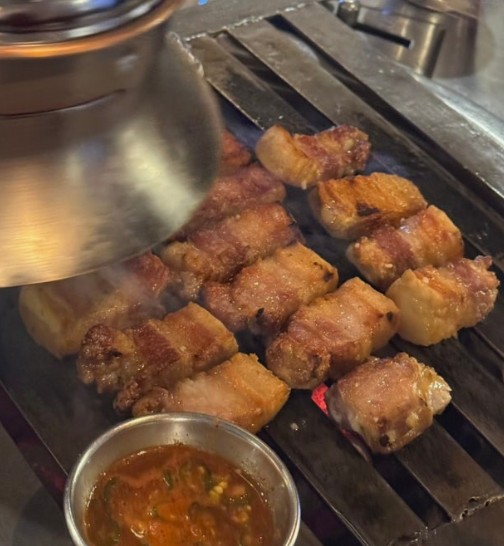
Why pork belly, and not something else
The standard explanation you will find in English says that Korea exported its lean pork to Japan and was left with the fatty cuts. It is a tidy story. It is also disputed inside Korea, and the fuller version is more interesting.
Here is what is not disputed. Before the 1970s, Koreans did not grill pork. Pigs were often raised on food waste, the meat carried a strong smell, and the only practical way to cook it was to boil or steam it under heavy seasoning that covered the odour. Grilled pork as a restaurant dish essentially did not exist.
Four things then happened close together:
Commercial pig farming arrived. Standardised breeds, proper feed, and castration of male pigs produced meat without the off-smell. For the first time, pork could go straight onto a grill and taste good.
Beef became expensive. A cattle price shock in 1976 pushed Korean beef out of reach for ordinary meals. Restaurants that had been grilling beef needed something to grill instead.
Export restrictions freed up supply. In 1978 the government blocked pork exports to Japan to hold down domestic prices, and export-grade pork — the good stuff — landed on the home market.
The equipment showed up. Propane burners and meat slicers spread at the same time, which is what made table-side grilling of thin-cut pork practical for a restaurant to serve at all.
So samgyeopsal restaurants appeared in large numbers in the late 1970s, and the reason is a convergence rather than a single cause.
Where the export story gets shaky is the claim that Koreans ate belly because the lean cuts had all gone abroad. Food historians point out that lean cuts were never priced above belly even during the peak export years, and that until brand-name pork arrived in the early 1990s, most Koreans did not think in terms of specific cuts at all — pork was “meat,” “fat,” “trotters,” and “for stew.” The distinction the story depends on didn’t exist yet in ordinary shopping.
Worth knowing, because you will encounter the simple version everywhere, stated as fact.
Why it’s the default for a work dinner
Ask a Korean office worker what a hoesik — a team dinner — involves, and samgyeopsal is the statistically likely answer. There are three reasons, and none of them is really about taste.
Nobody has to feel awkward about the bill. Take a team to a beef restaurant and everyone is quietly calculating what they are costing the person paying. Samgyeopsal removes that entirely — it is affordable enough that people order a second round without thinking, which is the point of the meal.
Almost nobody dislikes it. Announce beef and someone is delighted; announce raw fish and someone is not. Samgyeopsal is close to universally acceptable, which matters when you are feeding eight people who did not choose the restaurant.
The table has a job to do. This is the part that gets missed. Samgyeopsal does not arrive cooked. It arrives raw, in the middle of the table, and somebody has to turn it, somebody has to cut it with the scissors, somebody passes the lettuce, somebody moves the garlic to a hotter spot. “It’s burning, turn it.” “Put more garlic on.”
That shared task is doing the social work of the evening. There is always something to say, because there is always something happening on the grill, and people who spent the day being colleagues gradually stop talking like colleagues. A meal that arrived finished on plates would not do that.
Why soju is not optional
The pairing is so fixed that Koreans treat it as one item. There is a mechanical reason.
Pork belly leaves a film of fat across your mouth. After several pieces it starts to dull everything — the meat stops tasting as sharp, and you feel heavy before you feel full. Cold soju, taken as a shot rather than sipped, strips that film off and resets your palate.
Then the meat tastes new again, so you eat more, so you need another shot. Koreans do not describe it in these terms, but that is what is happening: soju is a palate cleanser that happens to also be alcohol, and the loop it creates is why a table of four can go through far more pork than any of them intended.
If you don’t drink, cold water works far less well and Koreans will tell you so. Sparkling water is the closest substitute.
How to actually eat it
Let the staff or the table’s designated griller work. If you’re a guest, don’t fight for the tongs.
Wait for the fat to render. Meat that looks cooked on the outside after ninety seconds is not ready. The point of pork belly is what happens when the fat turns translucent.
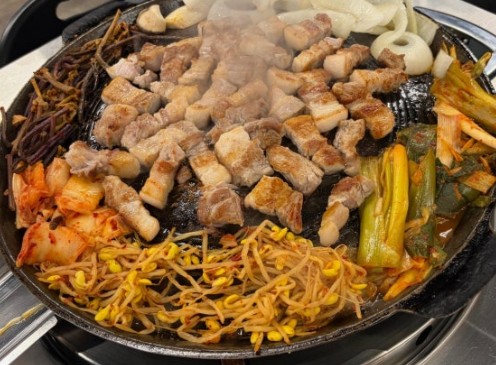
Use the grill’s cool zone. Kimchi, garlic cloves, mushrooms and onion go around the edge to cook slowly in the rendered fat. Grilled kimchi in particular is a different thing from raw kimchi, and most first-timers don’t realise it’s meant to be cooked.
Build the wrap deliberately. A lettuce leaf, a piece of pork, a smear of ssamjang, one slice of raw garlic if you can take it, a strip of grilled kimchi. Fold it and eat it in one — the wrap is designed as a single bite and eating it in two loses the point. The full mechanics are in how to eat Korean BBQ ssam.
Order the ending. After the meat, the standard close is fried rice made in the same pan, or cold noodles, or a small stew. Skipping it means leaving before the meal’s designed finish.
What to know before you go
Portions are per person and usually sold in minimums of two. Solo grilling is becoming more common in Seoul but is not universal.
The side dishes are free and refillable. So is the lettuce. Ask.
You will smell like it. This is not avoidable and Koreans account for it — samgyeopsal is not what you eat before something else.
It is not spicy at all. If Korean food’s reputation has been a barrier, this is one of the safest things on any menu. So is bulgogi, which is the marinated, sweeter, beef-based alternative.
Grilled kimchi is the best thing on the grill. Foreigners routinely miss it. Put a few pieces on early. What kimchi actually is explains why it changes so much with heat.
Frequently asked questions
Is samgyeopsal marinated? Usually not. Plain saeng-samgyeopsal is the standard. Marinated pork exists but is a different dish.
Is it spicy? No. The meat itself is unseasoned; the heat comes from what you add.
Do I cook it myself? Usually yes, though many restaurants have staff who grill for you, especially at the higher end.
Can I eat samgyeopsal alone? Increasingly, yes, but many places price by two portions. Solo-friendly grill restaurants are now common in Seoul.
What do I do with the leftover fat in the pan? It is the base for the fried rice at the end. That’s the design.
Why is it eaten on 3 March? The date reads 3-3, which echoes sam — the “three” in samgyeopsal. It is a marketing invention that stuck.