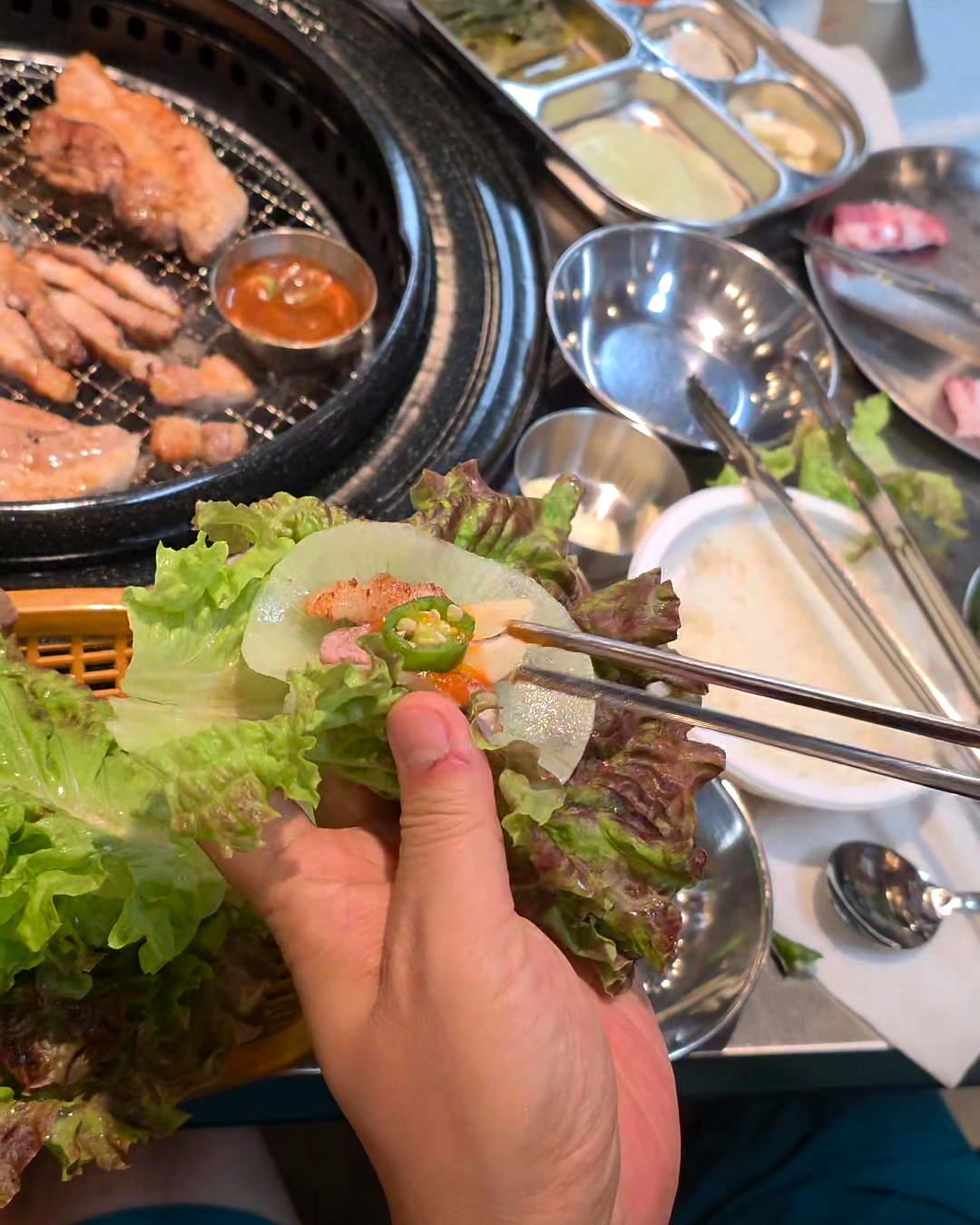
The first time I sat down at a Korean BBQ table, I built my lettuce wrap like a burrito — three pieces of pork, a mound of rice, a thick smear of sauce — and bit it in half. The sauce ran down my wrist and the whole thing collapsed. A Korean friend laughed, took the leaf, and rebuilt it: one leaf, one piece of meat, a small dab of sauce, folded tight, gone in a single bite.
That little parcel is called ssam, and getting it right is the difference between eating Korean BBQ and eating it the way locals do. It’s also the part that confuses almost every first-timer. So here’s exactly how the wrap works — what goes in, in what order, and the one rule that actually matters.
Short answer: A ssam (쌈) is a lettuce wrap you build yourself. Lay a leaf flat, add a little rice, one or two pieces of grilled meat, a small dab of ssamjang, and a slice of garlic. Fold it tight and eat the whole thing in one bite. Keep it small — that’s the only real rule.
Prefer to watch? Here’s the 30-second version:
What is ssam?
Ssam (쌈) literally means “wrapped.” It’s not a side salad sitting next to your meat — it is the way Koreans eat grilled meat. You take a fresh leaf, stack a few things inside, fold it, and eat it whole.
The point is balance. Hot, fatty pork belly on its own gets heavy fast. Wrap it in a cool, crisp leaf with a little rice and a sharp, savory sauce, and every bite resets your palate. That’s the quiet reason Koreans can sit at a grill for two hours and keep going — the wrap does the work. Treat the lettuce as decoration and you’re missing the whole experience.
Choose your wrapper
Look at the green basket on your table and you’ll usually find a few options. They’re not interchangeable — each one changes the bite.
- Lettuce (sangchu, 상추) — red or green leaf. This is the default and the easiest to work with: soft, wide, and sturdy enough to hold everything without tearing. Romaine is a bit too stiff and butter lettuce a bit too soft, so leaf lettuce is the sweet spot.
- Perilla (kkaennip, 깻잎) — sometimes called sesame leaf. It’s herbal and slightly minty, with a flavor strong enough to divide people the way cilantro does. Lay one on top of the lettuce for a double layer — it’s the most “local” upgrade, and it pairs especially well with rich pork belly.
- Ssammu (쌈무) — thin, round sheets of pickled radish. Tangy, faintly sweet, with a crisp snap. Use it instead of lettuce, or layer it underneath, when you want something that cuts the fat even more than greens do.
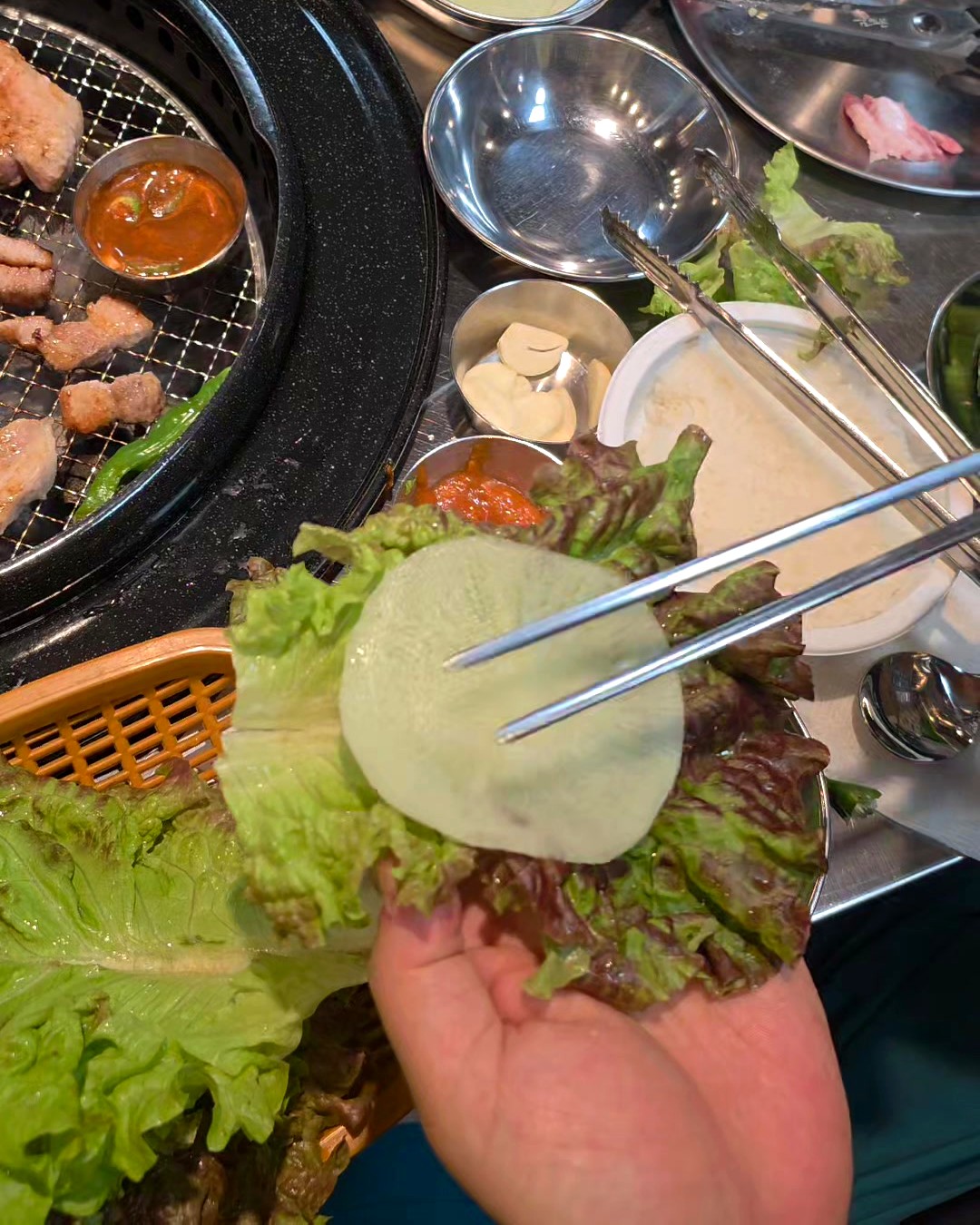
If your table has soy-pickled vegetables (jangajji, 장아찌), they work the same way — a sharp, salty layer that balances the meat.
How to build the perfect ssam
Here’s the order locals use without thinking. Each step is small on purpose.
- One leaf in your palm. Lettuce as the base; add a perilla leaf on top if you want it more aromatic.
- A little rice. Optional, but it soaks up the juices and rounds out the bite.
- One or two pieces of grilled meat, straight off the grill while it’s hot.
- A small dab of ssamjang. Less than you think — it’s strong.
- A slice of garlic (grill it on the edge of the pan first if raw is too sharp for you).
- Fold it tight into a small, neat parcel.
- One bite. The whole thing, at once.
That’s it. The skill isn’t in any single step — it’s in keeping the whole thing small enough to actually fit in your mouth.
The two sauces
There are usually two on the table, and they do different jobs:
- Ssamjang (쌈장) is the star — a thick paste of fermented soybean (doenjang) and chili paste (gochujang), often with garlic and sesame oil mixed in. It’s salty and deep, so a dab goes a long way.
- Gireumjang (기름장) is a light dip of sesame oil with salt and pepper. Dip the hot meat in it before wrapping; it lets the flavor of a good cut come through without covering it up.
Use one or the other in a given bite, not both at once.
Want it spicier? Add a cheongyang chili
If you like heat, this is the move locals reach for. Cheongyang chili (cheongyang-gochu, 청양고추) is a small, sharp Korean green chili — think of a jalapeño with more bite. Slice a piece and tuck it into the wrap before you fold it.
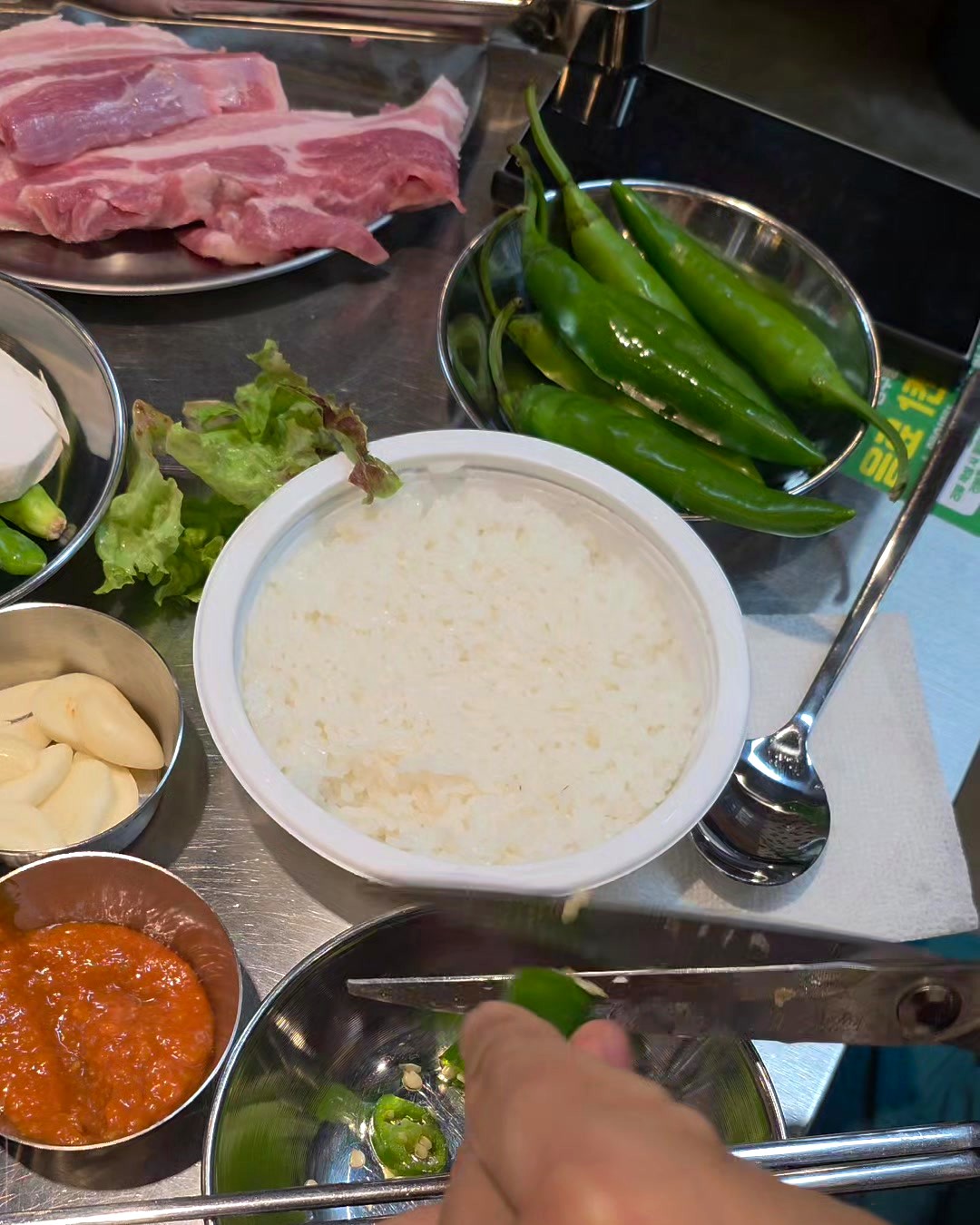
It isn’t heat for its own sake — the fresh, grassy sharpness cuts straight through the fat of the pork belly and wakes the whole bite up. Start with a small piece. Cheongyang is no joke.
The one rule that actually matters: one bite
Everything above is flexible. This part isn’t: a ssam is meant to be eaten in a single bite.
It’s not for show. Bite it in half and the structure fails — the sauce spills, the leaves come apart, and the careful balance of meat, rice, and sauce you just built falls onto the table (and your shirt, ask me how I know). The fix is simple: if the wrap is too big for your mouth, don’t take two bites — just use less filling next time. Overstuffing is the single most common beginner mistake. Small, balanced, gone in one go.
A few table manners worth knowing
You don’t need to memorize a rulebook, but these few things will help you blend in:
- Tongs and scissors are for the grill; your chopsticks are for eating. Don’t handle raw meat with the chopsticks you eat with.
- The meat gets cut on the grill with kitchen scissors, not on your plate — that’s why there’s no cutting board.
- Banchan (side dishes) and the lettuce are usually free and refillable. Don’t fill up on them before the meat; just ask for more when you run low.
- Pour drinks for others, not yourself, and let the eldest person start first.
- Most places have a two-person minimum — solo Korean BBQ is hard to find.
FAQ
What does ssam mean? It means “wrapped.” A ssam is any bite-sized parcel of meat, rice, and sauce folded inside a leafy vegetable.
Do you actually eat the lettuce at Korean BBQ? Yes. It’s the wrapper, not a garnish — it’s how the meal is meant to be eaten.
Lettuce or perilla — which should I use? Lettuce is the easy, classic choice. Perilla is stronger and more herbal; layer it on top of the lettuce if you want to try it. Many locals use both.
Do I really have to eat it in one bite? That’s the traditional way, and it’s there for a reason — the flavors are designed to land all at once, and biting it in half makes a mess. Just make smaller wraps and it’s easy.
What is ssamjang made of? Fermented soybean paste (doenjang) and chili paste (gochujang), usually with garlic and sesame oil. It’s salty and concentrated, so use a small amount.
Can I make ssam at home? Yes — any grilled or pan-fried pork or beef, leaf lettuce, rice, and a jar of ssamjang from a Korean grocery is enough to start.
More honest Korea
If you want the full picture — choosing cuts, grilling, and what every dish on the table is — read the Korean BBQ beginner’s guide. And for Korea’s other famous “spicy” export, here’s how Koreans actually eat buldak.
Written from my own table — the photos here are from a real Korean BBQ meal, not stock images.