
If you know Buldak at all, you probably know it from a video where someone sweats, gasps, and lunges for a glass of milk. The “Fire Noodle Challenge” turned these little black-and-red packets into a global dare. But that’s the foreigner version of Buldak — in Korea, nobody is filming themselves crying over it. It’s just food.
Short answer: Koreans eat Buldak like it’s dinner, not a dare. No milk chaser. Squeeze every last drop of sauce out with your chopsticks. And don’t stop chewing to catch your breath. New to it? Start with Carbonara, not the 2x.
The challenge is a Western invention
Buldak — 불닭볶음면, literally “fire chicken stir-fried noodles” — came out in 2012 from Samyang, one of Korea’s oldest noodle companies. It got famous abroad around 2016, when the Fire Noodle Challenge took off on YouTube. People ate it on an empty stomach, raced a timer, and treated it like a hot-sauce endurance test.
But look at the actual number. The Original is about 4,404 on the Scoville scale. A single jalapeño runs roughly 2,500–8,000. So one packet of Original Buldak is, give or take, about one jalapeño’s worth of heat — spread across a whole bowl of noodles you eat over several minutes.
For someone who grew up on kimchi, gochujang, and a bowl of jjamppong that fights back, 4,404 isn’t a feat. It’s Tuesday. The “challenge” framing only works if spicy food is unfamiliar to begin with. In Korea, it isn’t.
How K-content quietly took it global
Korea didn’t market Buldak into the world so much as Korean screens did it by accident.
Back in the first season of Squid Game, there’s a quiet convenience-store moment: Gi-hun and the old man (Player 001) sitting outside, breaking dry Samyang ramen into pieces, dusting it with the seasoning, and eating it raw with soju. No drama, no spice contest — just two people and cheap noodles. After that scene aired, global interest in Samyang ramen spiked and shops scrambled to keep it stocked. The everyday-ness was the whole appeal: it looked like real life, because it was.
Fast-forward to now, and the spicy side of that same company has gone fully mainstream abroad. Americans made up the majority of the one billion Buldak ramen packets Samyang sold in the second half of 2025 alone, and the brand’s sales hit $419 million last year — up from $50 million just three years earlier. As of 2026, you can buy Buldak Mac & Cheese — spicy Korean mac and cheese, in Sweet Corn and Carbonara flavors — exclusively at Walmart.
The point: what foreigners discovered as a meme, Koreans have just been eating. The world is finally catching up to the snack drawer.
How Koreans actually eat it
This is the part the challenge videos get wrong. Watch a Korean eat Buldak and you’ll notice it’s calm. A few small things make all the difference.
No milk, no panic dairy. The whole “chug milk to survive” routine is a foreigner move. Koreans generally don’t chase Buldak with milk. If they want it creamier, they build the dairy into the bowl — a slice of cheese melted on top, or the Carbonara version — not as an emergency fire extinguisher afterward.
Squeeze the sauce packet clean with your chopsticks.
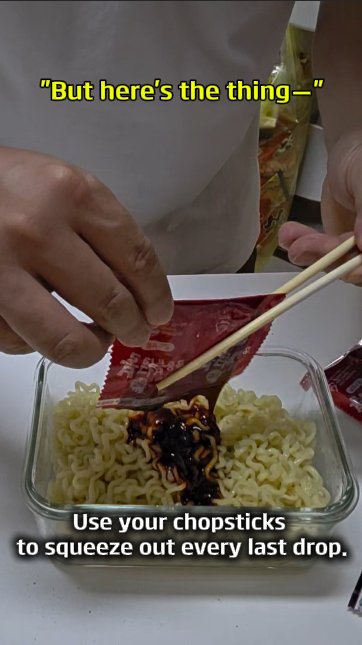
Buldak’s flavor lives entirely in that liquid sauce packet. Koreans don’t squeeze it with their fingers and leave half behind. They lay the packet flat and run closed chopsticks down it like a squeegee, pushing every last bit into the bowl. Nothing wasted.
Eat without stopping.

Here’s the real tell. A Korean eating Buldak doesn’t pause between bites to breathe or wave a hand. While they’re still chewing one mouthful, the chopsticks are already gathering the next. It’s a steady, unbroken rhythm. The heat builds less when you keep moving than when you stop, gasp, and let it sit. Water stays on the table — available, mostly ignored.
The golden combos (꿀조합). Koreans rarely eat Buldak totally plain. The usual add-ons:
- A fried or soft-boiled egg on top — the yolk rounds off the heat
- A slice of cheese, or melted mozzarella, for a creamy version
- Danmuji (yellow pickled radish) or kimchi on the side, for crunch and a cold break
- A scoop of rice stirred into the leftover sauce at the end, so nothing goes to waste
- The little seaweed-and-sesame flakes that come in the packet, sprinkled on last
None of this is to “survive” the spice. It’s just how you turn a cheap bowl of noodles into a proper meal.
The four Buldaks, ranked the Korean way
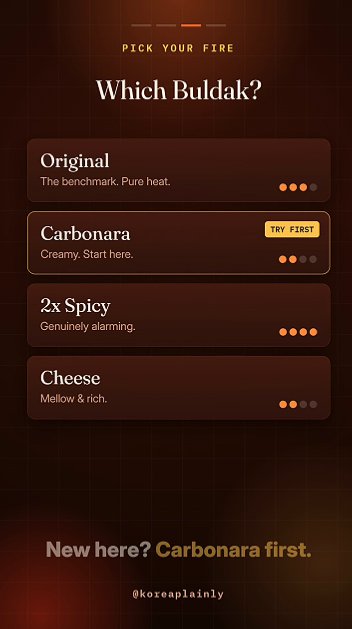
Koreans don’t pick a Buldak by how brave they’re feeling. They pick by mood. Roughly from gentlest to most serious:
- Carbonara — creamy, the mildest, and the honest entry point. If you’ve never had Buldak, start here. This is what people reach for when they want the flavor without committing to the burn.
- Original — the standard, the 4,404 one. The default late-night bowl.
- Cheese — Original plus a cheese powder, a touch rounder and saltier.
- 2x Spicy (핵불닭) — this is the one that’s genuinely hot, and the closest thing to the “challenge” the internet imagines. Even spice-tolerant Koreans treat it as a sometimes thing, not a flex.
Try it the Korean way
If you want to do it properly, the method is simple:
- Boil the noodles for about 5 minutes, then drain almost all the water — leave just a few spoonfuls in the pan.
- Take it off the heat, add the liquid sauce, and squeeze the packet clean with your chopsticks.
- Stir until every noodle is coated, then sprinkle the seaweed-and-sesame flakes on top.
- Optional, and very Korean: crack a fried egg over it, add a slice of cheese, and put some pickled radish on the side.
- Eat steadily, without stopping. Keep water nearby, but treat it as optional, not a lifeline.
One honest note: if you don’t eat spicy food often, begin with Carbonara, and skip the empty-stomach speed-run. The 2x is no joke. But the Original, eaten as a normal meal with an egg and some rice at the end? Completely manageable. That’s the whole secret — it was never meant to be a test.
The bigger picture
Buldak is the solo, late-night version of Korean eating: fast, cheap, a little indulgent, done alone with a phone in the other hand. When Koreans eat together, it tends to look completely different — a hot grill in the middle of the table, meat sizzling, everyone reaching in at once. If you want to see that side of how Koreans actually eat, here’s how Koreans do Korean BBQ (samgyeopsal).
Either way, the lesson is the same. The most famous Korean foods abroad usually arrive as a spectacle — a challenge, a trend, a viral clip. The real version is almost always quieter, and a lot more fun to actually live with.
So next time you make Buldak: skip the milk, squeeze the packet clean, don’t stop chewing. Eat it like it’s just dinner. Because in Korea, it is.
Buldak flavors, prices, and where you can buy them (like the Walmart Mac & Cheese run) change over time — check the retailer for current availability.