You walk up to the subway gate, tap your own credit card the way you would at home — and nothing happens. The machine next to it only takes Korean won in cash, and there’s a line forming behind you. This is the moment almost every visitor realizes Korea’s transit runs on its own kind of card. The good news: getting the right one takes five minutes, and this guide covers exactly which to choose.
Short answer: A foreign Visa or Mastercard can’t tap Korean transit gates, so you need a local prepaid card. There are three real choices — T-money (pay-as-you-go, works nationwide), the Climate Card (unlimited rides inside Seoul), and WOWPASS (a foreigner card that also handles shopping and currency exchange). Sightseeing only in Seoul? Get the Climate Card. Travelling around or want simple? Get T-money. Hate carrying cash for shopping too? Add WOWPASS. Many travelers carry two.
Why your own card won’t work
Korea’s buses and subways run on a local prepaid chip. Your foreign contactless card won’t tap through the gates, and the single-ride ticket machines take Korean won in cash. So the first thing to do after you land is pick up a local transit card — at a convenience store or an airport kiosk. Here are the three that matter.
T-money — the default
T-money is the card most people end up with, and for good reason: it works on subways, city buses, and most taxis all over the country, and the balance never expires.
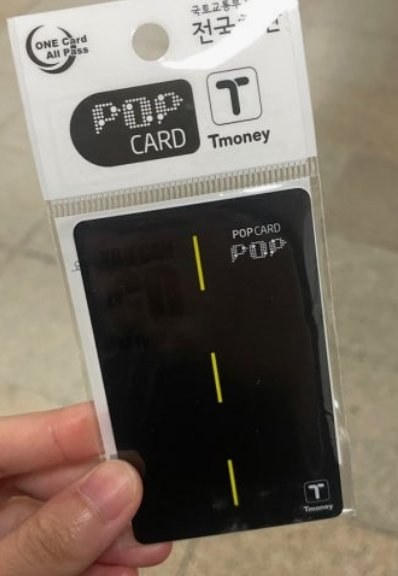 A T-money card (POP Card edition) — sold at any Korean convenience store.
- Where to buy: any convenience store (CU, GS25, 7-Eleven, Emart24) or an airport convenience store, for about 2,500–4,000 won. That’s the card price, and it’s not refundable — it’s a purchase, not a deposit.
- How to load it: with cash (Korean won), at a convenience store counter or a top-up machine (충전기) in any subway station. There’s no fee. For a 3–4 day trip, loading 30,000–50,000 won is a sensible start. Note: as a tourist you generally can’t reload T-money with a foreign credit card — it’s cash.
- Fares: a base subway ride is 1,550 won with T-money (raised in mid-2025), with a little more for longer distances. Buses are similar.
- The transfer discount: tap on and off each ride, and if you switch between bus and subway within 30 minutes, you skip the second base fare. The catch — you must tap off, especially on buses, or you lose the discount.
- Refunds: get your leftover balance back at a convenience store (balances up to 20,000 won) for a small 500-won fee. The card price isn’t refunded.
On an iPhone, you can now add Mobile T-money to Apple Wallet and tap with your phone — but topping it up still needs cash at a convenience store or a Korean card, so for most visitors a physical card is still the simplest.
Climate Card — unlimited rides in Seoul
The Climate Card (기후동행카드) is an unlimited-ride pass for Seoul’s subways and buses, and in 2026 it added short-term passes aimed squarely at tourists.
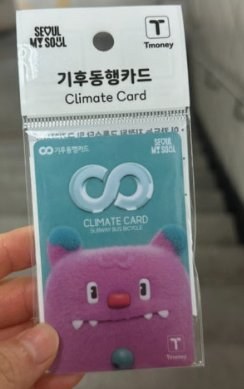 The Seoul Climate Card (기후동행카드).
- Tourist passes: 1-day 5,000 won, 3-day 10,000 won, 5-day 15,000 won — unlimited rides for that window. (The physical card itself is a one-time 3,000 won.)
- Where to buy and load: the airport Transportation Center, subway station machines, or convenience stores near stations. You buy and load it with cash (Korean won only).
- The big limitation: it only works inside Seoul. Ride past the city limits (think Nami Island or Suwon) and the exit gate will stop you to collect the extra fare.
- Airport note: you can’t use the Climate Card to enter the system at Incheon Airport on arrival (so it’s not for the airport train coming in), and it is not accepted on airport limousine buses either. It’s a getting-around-Seoul pass, not an airport-transfer pass.
If you’re spending a few full days bouncing around Seoul’s neighborhoods, the math beats pay-as-you-go quickly.
WOWPASS (and NAMANE) — one card for spending and transit
WOWPASS is a prepaid card built specifically for foreign tourists. It combines a Korean-network payment card (so it’s accepted where your foreign card might get rejected, with no foreign-transaction fees), a built-in T-money transit chip, and a currency-exchange feature.
- How it works: buy it at a bright WOWPASS kiosk (at the airport, major subway stations, and hotels — you’ll need your passport), then load foreign cash (USD, EUR, JPY and others) at the kiosk, or top up the shopping balance in the app with a foreign card. The card costs about 5,000 won.
- The catch most guides skip: the transit (T-money) balance is separate from the shopping balance, and the transit side still needs to be topped up with Korean-won cash. So WOWPASS solves shopping without cash — but not the cash-to-ride part.
- NAMANE is a similar foreigner card; its advantage is that you can top up anywhere from the app with a foreign card or Apple/Google Pay.
WOWPASS shines if you want to avoid money changers and foreign-card fees on everyday spending. For pure transit, T-money or the Climate Card is simpler.
Which one do you actually need?
- Sightseeing in Seoul, riding a lot → the Climate Card (1/3/5-day) usually wins on cost.
- Travelling beyond Seoul, or you just want one simple tap-and-go → T-money, since it works nationwide and never expires.
- You hate carrying cash and want one card for shopping too → WOWPASS (paired with a transit card or its own cash-loaded transit balance).
Plenty of travelers carry two — a Climate Card or T-money for transit, and WOWPASS for spending. That’s redundant but genuinely common.
Quick comparison
| Card | Best for | Cost | How to load |
|---|---|---|---|
| T-money | Simple, nationwide pay-as-you-go | 2,500–4,000 won + fares | Cash (won) |
| Climate Card | Unlimited rides inside Seoul | 3,000 won + 5,000/10,000/15,000 (1/3/5-day) | Cash (won) |
| WOWPASS | Shopping + transit, no FX fees | ~5,000 won | Foreign cash/card (shopping); cash for transit |
A few rules that catch first-timers
- Always tap off, especially on buses — skip it and you lose the transfer discount (and on the Climate Card you can lock the card for the day).
- Loading transit needs cash. Foreign credit cards mostly can’t top up T-money or the transit side of WOWPASS.
- The Climate Card is Seoul-only and doesn’t cover airport transfers.
- Mobile/app transit is still patchy for foreigners in 2026 — physical cards are the reliable choice.
- Refund leftover T-money at a convenience store before you fly home.
FAQ
Where do I buy a T-money card? At any convenience store (CU, GS25, 7-Eleven, Emart24) or an airport convenience store, for about 2,500–4,000 won. Load it with cash.
Can I reload a transit card with my foreign credit card? Mostly no. As a tourist, T-money and the transit side of WOWPASS are topped up with Korean-won cash. WOWPASS’s shopping balance can be loaded with a foreign card.
Is the Climate Card worth it? If you’re staying in Seoul and riding the subway and buses a lot, yes — the 1/3/5-day passes (5,000/10,000/15,000 won) beat paying per ride. If you’re moving between cities, T-money is more flexible.
Can I use these on the airport bus or airport train? T-money works on the airport All-Stop train (not the Express). The Climate Card does not work for airport transfers or on airport limousine buses. For the full airport rundown, see our Incheon Airport to Seoul guide.
What about my leftover balance? Refund T-money at a convenience store (up to 20,000 won, small fee), or keep the card for next time — it doesn’t expire.
Getting around once you’ve got your card
Two things make the rest easy. First, Google Maps can’t navigate in Korea, so install Naver Map or KakaoMap — here’s how to set them up in English. Second, for getting from the airport into the city, see Incheon Airport to Seoul and the airport bus guide.
The card photos here are my own. Fares and card rules were cross-checked against current 2026 sources, but they change — confirm prices and the latest Climate Card terms on the official T-money and Seoul city sites before you rely on them.