If you’ve watched those seaweed-and-rice rolls blow up on TikTok — or seen Trader Joe’s sell out of frozen kimbap across the US — you’ve already met gimbap (김밥). At a glance it looks like a sushi roll, and that mix-up is exactly what’s worth clearing up. Koreans eat gimbap constantly: packed for picnics, grabbed for a fast lunch, and — the way I had it this week — rolled at home and eaten next to a hot bowl of ramyun. This is the full picture: what gimbap is, why it isn’t sushi, the kinds you’ll see, how to roll it yourself, and how it became a global star.
What is gimbap?
The name says it plainly: gim (김) is dried seaweed, bap (밥) is rice. Gimbap is steamed rice and a line of fillings rolled up in a sheet of gim, then sliced into bite-sized rounds. The rice is seasoned with sesame oil and salt, which gives gimbap its nutty aroma and slight sheen. It’s everyday food — cheap, portable, and sold everywhere from convenience stores to gimbap-only chains. One roll is a whole meal.
Why gimbap is not sushi
They look alike, but they’re built on completely different ideas:
- The rice. Sushi rice is seasoned with vinegar; gimbap rice is seasoned with sesame oil and salt. That one swap flips the whole flavor — savory and nutty instead of tangy.
- The fillings. Sushi is built around raw fish. Gimbap almost never uses raw fish. Instead it’s packed with cooked and pickled ingredients — egg, spinach, carrot, pickled radish (danmuji), burdock root, and a protein like bulgogi, tuna-mayo, fish cake, or ham.
- How it’s eaten. Sushi usually gets dipped in soy sauce; gimbap is eaten as-is, no dipping. It’s a self-contained meal, not something you assemble at the table.
- The occasion. Sushi is often a sit-down meal. Gimbap is grab-and-go — lunchboxes, picnics, road trips, quick snacks.
So gimbap isn’t “Korean sushi.” It’s its own thing — closer to a portable rice meal than to sashimi.
The many kinds of gimbap
Once you know the base, the variations are endless. The ones you’ll run into most:
- Vegetable (야채) gimbap — the classic everyday roll: egg, carrot, spinach, danmuji, burdock.
- Tuna-mayo (참치) gimbap — canned tuna in mayo; one of the most popular orders.
- Bulgogi gimbap — sweet-savory marinated beef.
- Cheese gimbap — a strip of melty cheese through the middle.
- Kimchi gimbap — chopped kimchi for a tangy, spicy kick.
- Nude (누드) gimbap — rice on the outside, seaweed hidden inside, like a California roll.
- Kkoma (꼬마) gimbap — thin “mini” rolls, often served with a spicy dip.
- Samgak-gimbap — the triangular convenience-store version, wrapped so the seaweed stays crisp until you open it.
- Chungmu-gimbap — a regional style from Tongyeong: plain rice rolls served with spicy squid and radish kimchi on the side.
If you’re at a gimbap chain and don’t know where to start, plain vegetable or tuna-mayo is the safe, beloved default.
How Koreans make gimbap (a simple guide)
Rolling gimbap at home is easier than it looks. Here’s how I did it this week.
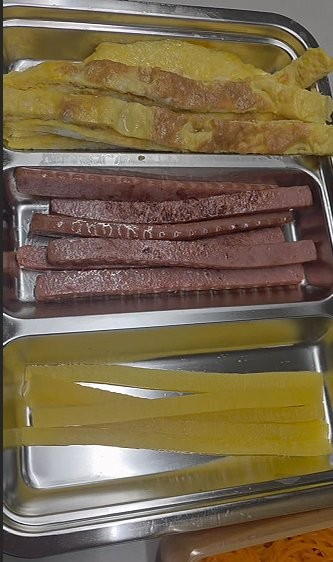
1. Prep the fillings. Everything goes in cooked or pickled, cut into long strips. I used egg (fried into a thin sheet and sliced), ham, and yellow pickled radish (danmuji), plus carrot. Classic additions are spinach and burdock root. The rule: nothing raw, and everything roughly the same length as the seaweed sheet.
2. Season the rice. Warm steamed rice, tossed with a little sesame oil and salt (some add toasted sesame seeds). Not vinegar — that’s sushi. Let it cool slightly so it’s easy to handle.
3. Roll it. Lay a sheet of gim (rough side up) on a bamboo mat. Spread a thin, even layer of rice over about two-thirds of the sheet, leaving the far edge bare. Line your fillings across the center, then roll away from you with the mat, tucking the fillings in tight and pressing gently as you go. A dab of water or a few grains of rice on the bare edge seals it.
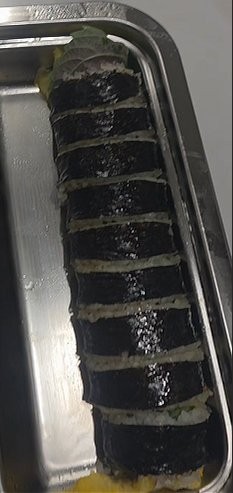
4. Slice. Brush the finished roll with a touch of sesame oil (it adds shine and keeps the knife from sticking), then slice into bite-sized rounds with a sharp, slightly wet blade.
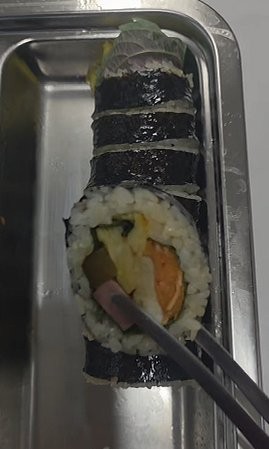
A few tips: don’t overfill, or the roll won’t close; keep the rice layer thin; and wipe the knife between cuts for clean slices.
How Koreans actually eat it
Gimbap is picnic and lunchbox (dosirak) food first — easy to make in bulk, easy to carry, no reheating needed. But the pairing Koreans swear by is ramyun and gimbap: a hot, spicy bowl of instant noodles with cool, sesame-scented gimbap on the side. The rich broth and the clean rolls balance each other perfectly, and you’ll see the combo everywhere from snack bars (bunsikjip) to office desks.
One more Korean trick: if gimbap has gone cold or you’re reheating frozen rolls, don’t microwave them — the seaweed turns soggy. Dip the pieces in beaten egg and pan-fry them (gyeran-gimbap). Crisp outside, warm inside.
Where to get it, and what it costs
You don’t have to roll your own. Gimbap is one of the cheapest hot-kitchen foods in Korea: a basic roll runs around 3,000–4,500 won at a gimbap chain (the nationwide Kimbap Cheonguk — “Gimbap Heaven” — is the classic), with premium and specialty rolls a bit more. Convenience stores stock samgak-gimbap for a quick snack, and bunsikjip (snack bars) serve it alongside ramyun and tteokbokki.
Why it went global
Gimbap’s big international moment came in 2023, when a Korean company put frozen gimbap on Trader Joe’s shelves in the US for $3.99. It sold out nationwide within weeks, stores capped it at one per customer, and a single TikTok review pulled in over 13 million views. Riding the same wave as K-pop and K-drama, the humble seaweed roll became a genuine K-food star — and a lot of people learned, for the first time, that it isn’t sushi.
Next time you spot gimbap, you’ll know exactly what you’re looking at: not sushi, but one of the most everyday, most-loved foods in Korea. Roll your own or grab one from a chain, add a bowl of ramyun, and you’re eating like a local.