Shin Ramyun is the most famous Korean instant noodle in the world — Nongshim’s red packet, the spicy one everyone recognizes. The package has instructions printed right on the back, and they work. But ask a Korean how they actually make it, and you’ll get something a little different from the directions, with a couple of small touches that turn it from “instant noodles” into breakfast.
So here’s exactly how I make it on a lazy holiday morning, eating alone, step by step — every photo is from my own kitchen.
Prefer to watch first? Here’s the whole thing in under a minute — then read on for the details.
Short answer: Boil water, add the soup powder first, then the noodles. Loosen them as they cook. Add green onion and crack in one egg — the classic Korean “pa-song-song gyeran-tak.” Don’t whisk the egg; just break the yolk gently. Pour it into a bowl, and if you like heat, finish with a shake of chili flakes.
A lazy morning, eating alone
It’s a holiday and it’s just me, so I keep it casual: a small pot, water filled in by eye — no measuring cup. (Side note for visitors: tap water in Korea is safe to drink, so cooking with it straight from the faucet is completely normal.) I went with two packets this morning because I was hungry.
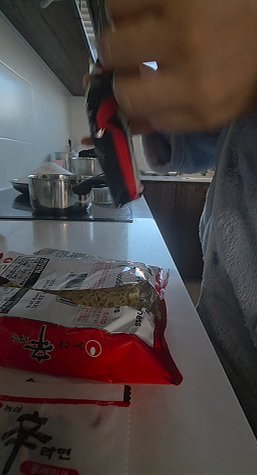 Nongshim’s Shin Ramyun — the red packet the whole world knows.
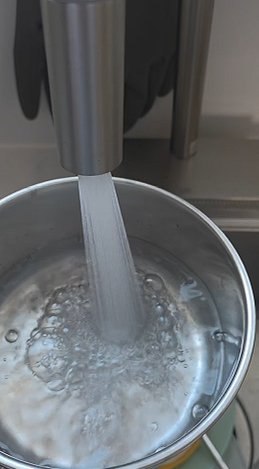 Small pot, water by eye. Korean tap water is fine to cook with straight from the faucet.
While the water heats, I tear open the packet and get everything ready. Koreans don’t waste the gap — the water heating is your prep time, not your standing-around time.
Step 1: Soup powder first (and a warning)
Here’s my way: once the water is boiling, I add the soup powder before the noodles. A heads-up, though — dropping the powder into already-boiling water can make it suddenly foam up and boil over, so add it carefully.
If you’d rather avoid that, there’s an easy alternative Koreans use all the time: add the powder while the water is still heating, and then drop the noodles in once it comes to a boil. Either order works.
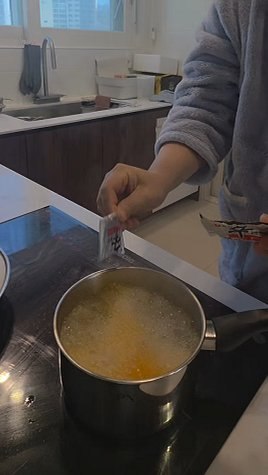 Soup powder going in. Add it carefully — boiling water plus powder can foam up fast.
Step 2: Add the noodles and loosen them
Drop the noodle block in. As it softens, keep lifting and turning the noodles with your chopsticks so they separate and cook evenly instead of clumping. This is the single move that gives you a better bowl than just letting it sit.
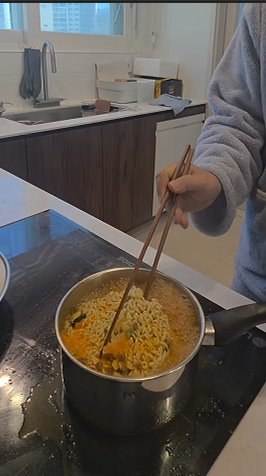 Noodles in. Keep turning them so they loosen and cook evenly.
Step 3: Pa-song-song, gyeran-tak
This is the part that makes it Korean. There’s a little phrase we use for cooking ramyun — “pa-song-song, gyeran-tak” (파송송 계란탁) — which is basically the sound of green onion sprinkled in and an egg cracked on top. Those two additions are the standard home upgrade.
For the green onion: chopped scallion or even a little raw onion both work. It was a lazy morning and I didn’t feel like getting the knife out, so I just used kitchen scissors to snip the green onion straight into the pot — a very Korean shortcut.
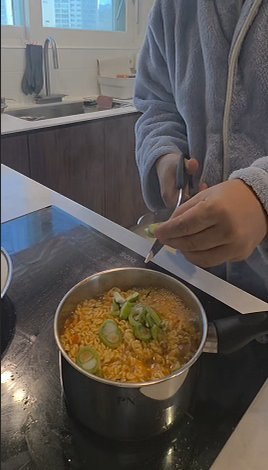 “Pa-song-song” — green onion, snipped straight in with scissors. No cutting board required.
Then the egg — gyeran-tak. Crack one in. One important tip: don’t whisk the egg into the broth. Stirring it up too much can leave a faint eggy, almost fishy smell. Instead, just let it sit and gently break the yolk so it half-poaches in the hot broth. Cleaner taste, better look.
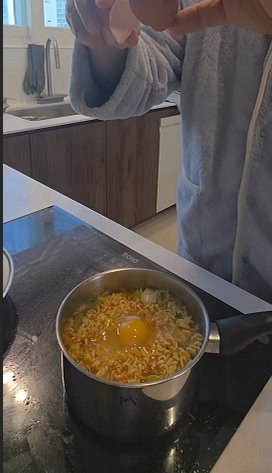 “Gyeran-tak” — one egg, cracked in. Don’t whisk it; just break the yolk gently.
Step 4: Into the bowl, then chili flakes
Once everything’s cooked through, move it to a bowl. You can absolutely eat it straight from the pot — very normal in Korea — but a bowl is nicer when you’ve got the morning to yourself.
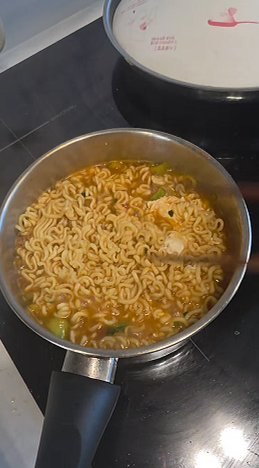 Cooked through, egg half-set, green onion floating on top.
I like heat, so I finish mine with a few shakes of gochugaru (Korean chili flakes) on top. Shin Ramyun is already spicy — around the level of a mild jalapeño — but a little extra chili is how I take it. That’s it. Done.
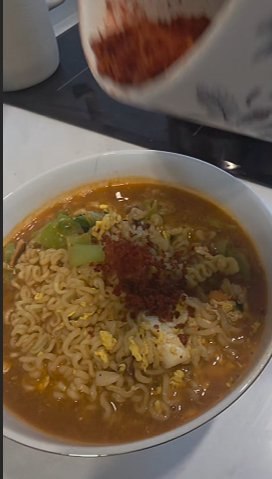 Plated and finished with a shake of chili flakes. A proper Korean breakfast.
A few notes
- Order is flexible. Powder-first or noodles-first both work; the package’s “everything together” method is fine too. The egg and green onion are where the real upgrade is.
- Don’t overcook. Korean ramyun noodles are best with a little chew. Pull them off the heat while they still have bite.
- Eat it fast. Ramyun waits for no one — the noodles keep softening in the hot broth, so it’s at its best the moment it’s done.
FAQ
Do I add the soup powder or the noodles first? Either works. Powder-first gives the broth a head start on flavor; just add it carefully, since powder in boiling water can foam over. Or add the powder before it boils, then the noodles.
What is “pa-song-song gyeran-tak”? It’s a Korean phrase for the two classic ramyun add-ins — green onion sprinkled in (pa-song-song) and an egg cracked on top (gyeran-tak).
Should I stir the egg in? Better not to. Whisking it through the broth can leave a faintly eggy smell. Crack it in whole and gently break the yolk so it half-poaches.
Is Shin Ramyun very spicy? It’s moderately spicy — roughly a mild jalapeño. If you want more, add chili flakes; if you want less, use a bit less of the soup powder.
More Korean noodles
Once you’ve got Shin Ramyun down, try the rest of Korea’s instant-noodle world: jjapaguri (ram-don), the Chapagetti-and-Neoguri mashup from Parasite; how Koreans eat buldak (fire noodles) without crying; and what else to grab in a Korean convenience store.
The photos here are from my own kitchen. Ramyun is personal — treat my way as a starting point and tune the spice, egg, and toppings to your taste.