If you’ve seen Parasite, you remember the noodles — the dish the housekeeper throws together in eight minutes while the rich family pulls up to the gate. The English subtitles called it “ram-don,” a word the film’s translator invented by mashing ramen and udon together because there was no English name for it. In Korea, it has a real name: jjapaguri (짜파구리), and we’ve been eating it long before the movie.
Here’s how it’s actually made in a Korean kitchen — not a restaurant version, not a from-scratch recreation, just the way we really do it on a weeknight. I made a batch for four in my own kitchen, so every photo below is the real thing.
Prefer to watch first? Here’s the whole thing in under a minute — then read on for the details and the tips that keep it from going wrong.
Short answer: Jjapaguri is two instant noodles cooked together — Chapagetti (black-bean, jjajang-style) and Neoguri (spicy seafood udon). Boil both together with their dried flakes and Neoguri’s kelp, drain almost all the water, then stir in the Chapagetti powder, about half the Neoguri powder, and the Chapagetti oil over low heat. Top with a fried egg. That’s it.
What jjapaguri actually is
It’s a mashup of two Nongshim instant noodles that most Korean households already have in the cupboard. Chapagetti is the instant version of jjajangmyeon — Korean-Chinese black-bean noodles, savory and a little sweet. Neoguri is a thick, chewy, udon-style noodle in a spicy seafood broth, and it famously comes with a piece of dried kelp in the packet. Combine them and you get something darker and richer than either one alone: savory black-bean sauce with a seafood kick.
The combo didn’t come from a chef. Koreans have been mixing instant noodles for years, and jjapaguri took off after it showed up on a Korean variety show back in 2013. Then Parasite won Best Picture in 2020, the whole world saw it, and suddenly everyone wanted to make “ram-don.” (Fun fact Koreans love: Neoguri is reportedly director Bong Joon-ho’s favorite instant noodle.)
 The two halves of jjapaguri: Chapagetti (black-bean) and Neoguri (spicy seafood). I used the Sacheon — Sichuan, spicier — Chapagetti this time.
A note on quantities (and substitutions)
The classic ratio is dead simple: 1 packet of Chapagetti + 1 packet of Neoguri makes about two servings.
I was cooking for four hungry people, so I scaled it up to five packets — three Chapagetti and two Neoguri. A small real-life note on flavor: the usual move is Chapagetti plus the spicy Neoguri, but I was out of spicy and only had the mild Neoguri, so I used that instead. It still works — you just get a gentler, less fiery bowl, which is honestly nice if you’re feeding people who don’t love heat. This is the kind of swap Koreans make all the time; jjapaguri is forgiving.
I also reached for the Sacheon (Sichuan) Chapagetti, which comes with a chili-oil packet instead of the standard olive-oil one — a little extra heat to make up for the mild Neoguri.
Step 1: Boil the noodles with the flakes and the kelp
Bring a pot of water to a boil, then add everything dry first — both noodle blocks and both dried-vegetable flake packets. Don’t throw away the piece of dried kelp in the Neoguri packet; drop it in too. It’s not packaging, it’s flavor, and it’s a step most Western recipes skip.
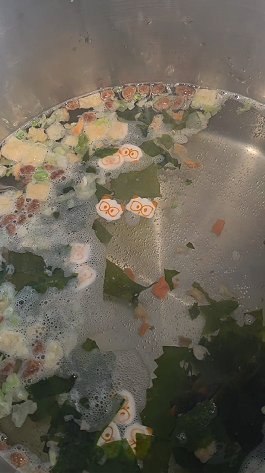 Flakes and the Neoguri kelp go in first, then the noodles. Keep the kelp — it’s part of the broth.
Boil until the noodles are just cooked but still have a little bite — roughly 4 minutes. They’ll keep cooking in the sauce, so slightly under is better than over.
Step 2: Drain — but leave a little water
This is the step that makes or breaks it. Pour out most of the water, but not all of it. Jjapaguri is a sauced noodle dish, not a soup, so you want the water mostly gone — but if you drain it bone-dry, the sauce turns thick and claggy and the noodles clump. Leave a small amount behind (a little under half a cup for two packets; a bit more for a big batch like mine).
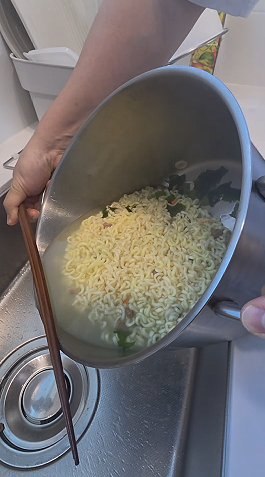 Tip the water out, but keep a splash. Over-draining is the most common mistake — dry jjapaguri is sad jjapaguri.
Step 3: Fry the eggs while you’re at it
While the noodles boil, get your eggs going in a separate pan — one or two per person, sunny-side up. A fried egg on top is the standard finish, and the soft yolk running into the black-bean sauce is half the point.
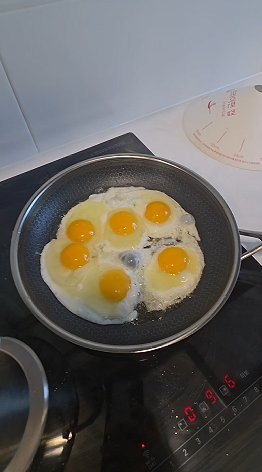 One or two eggs per person. The runny yolk is non-negotiable.
Step 4: Lower the heat, then add the powder
Here’s the rule that saves your pot: turn the heat down to low before you add the seasoning. If you leave it on high, the sauce hits the dry bottom of the pot and scorches and sticks almost instantly. Low and slow.
Add the Chapagetti powder (the main flavor) and about half to two-thirds of the Neoguri powder — start with half if you’re not sure, since the Neoguri side is where most of the salt and heat lives. Stir it through so every noodle gets coated.
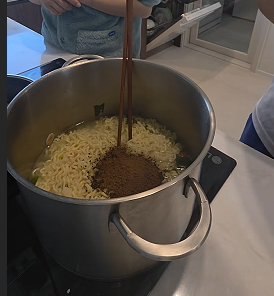 Heat on low, then the powder. Full Chapagetti, about half the Neoguri to start — add more to taste.
Step 5: Add the oil packet and finish
Once the powder is mixed in, add the oil packet — the olive oil from regular Chapagetti, or the chili oil if you’re using the Sacheon version like I did — and give it one more good stir. The oil is what makes the noodles glossy instead of dull, so don’t skip it.
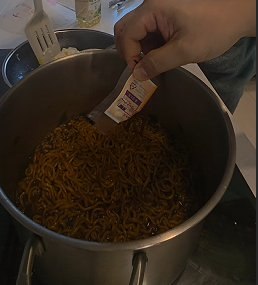 The oil packet last. This is what gives jjapaguri its glossy, restaurant-looking finish.
Step 6: Plate it (with a little sauce left)
Pile it into a bowl and top each serving with a fried egg. One last tip from experience: leave it just slightly saucy rather than completely dry. A little moisture clinging to the noodles tastes better and keeps them from drying out by the time everyone sits down.
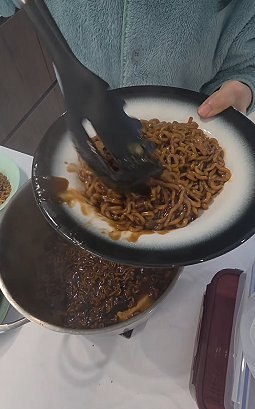 Plated, glossy, and topped with a fried egg. A touch of sauce left in means it stays good to the last bite.
Want the Parasite version?
In the film, the family adds sirloin (Hanwoo) steak on top. If you want to recreate that scene, cube some steak, sear it in a separate pan while the noodles boil, and lay it over the finished noodles. It turns a cheap pantry dish into something genuinely indulgent — which was kind of the whole joke in the movie.
Want it spicier? The Sacheon Chapagetti version
Once the basic ram-don makes sense, here’s the upgrade a lot of Koreans reach for when they want heat. For two servings I used two packs of Spicy Sacheon Chapagetti (매운 사천짜파게티) and one pack of Spicy Neoguri (매운 너구리). That 2:1 ratio keeps the black-bean base of regular jjapaguri but layers in Sacheon’s chili and Neoguri’s thick, seafood-leaning udon-style noodles. I made this exact bowl on a lazy Saturday morning — rich, a little messy, and squarely a weekend-at-home meal.
A few things matter more in the spicy version than in the plain one:
- Drop the dried flakes and Neoguri’s kelp piece into the water early, before the noodles, so the broth has a base before it ever becomes sauce.
- Fry two eggs while the noodles cook — they go on top at the end.
- Right before draining, save a small bowl of the starchy noodle water. This is the whole trick: after you drain and stir in the powder, that water is what pulls the sauce to the right consistency instead of letting it seize into clumps.
- Mix on low heat so nothing sticks to the pan, then add the chili oil and stir once more.
- Plate it and lay the fried eggs on top.
If it tightens up while you’re eating, a splash of the reserved noodle water loosens it right back.
FAQ
Is jjapaguri the same as ram-don? Yes. “Ram-don” is just the name Parasite’s translator invented for English subtitles. The real Korean name is jjapaguri (짜파구리), sometimes spelled chapaguri.
What two noodles do I need? Chapagetti and Neoguri, both made by Nongshim. You’ll find them at any Korean or Asian grocery store.
Do I have to use the spicy Neoguri? No. Spicy Neoguri is standard, but mild Neoguri works fine and makes a gentler bowl — handy if you’re feeding kids or spice-averse friends.
How much seasoning do I use? A safe ratio is the full Chapagetti powder plus about half the Neoguri powder, then adjust to taste. The Neoguri side carries most of the heat and salt.
Why did mine turn out dry and clumpy? You probably drained too much water, or added the seasoning over high heat. Leave a little cooking water behind, and lower the heat before the powder goes in.
More Korean noodles and snacks
If you like this, you’ll like the rest of Korea’s instant-noodle world. See how Koreans actually eat buldak (fire noodles) without crying, what to grab in a Korean convenience store, and — when you want the real thing off the grill — how to eat Korean BBQ like a local.
The photos here are from my own kitchen. Jjapaguri is forgiving — treat the ratios as a starting point and adjust the heat and saltiness to your taste.