You don’t need to speak Korean to notice it. Watch three episodes of anything — romance, thriller, sageuk — and the same handful of words keeps surfacing. Daebak. Aigoo. Jinjja? You start recognizing them before you look them up, because they carry obvious emotional weight even through subtitles. And here’s the thing: subtitles can only partially capture them. These words aren’t really vocabulary. They’re emotional punctuation — and understanding them changes how you watch.
Why these words don’t translate
Korean communication leans indirect. Rather than stating feelings outright, speakers often use short exclamatory words that carry the emotion instead — filling the space where a direct statement would feel too strong or too blunt. That’s why these terms rely more on tone and timing than on grammar, and why a subtitle rendering aigoo as “geez” is technically fine and completely inadequate.
The most common mistake learners make is treating them as fixed translations. They’re not. They’re registers.
The reaction words
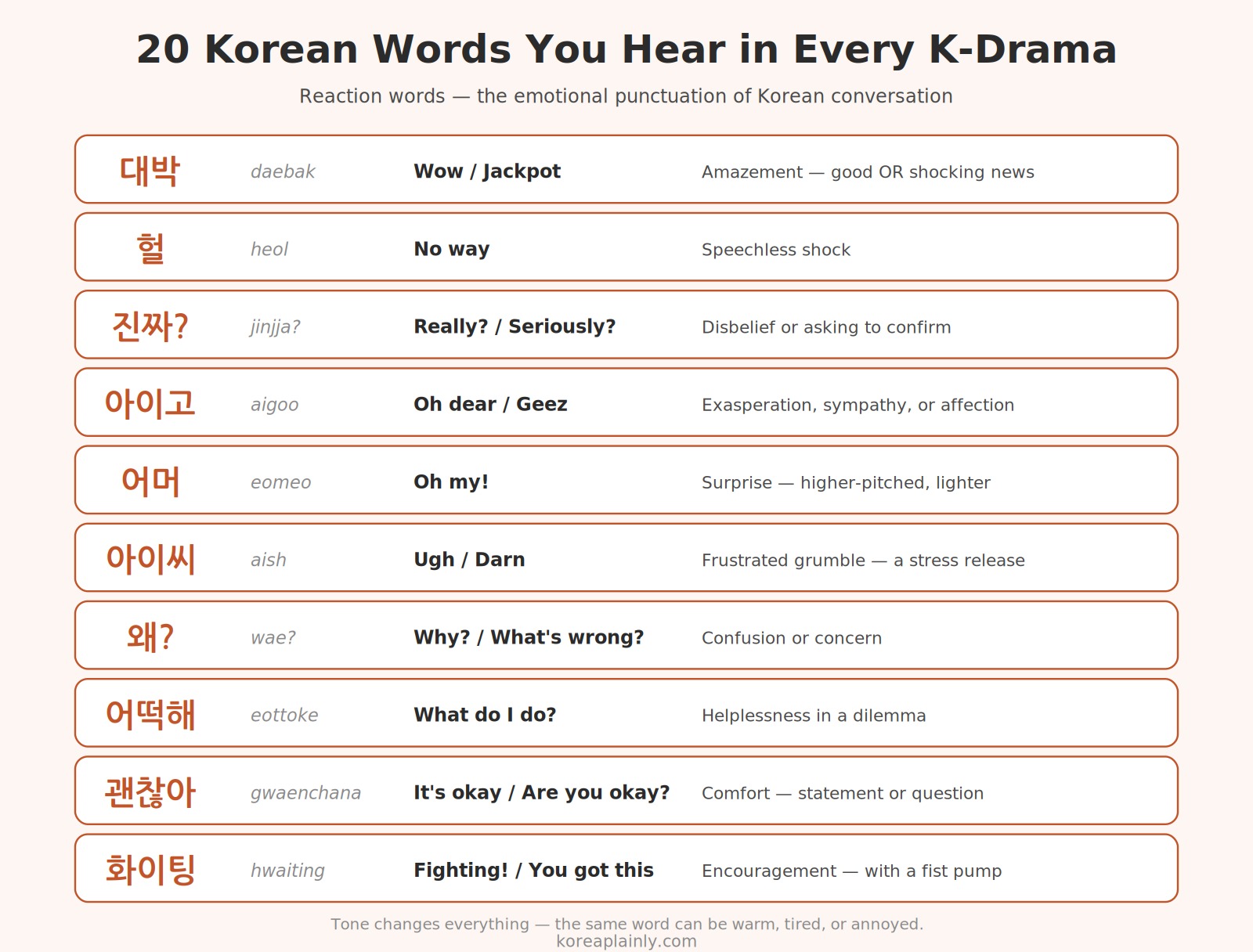
Daebak (대박) is the most famous. It literally suggests a jackpot, and it means amazement — but not necessarily good amazement. A K-drama character discovering their crush likes them back: daebak. A shocking piece of bad news: also daebak. It’s closer to “that’s insane” than to “great.”
Heol (헐) is shocked speechlessness — the sound of your brain buffering. Not necessarily negative; you can heol at something impressively good.
Jinjja? (진짜?) and jeongmal? (정말?) both mean “really?” — disbelief, or asking someone to confirm. Jinjja is the more casual, more constant one.
Aigoo (아이고) is the deepest one. Depending on delivery it means completely different things: an older woman watching a child do something silly says it with affection, almost “oh, you.” Said through gritted teeth it means “I cannot deal with this.” A young person can say it breezily and self-deprecatingly. Here’s a reliable tell: if they laugh after aigoo, it’s warm; if they sigh, it’s resigned; if they glare, it’s irritated. The same character can say it three times in one episode and mean three different things.
Eomeo (어머) is surprise, higher-pitched and lighter than aigoo — closer to “oh my!”
Aish (아이씨) gets subtitled as a mild curse, but it’s better understood as verbal stress release — the equivalent of muttering “ugh” or “shoot.” It usually isn’t about anyone; it’s about the moment.
Wae? (왜?) is “why?” or “what’s wrong?” — concern or confusion. Eottoke (어떡해) is “what do I do?”, the sound of helplessness in a dilemma. Gwaenchana (괜찮아) is “it’s okay” — or, as a question, “are you okay?”, one of the warmest lines in any drama.
And hwaiting (화이팅) — from English “fighting” — isn’t aggressive at all. It’s encouragement, usually with a small fist pump. “You’ve got this.”
The intensity spectrum
These words aren’t interchangeable; they sit at different emotional altitudes.
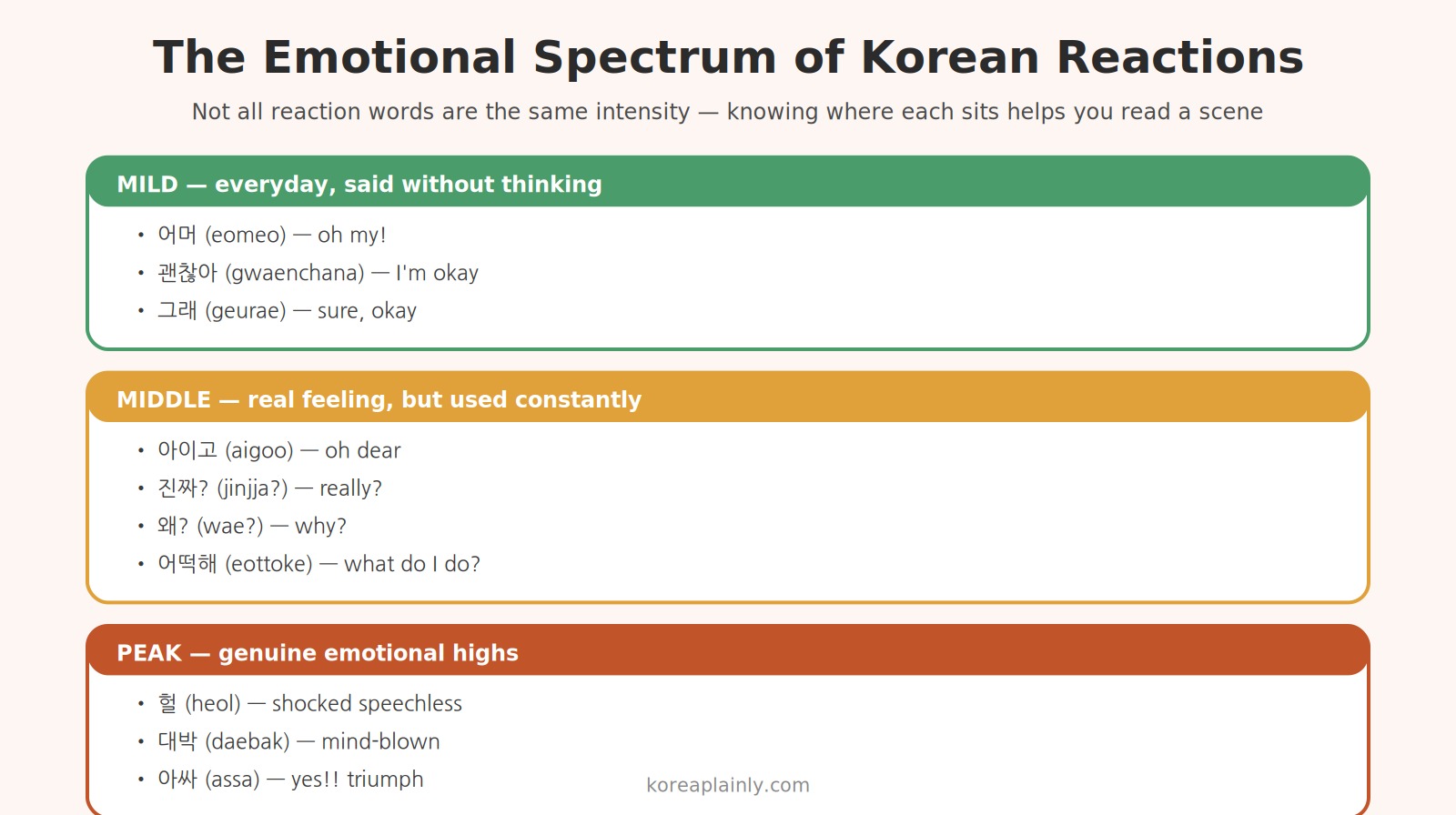
Mild and everyday: eomeo, gwaenchana, geurae. Middle tier — real feeling, but used so often it reads as natural: aigoo, jinjja, wae, eottoke. Peak: heol, daebak, assa (아싸, triumph).
Knowing the ladder lets you read scenes accurately. A character who goes from jinjja to heol in three seconds is genuinely escalating. And characters stack them for effect: “Jinjja? Heol… daebak.” — Really? No way… that’s incredible.
The lines you already recognize
Beyond reactions, a handful of phrases appear in essentially every drama.
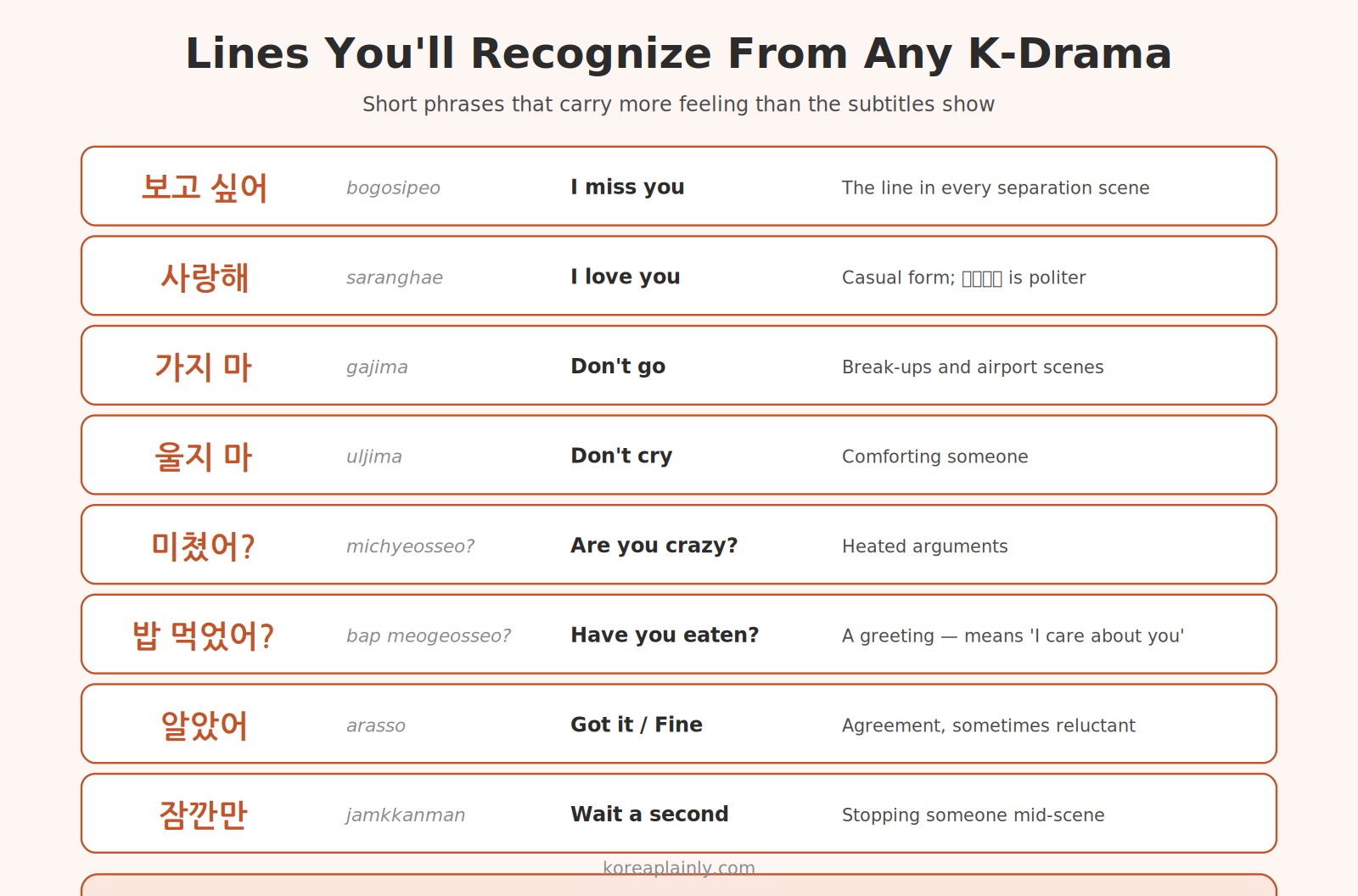
Bogosipeo (보고 싶어) — “I miss you,” the separation-scene staple. Saranghae (사랑해) — “I love you.” Gajima (가지 마) — “don’t go.” Uljima (울지 마) — “don’t cry.” Michyeosseo? (미쳤어?) — “are you crazy?”, the argument line. Jamkkanman (잠깐만) — “wait a second.” Arasso (알았어) — “got it,” often reluctantly.
And the one that isn’t what it looks like: bap meogeosseo? (밥 먹었어?) — literally “have you eaten?” It’s a greeting. It isn’t a question about food; it’s a way of saying I care about you, rooted in a history when the answer actually mattered. Subtitles render it literally and viewers miss the warmth entirely.
What the words reveal
Notice what these terms have in common: almost all of them are about feeling, not information. Korean has an unusually rich vocabulary for emotional shorthand, and it’s cross-generational — grandmothers and teenagers both say aigoo. That’s a window into something real about the culture: emotional clarity is prioritized, and there’s a social expectation that you’ll signal your feelings so others can respond.
Which is also why these words are the easiest Korean to start using. You don’t need grammar. Drop a jinjja? at the right moment, or a heol when a friend tells you something wild, and you’re communicating perfectly — no fluency required.
Next episode, listen for the words instead of just reading the subtitles. You’ll notice the actors are doing about 30% of their acting in those two syllables.