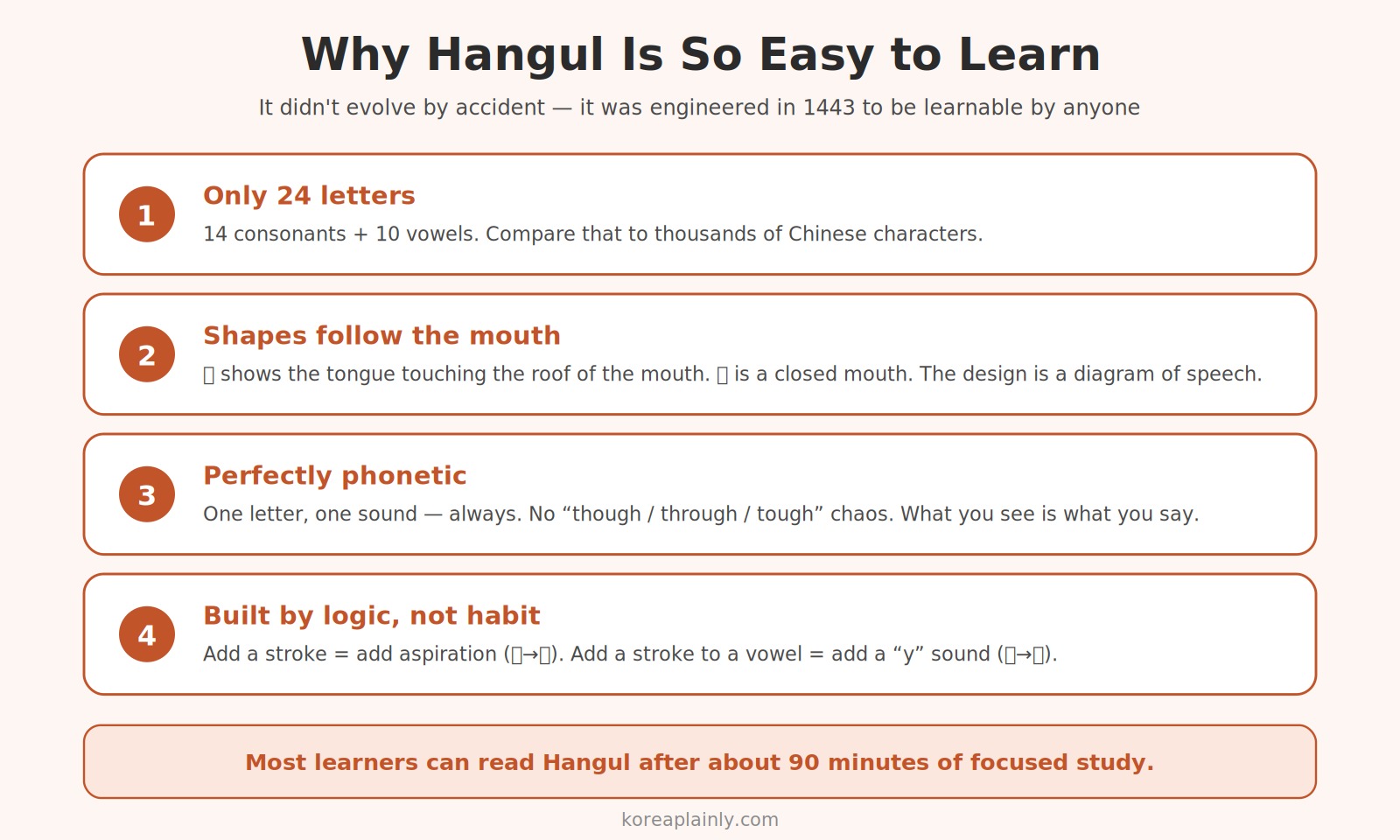
Here’s a claim that sounds like marketing but isn’t: you can learn to read Korean in about 90 minutes. Not understand it — read it. Sound out any word on any sign, menu, or K-pop album. That’s possible because Hangul, the Korean alphabet, is unlike almost every other writing system on Earth. It didn’t evolve slowly out of ancient scribbles. It was invented, deliberately, by one king in 1443, with the explicit goal of being learnable by anyone. Six hundred years later, it’s still considered one of the most logical scripts ever created — and it’s the single best first step into Korean.
Why Hangul exists (and why that matters to you)
Before Hangul, Korean was written with Chinese characters (hanja). The problem was fundamental: Chinese and Korean are completely different languages, so writing Korean with Chinese characters was like forcing a square peg into a round hole — and mastering thousands of characters took years, which meant literacy belonged to the aristocracy alone.
King Sejong the Great, the fourth ruler of the Joseon dynasty, decided that was unacceptable. Working with a group of scholars called the Hall of Worthies, he designed an entirely new alphabet from scratch and published it in 1446 in a document called Hunminjeongeum — “The Correct Sounds for the Instruction of the People.” The name says the mission: he wanted ordinary people, regardless of status, to be able to read and write.
This origin is why Hangul is easy. Every other major alphabet is an accident of history, full of leftovers and inconsistencies. Hangul was engineered for one purpose: fast literacy. That’s not a legend — it’s the reason the system behaves so predictably.
The 14 basic consonants
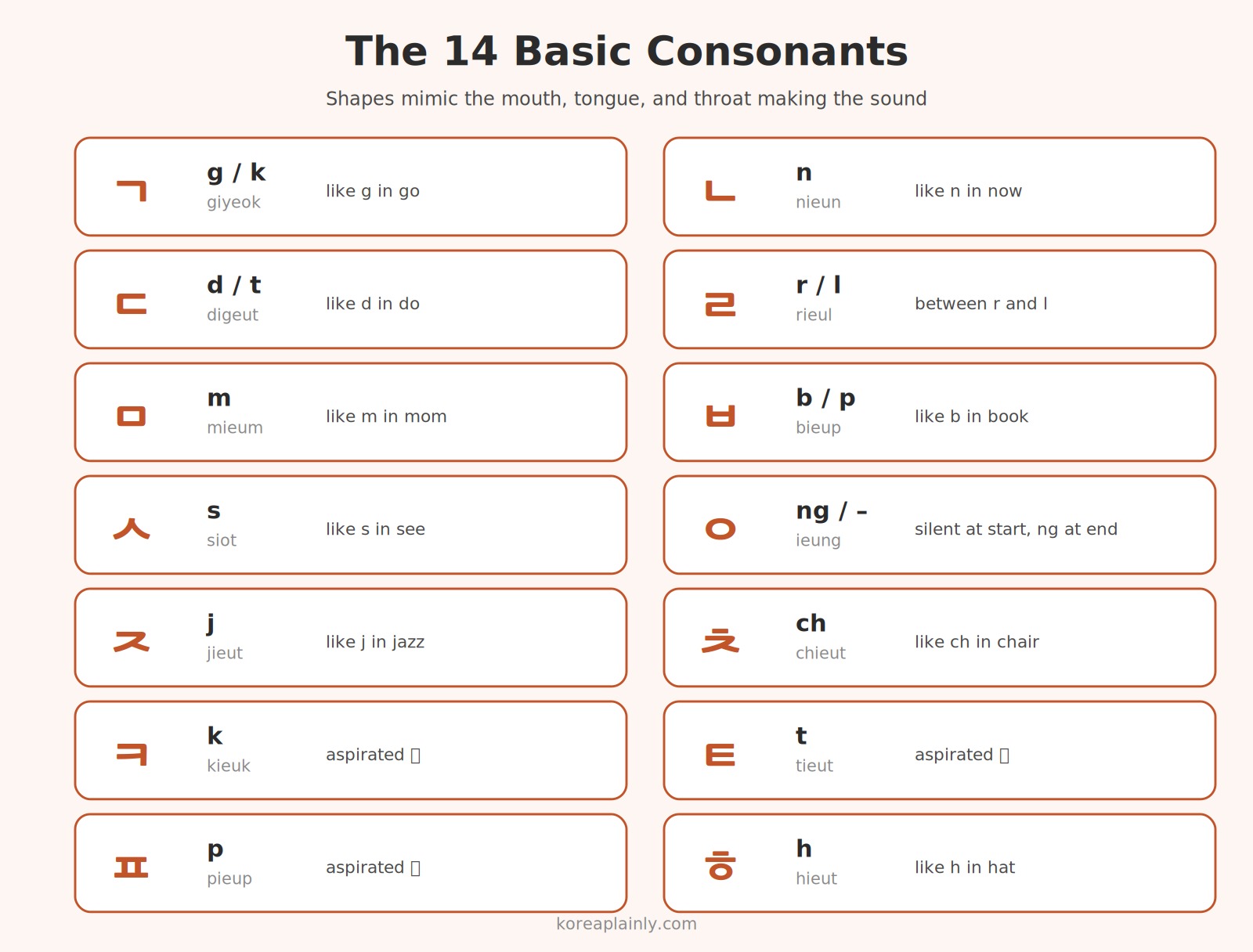
Hangul has 24 basic letters: 14 consonants and 10 vowels. Start with the consonants — and notice the genius in them. Their shapes are diagrams of your mouth. ㄴ (n) shows your tongue touching the roof of your mouth. ㅁ (m) is a closed mouth. ㄱ (g/k) is the back of your tongue blocking your throat. You’re not memorizing arbitrary squiggles; you’re learning a picture of how the sound is made.
There’s a second layer of logic: add a stroke, add aspiration. ㄱ (g) becomes ㅋ (k). ㄷ (d) becomes ㅌ (t). ㅂ (b) becomes ㅍ (p). Once you see that pattern, you’re learning families, not fourteen separate things.
One letter deserves special attention: ㅇ. At the start of a syllable it’s silent — a placeholder that holds the spot when a syllable begins with a vowel sound. At the end, it’s “ng.” That’s it. It confuses beginners for about five minutes and then never again.
The 10 basic vowels
The vowels come from a philosophy: three symbols representing heaven (a dot, now a short stroke), earth (a horizontal line ㅡ), and human (a vertical line ㅣ). Every vowel is built from those three pieces.
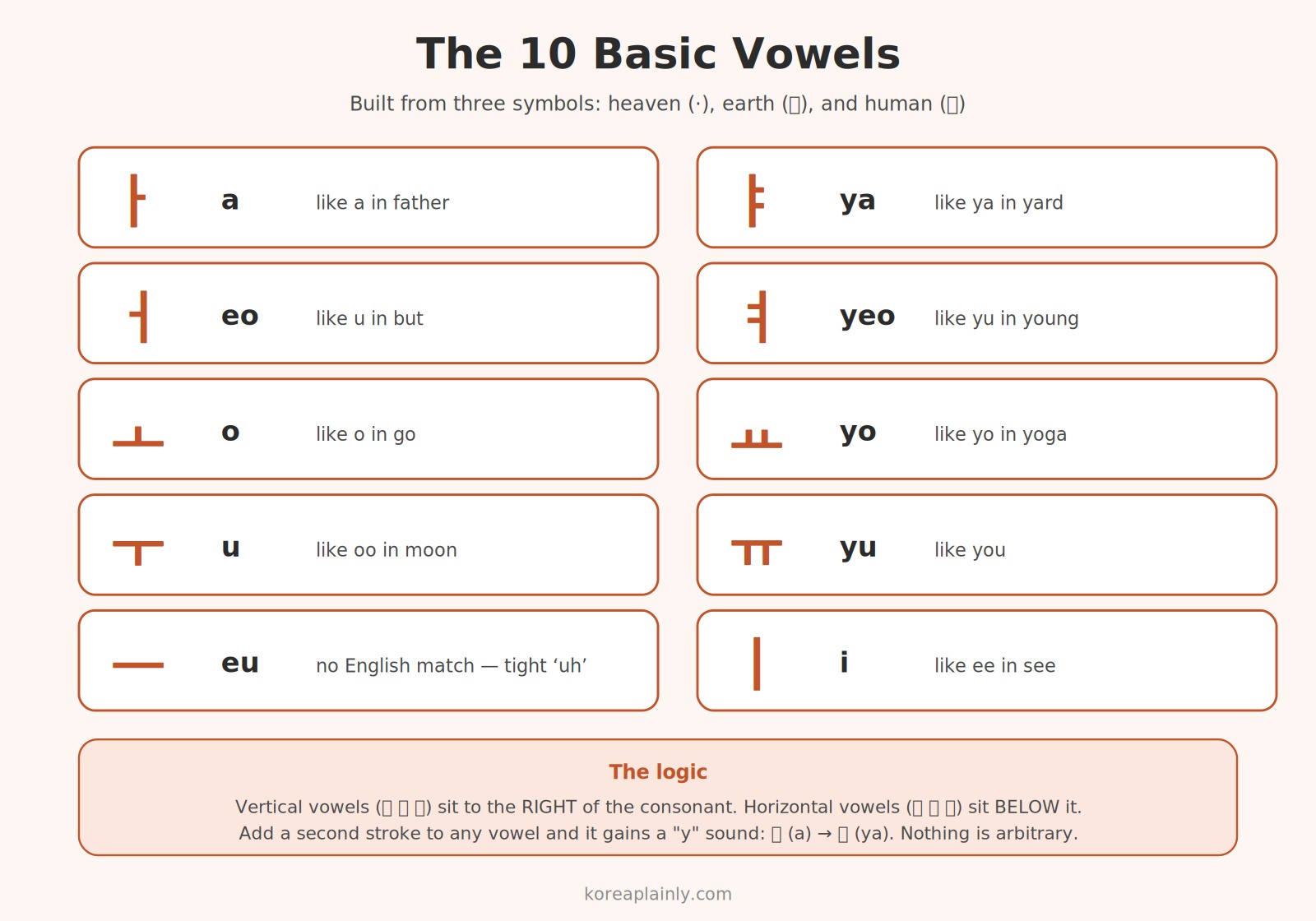
And the same “add a stroke” logic returns: ㅏ (a) becomes ㅑ (ya). ㅗ (o) becomes ㅛ (yo). One extra mark, one “y” sound. Nothing is random.
Unlike English — where “a” makes a different sound in cat, car, cake, and about — a Korean vowel always sounds the same. ㅏ is “ah.” Forever.
How letters become blocks
This is the one structural difference that trips people up. English writes letters in a straight line: C-A-T. Korean gathers letters into square syllable blocks.
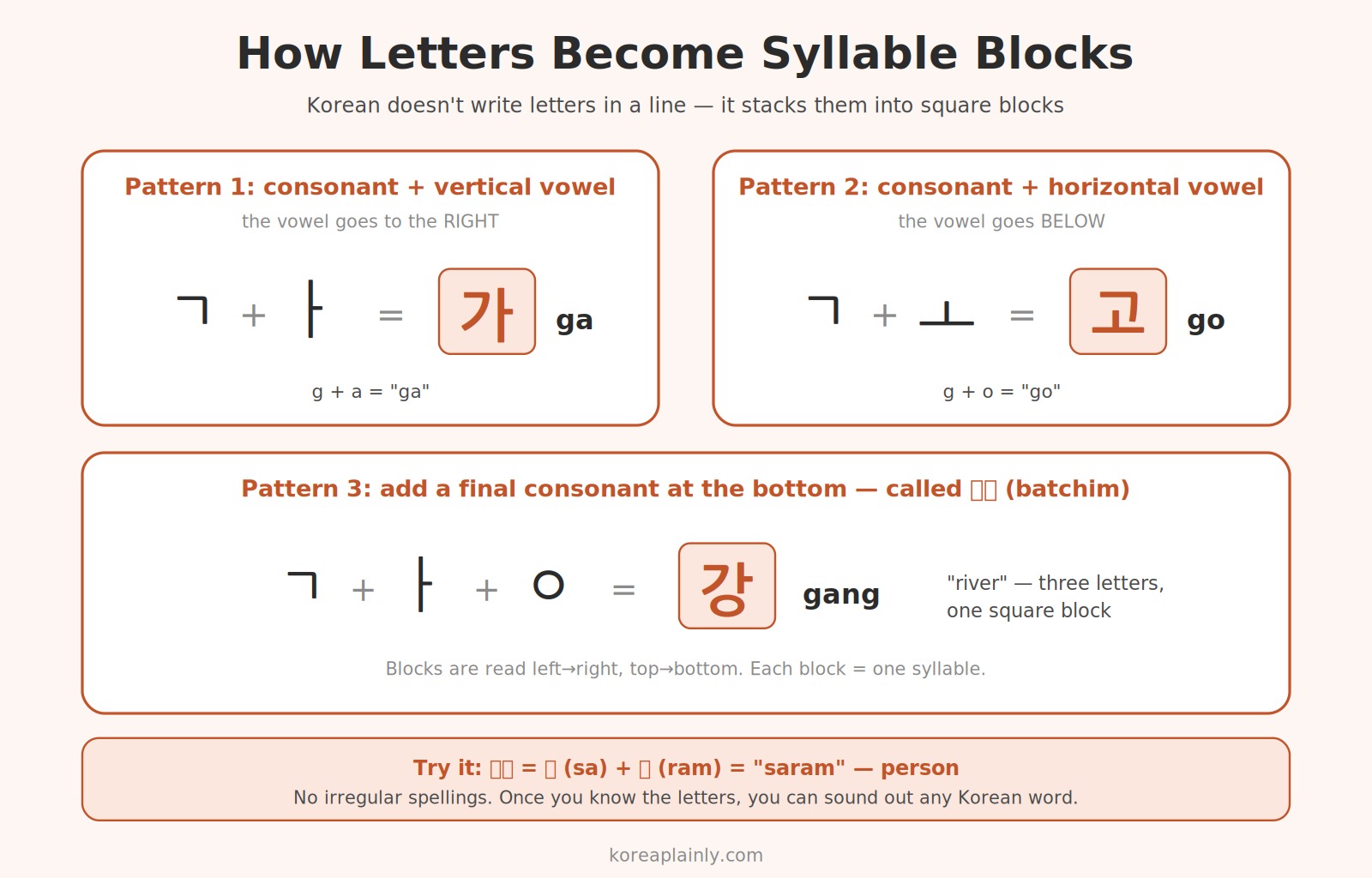
The rule for placement is visual, and it follows the vowel’s shape. Vertical vowels (ㅏ ㅓ ㅣ) stand to the right of the consonant: ㄱ + ㅏ = 가 (ga). Horizontal vowels (ㅗ ㅜ ㅡ) sit below it: ㄱ + ㅗ = 고 (go). The vowel’s own shape tells you where it goes.
You can also add a final consonant at the bottom of the block, called batchim (받침, literally “supporting platform”): ㄱ + ㅏ + ㅇ = 강 (gang, “river”). Three letters, one block, one syllable.
So 사람 (saram, “person”) is just two blocks: 사 (sa) + 람 (ram). Read left to right, top to bottom, exactly as you’d expect.
Why this system beats English spelling
Here’s the payoff. English has though, through, tough, thought — four spellings that share letters and share almost nothing else. Hangul has none of that. It’s perfectly phonetic: one letter, one sound. Which means the moment you know 24 letters, you can pronounce any Korean word correctly, even one you’ve never seen and don’t understand.
That’s an unusual gift for a language learner. You get reading ability before comprehension — and reading is what lets everything else in. Menus stop being decoration. Signs become information. K-pop lyric sheets become readable. And crucially, you stop depending on romanization, which is genuinely misleading (Korean has sounds English letters simply can’t represent).
How to actually learn it
- Learn the 24 basics first. Ignore double consonants (ㄲ ㄸ ㅃ ㅆ ㅉ) and compound vowels (ㅘ ㅝ ㅢ) at the start. They’re combinations of what you already know — get the foundation, then they cost almost nothing.
- Write by hand. Stroke order matters and the muscle memory sticks. Top-left to bottom-right, same instinct as English.
- Read real words from day one. Don’t drill letters in isolation. Sound out 커피 (keopi, coffee), 김치 (kimchi), 서울 (Seoul). Decoding blocks is the skill you actually need.
- Use mnemonics for lookalikes. ㅂ and ㅍ, ㅈ and ㅊ trip everyone up early. Invent a story for each. It works.
- Practice on signage. Once you can read, Korea becomes a giant flashcard deck — every subway station, every storefront.
One honest caveat: reading Hangul is not speaking Korean. The alphabet is famously easy; the language — with its honorifics, particles, and reversed word order — is famously hard for English speakers. But that’s precisely why Hangul is the right first move. It’s the one part of Korean that pays off immediately, in an afternoon, and it makes every subsequent step easier.
King Sejong built this so ordinary people could learn it fast. Six centuries later, you get to be the proof.