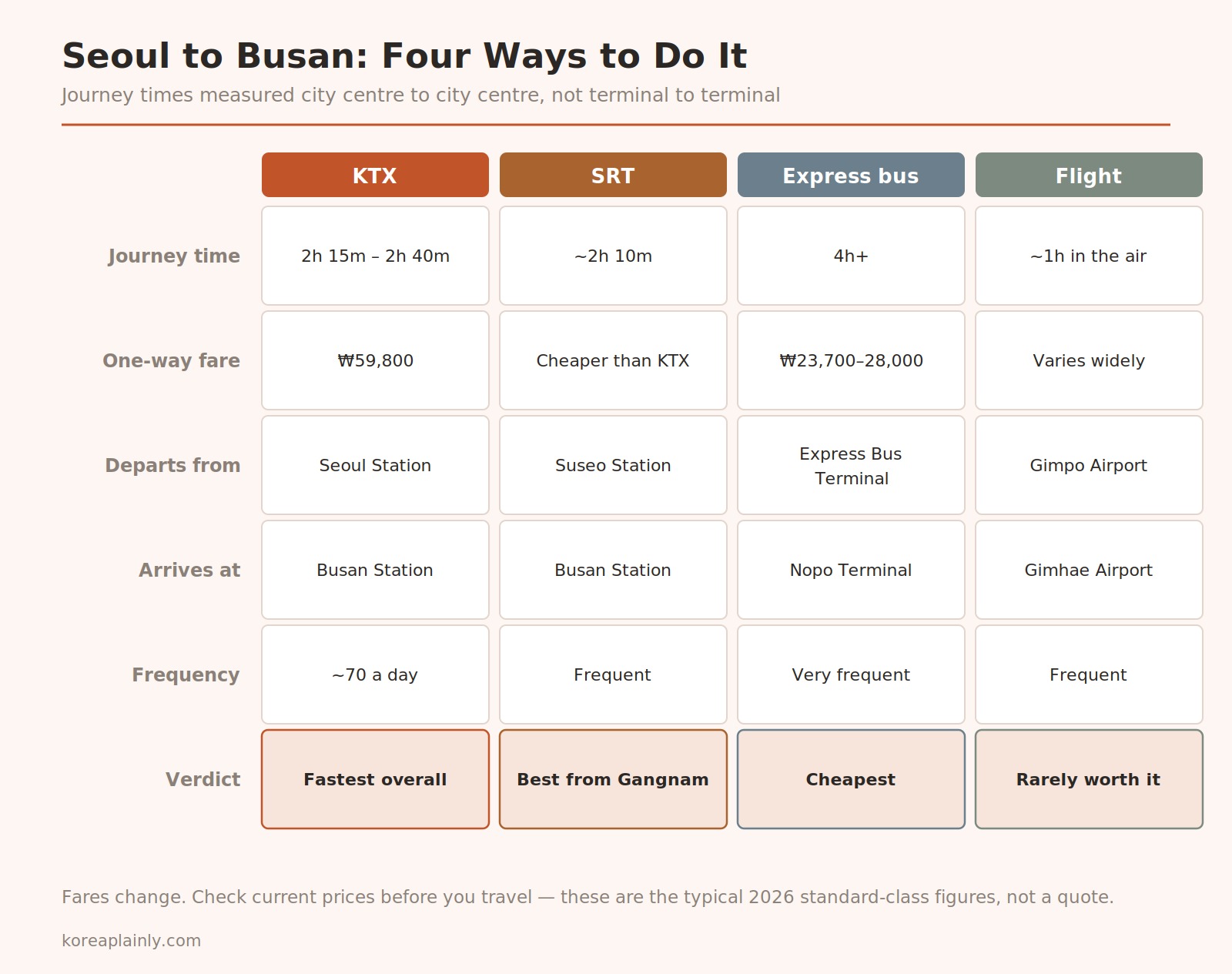
Take the KTX. For almost every visitor, that is the answer — roughly two and a quarter hours, about ₩59,800 in standard class, city centre to city centre, running most of the day.
The rest of this is about the cases where that isn’t the answer, and about the part most comparisons skip: the difference between how long a journey takes and how long the day takes.
Why the KTX usually wins
Korea is compact, and Seoul and Busan sit at opposite ends of it — a bit over 400 km by rail. The KTX covers that at up to 305 km/h with a handful of stops at Suwon, Daejeon and Daegu.
The number that matters isn’t the speed. It’s where it starts and ends. Seoul Station is in central Seoul and Busan Station is in central Busan. You walk in, you walk out, and both ends connect directly to the local subway. There is no airport transfer, no security queue, no arriving 90 minutes early.
Services run from around 05:13 to roughly 22:40, with something like 70 KTX departures a day on this route. The practical effect is that you don’t plan your day around the train; you pick a train that fits your day.
The SRT, which most guides bury
The SRT is Korea’s second high-speed operator, and on this route it is marginally faster than the KTX — around 2 hours 10 minutes — and generally cheaper.
The catch is where it leaves from. The SRT departs Suseo Station, in the Gangnam area, not Seoul Station. That is either its biggest advantage or a real inconvenience, and which one depends entirely on where you’re sleeping:
- Staying in Gangnam, Seocho, Jamsil, or southern Seoul? Suseo is 15–20 minutes away. The SRT is straightforwardly better — faster, cheaper, closer.
- Staying in Myeongdong, Hongdae, Insadong, or anywhere north of the river? Getting to Suseo adds enough time to erase the advantage. Take the KTX from Seoul Station.
This is the single most useful thing to know about the route, and it turns on a question no comparison table asks: which side of the river are you on?
The express bus
Roughly ₩23,700–28,000 one way, and about four hours if traffic behaves.
That fare is genuinely less than half the KTX, which matters if you’re travelling on a tight budget. Korean express buses are also better than the word “bus” suggests — the premium classes have wide reclining seats, three across instead of four, and are more comfortable than a KTX standard seat.
The problems are two:
Time is not fixed. Four hours is the good case. The Seoul–Busan corridor is the busiest road in the country, and on a Friday evening or a holiday weekend that number goes up in a way the train’s doesn’t. The KTX is late by minutes; the bus is late by hours.
It arrives at Nopo, not the centre. Nopo Terminal is at the northern edge of Busan, on the end of subway Line 1. Add 30–40 minutes and a subway fare to get anywhere you actually wanted to be. That erodes a chunk of both the money saved and the comparison.
Take the bus if the fare difference genuinely matters to you, or if you’re travelling overnight. Otherwise the ₩30,000 buys back two hours plus a central arrival.
Flying, and why it usually loses
Gimpo to Gimhae is about an hour in the air, which sounds like it should beat a two-hour train. It doesn’t, and the reason is the parts either side.
Gimpo is a subway ride from central Seoul. You arrive an hour or so before departure. Gimhae Airport is well outside Busan, and getting into the city takes another 40–50 minutes. Add it up honestly and you land somewhere near four hours door to door — worse than the KTX, with more steps and more things that can go wrong.
There are two cases where flying makes sense: a genuinely cheap fare on a quiet weekday, or connecting to an international flight where the airport is where you need to be anyway. Otherwise, don’t.
The thing to sort out before anything else
None of the above matters if you can’t buy a ticket, and this is where visitors most often get stuck. Korail’s payment flow was built around Korean cards, and international cards frequently fail on it — often silently, with no useful error message.
It’s a solved problem, but you should know the workaround before you’re standing at Seoul Station. How to book KTX tickets as a foreigner covers the five methods in order of reliability.
Two timing points worth having now:
Reservations open one month before departure. Not a year, whatever resellers imply. For ordinary travel dates you can book a few days out without trouble. For Chuseok, Seollal, or a summer weekend, book the day the window opens.
Friday evening and Sunday evening sell out first, in both directions, because the whole country is doing the same thing you are.
When you arrive
Busan Station puts you in the old centre, near the port and Chinatown. That is not where most visitors are going — Haeundae, the beach district, is a further 17 km east across the city, and the journey from the station involves one subway transfer or a taxi.
Busan Station to Haeundae covers the three options and which one to take depending on how much luggage you’re carrying.
If you’re still deciding whether Busan is worth the trip at all, Seoul vs Busan makes the case for each.
Frequently asked questions
How long is the train from Seoul to Busan? Between 2 hours 15 minutes and 2 hours 40 minutes on the KTX, depending on how many stops the service makes. The SRT runs about 2 hours 10 minutes.
How much does the KTX cost? Around ₩59,800 one way in standard class. First class runs roughly 40% higher.
Do I need to book in advance? For normal dates, a few days ahead is fine. For holidays and summer weekends, book as early as the one-month window allows.
Is the bus much cheaper? Yes — roughly ₩23,700–28,000 versus ₩59,800. You pay for it in about two extra hours and a less central arrival point.
KTX or SRT? SRT if you’re staying in southern Seoul near Suseo. KTX otherwise.
Is it worth flying? Rarely. Door to door, flying is usually slower than the train once you count airport transfers on both ends.
Fares and schedules change. The figures here reflect standard 2026 pricing; check current fares before you book.