Saju (사주) is a Korean system that turns your birth date and time into a chart of eight characters, then reads that chart for personality, tendencies, and timing. The full name is saju palja (사주팔자) — “four pillars, eight characters.” The thing most first-time readers get wrong is right there in the definition: saju is calculated, not channeled. There is no medium, no spirit, no intuition step. Two practitioners working from the same birth data produce the same eight characters, every time. What they can differ on is the interpretation — but the chart itself is arithmetic.
That single fact separates saju from almost everything English speakers tend to file it next to.
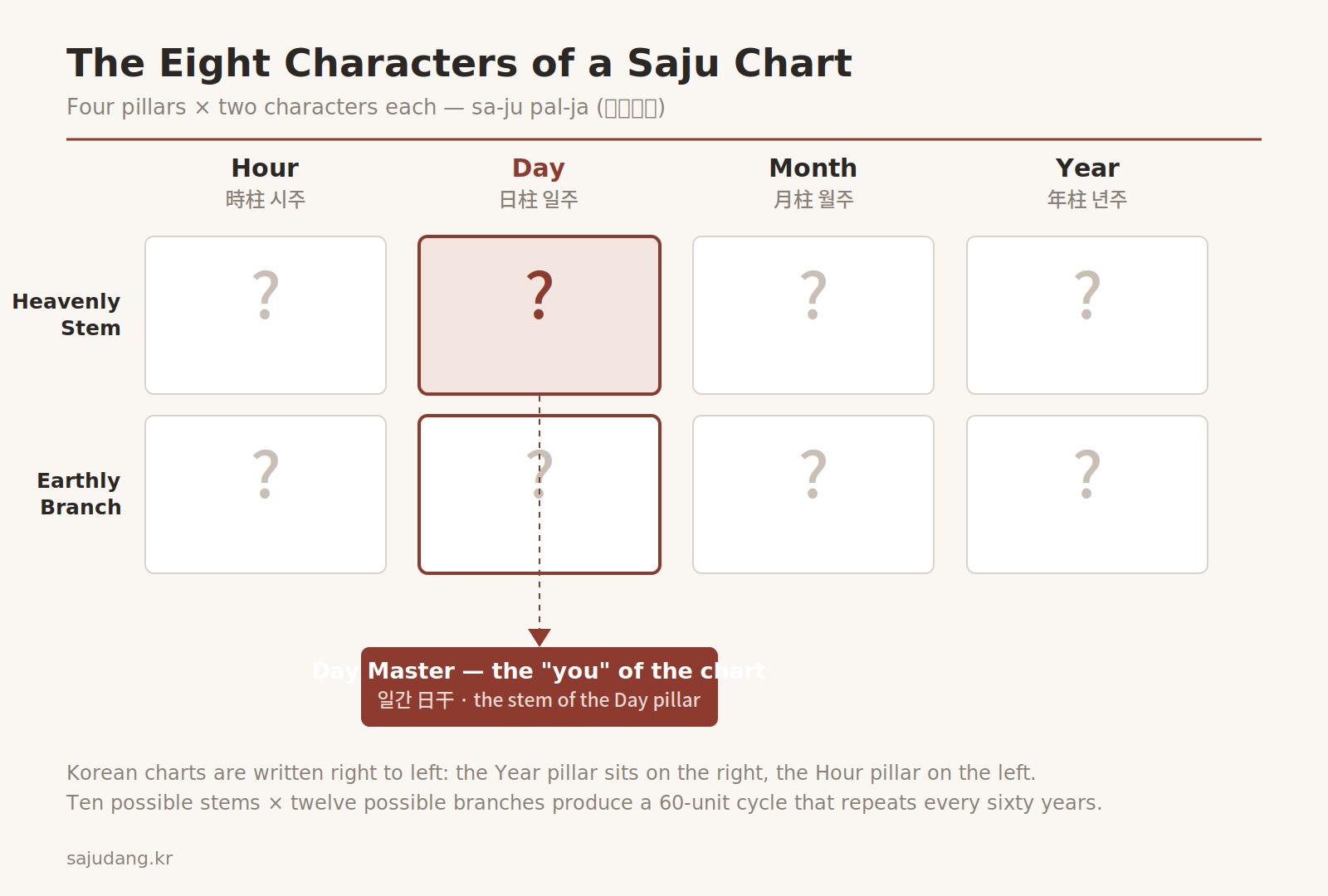
The eight characters, and where they come from
Your birth moment is split into four units of time: the year, the month, the day, and the hour. Each of those is a “pillar,” and each pillar carries two characters — one Heavenly Stem on top, one Earthly Branch below. Four pillars, two characters each, eight characters total.
The stems come from a set of ten. The branches come from a set of twelve — the same twelve you already know as the zodiac animals. Because ten and twelve only line up again every sixty steps, stems and branches pair off into a sixty-unit cycle that has been used to count years, months, days, and hours in East Asia for well over two thousand years. Your chart is simply where those four counters happened to be standing at the moment you were born.
One layout detail that confuses newcomers: Korean charts are written right to left. The Year pillar sits on the far right, the Hour pillar on the far left. If you get a printout in Seoul and try to read it like an English sentence, you will read your life backwards.
Your Day Master is the center — not your animal
Here is the correction that matters most for anyone arriving from Western astrology or the twelve-animal zodiac.
Most English-language material treats the year animal as the headline. “You’re a Tiger.” In actual saju practice, the year branch is one character out of eight, and it is rarely the most important one. The character that anchors the entire reading is the Heavenly Stem of the Day pillar — the Day Master (일간, 日干).
The Day Master is you in the chart. Everything else is read in relation to it: this character supports me, that one drains me, this one restrains me, that one is what I produce. When a Korean practitioner says “your wealth star is strong” or “you have too much output,” those labels are all defined by measuring some other character against your Day Master. Change the Day Master and every one of those labels changes, even if the other seven characters stay identical.
So the first genuinely useful thing to know about your own chart is not your animal. It is which of these ten you are.
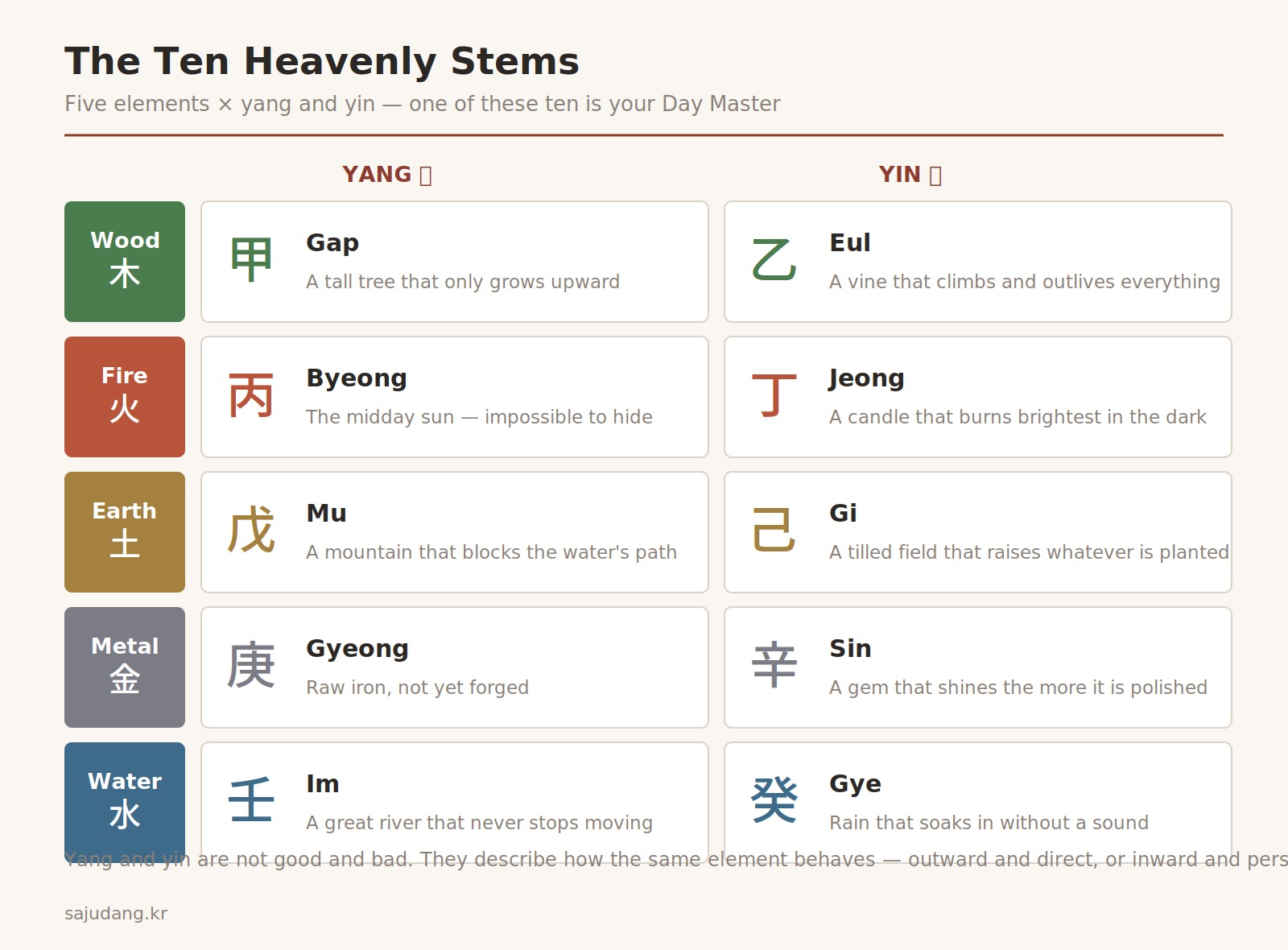
Each of the five elements appears twice — once in its yang form, once in its yin form. This is not a good-and-bad split. It describes how the same material behaves. Yang Wood (갑, 甲) is the tree that grows straight up and will not bend; yin Wood (을, 乙) is the vine that bends around every obstacle and is still there in twenty years. Both are Wood. They fail in completely different ways.
Why a chart is read as a balance problem
The five elements — Wood, Fire, Earth, Metal, Water — are not five separate categories. They are five positions in two loops that run simultaneously.
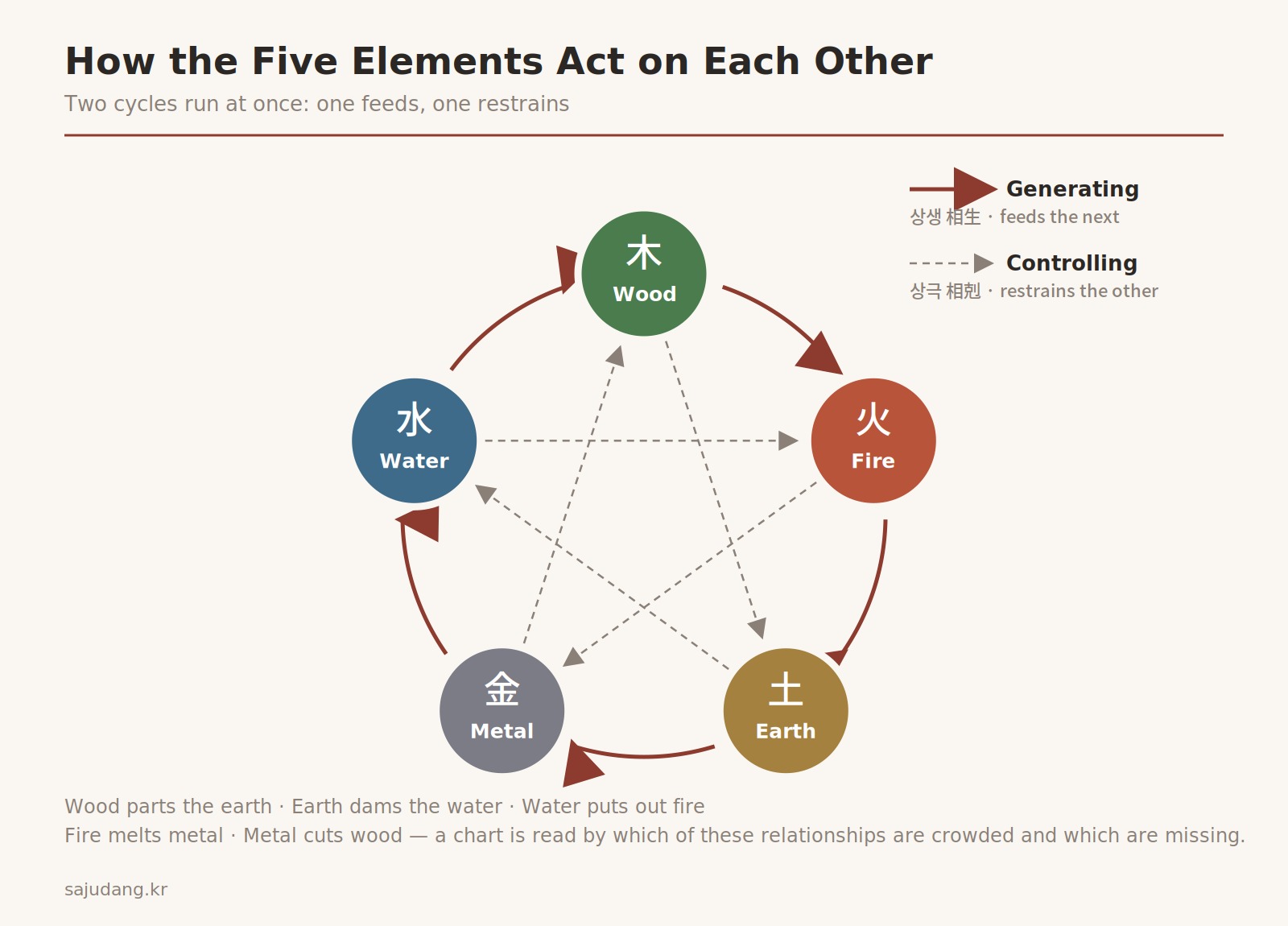
The generating cycle (상생) is the intuitive one: wood burns into fire, fire leaves ash that becomes earth, earth carries metal, metal-cold surfaces gather water, water grows wood. Each element feeds the next.
The controlling cycle (상극) cuts across the circle: wood’s roots break up earth, earth banks and dams water, water puts out fire, fire melts metal, metal cuts wood. Each element restrains the one two steps ahead.
A saju reading is essentially a diagnosis of how these relationships sit in your particular eight characters. Is one element crowded to the point that it swamps everything else? Is one missing entirely, so the loop has a gap in it? Is your Day Master supported by the season it was born into, or working against it? A chart with heavy Fire and no Water is a different problem from a chart with heavy Fire and heavy Water, and both are different from a chart with barely any Fire at all. The interpretation follows from the structure — which is why the same chart, read competently, should yield broadly the same diagnosis regardless of who is reading it.
The birth time problem — read this before you get a reading
The hour pillar comes from a twelve-block clock, where each block spans two hours. This creates two practical problems that no one warns visitors about.
First: many people simply don’t know their birth hour. Korean family registries traditionally recorded it; many Western birth records do not, or record only the date. If you cannot find your birth time, you can still get a three-pillar reading — year, month, and day are all intact, and the Day Master lives in the day pillar, so the core of the chart survives. What you lose is the hour pillar’s information, which in traditional practice covers later life, children, and a portion of career detail. A practitioner who tells you the reading is worthless without it is overselling; one who tells you it makes no difference is underselling.
Second: clock time is not sun time. South Korea sets its clocks to a meridian well east of the peninsula itself, which means Seoul’s actual solar noon falls roughly half an hour after the clock says noon. Careful practitioners adjust for this before assigning the hour branch. If you were born near the boundary of a two-hour block — and one in six people roughly is — that half hour is the difference between two entirely different hour pillars. If you were born outside Korea, the same correction applies using your own birth longitude. Any tool or reader that ignores birth location is quietly guessing on this.
When does a saju year actually begin?
Not January 1. Also — and this trips up nearly everyone — not Lunar New Year either.
The saju calendar is solar. Months are bounded by the twenty-four solar terms (절기), and the year boundary falls at ipchun (입춘, “start of spring”), around February 4th. Someone born on January 20th belongs to the previous saju year, not the one that began three weeks earlier on the Gregorian calendar. Someone born on February 1st in a year when Lunar New Year fell in mid-January is still in the previous saju year, because Lunar New Year is irrelevant to the calculation.
This is the single most common error in casual English-language saju content, and it produces a completely wrong year pillar for anyone born in January or early February — which is about one person in nine. If you are starting to suspect that Korea counts years in more than one way at once, you are right — the traditional Korean age system is a separate case of exactly that.
What saju does not claim
Being honest about the boundaries makes the rest more useful, not less.
It is not shamanism. Korea has a separate and much older shamanic tradition, musok (무속), where a mudang (무당) acts as a medium and spirits are genuinely involved. Saju has no spirits and no medium. A saju practitioner is doing something closer to structured chart analysis. Lumping them together is the most common category error foreigners make, partly because both sometimes operate out of similar-looking storefronts.
It does not predict events. A competent reading will not tell you that you will meet someone in April. It describes tendencies, pressures, and the shape of periods — this decade tends to reward consolidation rather than expansion; this is a year where your chart’s weak point gets loaded. What you do inside that shape is not in the chart.
It is not a verdict. The traditional literature is far more comfortable with difficulty than its pop reputation suggests. A “clash” is not doom; it usually describes a specific, recurring friction, and knowing where the friction lives is more useful than being told it does not exist. Any reading that is entirely flattering has stopped being a reading.
Saju, BaZi, the zodiac, and MBTI
BaZi (八字) is the Chinese system, and the calculation is essentially the same one — same stems, same branches, same sixty-unit cycle. The traditions diverged in emphasis rather than mechanics. Korean practice leans heavily on the Day Master as the reading’s anchor and makes more use of sinsal (신살), a layer of named markers. Chinese practice tends to give more weight to seasonal strength and to the “useful god” framework. Same architecture, different accent.
The twelve animals are the earthly branches — a subset of saju, not a parallel system. Reading only your year animal is roughly like describing a paragraph by quoting one word from it.
MBTI is worth mentioning because in Korea the two now coexist in a way outsiders find odd. A Korean in their twenties may know their MBTI type, their Day Master, and their partner’s gunghap (궁합, compatibility) score, and use all three in the same conversation without any sense of contradiction. MBTI describes how you are; saju adds when — which brings us to the part most introductions skip.
The part that gets left out: timing
Your eight characters do not change. What changes is what runs over them.
Saju divides life into luck pillars (대운, daeun) — successive ten-year periods, each with its own stem and branch, which layer onto your natal chart and change which relationships are active. On top of that, each calendar year contributes its own pair of characters.
This is the actual engine of a saju reading, and it is why “what is my saju” and “what does my saju say about this year” are different questions with different answers. A chart that is short on Water is a chart with a particular vulnerability — but a decade that floods it with Water is a very different ten years from one that adds more Fire. Two people with identical natal charts born ten years apart are living in different luck pillars right now and would get meaningfully different readings.
Most free online summaries stop at the natal chart. The natal chart is the noun. The luck cycles are the verb.
How Koreans actually use it
Not the way the K-drama scene suggests. In practice saju shows up at decision points: before a marriage, when a job change is on the table, when naming a baby, when choosing a date for something that matters. Late December through January is the annual peak, when a large share of the country checks its sinnyeon unse (신년운세, new year fortune) — including plenty of people who will tell you flatly that they do not believe in it.
That contradiction is the honest description of saju’s place in Korean life. It is not treated as a religion and, for most people, not really as prediction either. It functions closer to a shared vocabulary for talking about temperament and timing — one that has the advantage of blaming neither party when a couple is told they will grind against each other in a specific, nameable way.
Readings in Seoul are widely available and not expensive; walk-in saju cafés in areas like Hongdae and Insadong typically charge somewhere in the range of a nice dinner, with prices scaling by the practitioner’s reputation and the depth of the session. English-speaking readers exist but are the exception, and are usually found by booking ahead rather than walking in.
Reading your own chart
The calculation part — turning your birth data into eight characters, correcting for solar time, locating your Day Master, mapping your luck pillars — is deterministic. It should never vary between attempts. If you have run your birth data through an AI chatbot and gotten three different charts on three tries, you have learned something about that tool rather than about your chart.
If you want to see your own eight characters without booking anything, Sajudang computes the chart with a rule engine built from classical texts and uses AI only to write out what the engine decided — so the same birth data returns the same answer every time, with the reasoning shown.
Frequently asked questions
Is saju the same as the Chinese zodiac? No. The twelve animals are the earthly branches, which make up four of your eight characters. The zodiac is one component of saju, not an equivalent system.
Can I get a saju reading without knowing my birth time? Yes. Year, month, and day pillars are still computable, and your Day Master is in the day pillar. You lose the hour pillar, which traditionally covers later life and children.
Is saju religious? No. It has no deity, no ritual, and no clergy. It is a calendrical interpretive system, and Koreans of every religious background use it — or don’t — without it conflicting with belief.
Does the saju year start at Lunar New Year? No. It starts at ipchun, around February 4th, on the solar calendar. Lunar New Year plays no part in the calculation.
How accurate is saju? Saju is not empirically validated in the scientific sense, and it is best treated as a framework for reflection rather than as fact. What is objectively verifiable is the calculation: the chart derived from a given birth moment is fixed and reproducible.