Meet a Korean for the first time and one of the very first questions you’ll get is: “How old are you?” In much of the West, asking a stranger’s age can feel intrusive — but in Korea it’s the opposite of rude. The entire language runs on age-based politeness: which honorific title to use, which speech level to speak in, who defers to whom. Koreans genuinely need your age to know how to talk to you at all. And here’s the twist that catches every newcomer off guard: the number they expect might be one or even two years higher than the age you’ve used your whole life. This is “Korean age,” and until recently it governed daily life. Here’s how it worked, why it existed, what the 2023 law actually changed, and how to answer the age question without tangling yourself up.
The traditional system: two rules that change everything
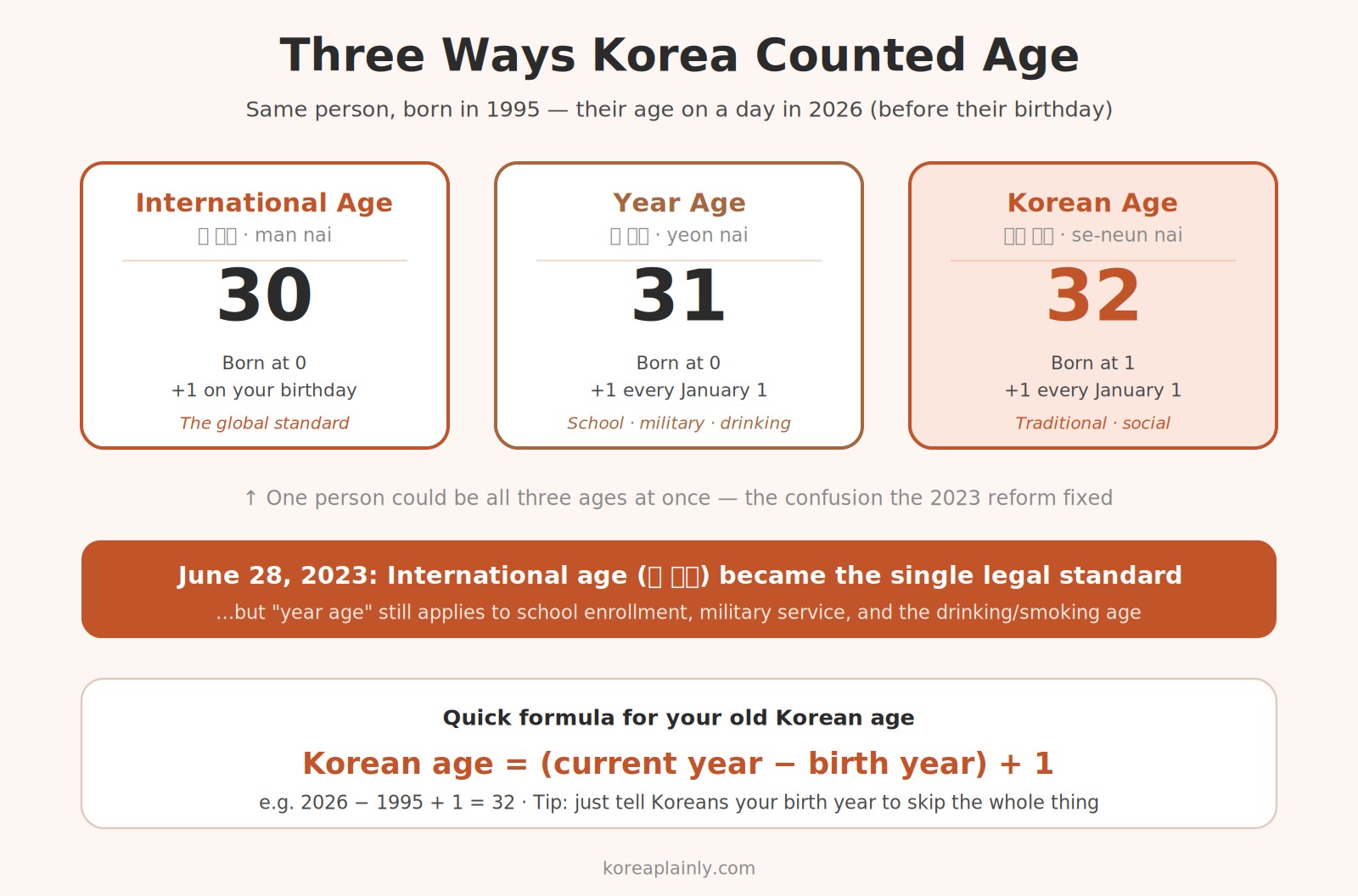
Under the traditional Korean age system (세는 나이, se-neun nai), two things work differently from what most of the world does:
- You’re one year old the day you’re born. The roughly nine months spent in the womb are counted as your first year of life.
- Everyone ages up together on January 1 — not on their individual birthday.
Combine those and you get the quirk Korea became famous for: a baby born on December 31 is one year old at birth, and then turns two the very next day, January 1 — at one day old. The actual birthday plays no role in the count at all. The practical result is that Koreans were always one or two years “older” than their international age, with the exact gap depending on whether their birthday had already passed in the current year.
Why the system existed in the first place
It’s easy to write this off as arbitrary, but it wasn’t. Two forces kept it alive for centuries.
The first is Confucian social structure. Korean society is deeply organized around age hierarchy — age determines the honorifics people use, the speech level they adopt, who pours whose drink, and who defers to whom. In that world, knowing someone’s precise position relative to you matters enormously, and a shared, group-based counting system made that instantly legible.
The second is calculational simplicity. Because everyone advanced a year together on January 1, you didn’t need anyone’s exact birthday to place them. If you were born in 1995 and someone else in 1993, they were reliably “two years older” all year round — no month-by-month math required. In a culture where relative age dictated social behavior, that clean, birth-year-based logic was genuinely useful.
The deeper confusion: Korea ran three age systems at once
The single biggest source of chaos wasn’t Korean age by itself — it was that three different systems operated simultaneously, each dominant in different contexts:
- Korean age (세는 나이): born at 1, +1 every January 1. The traditional, social number used in everyday conversation.
- International age (만 나이, man nai): born at 0, +1 on your actual birthday. The global standard, already used in Korea for medical and most legal documents.
- Year age (연 나이, yeon nai): born at 0, but +1 every January 1. A hybrid used for specific legal thresholds like the drinking/smoking age and military service.
This meant one person could truthfully hold three different ages at the same moment. A doctor calculating medication used one age; a school registrar used another; the person’s own friends used a third over dinner. For a country as internationally connected as Korea had become, this was a real and growing headache — in contracts, healthcare, pensions, and cross-border dealings alike.
What the 2023 law actually changed
On June 28, 2023, South Korea’s revised Civil Act took effect, making international age (만 나이) the sole standard for all legal and administrative purposes. The bills had passed the National Assembly in December 2022 with over 80% public support, and on the day they took effect, Koreans officially became a year or two younger overnight. Passports, contracts, medical records, pension and benefit eligibility, and virtually all official matters now key off your real birth-date age — exactly like the rest of the world.
But the reform was precise, not total. Two areas deliberately kept the “year age” system:
- School enrollment, which still groups children by birth year rather than exact birthday — a cleaner administrative cutoff than staggering millions of individual birthdays.
- The legal drinking/smoking age and military service eligibility, where everyone born in a given year qualifies from January 1. For example, everyone born in 2004 becomes eligible for the relevant thresholds at the same time, regardless of birth month.
So the law didn’t erase every alternative — it eliminated the ambiguity by making international age the default, while leaving year-age in place for a few areas where a shared annual cutoff makes practical sense.
Why you’ll still hear Korean age anyway
Here’s the part that surprises people who assume a law settled everything: in everyday conversation, Korean age hasn’t disappeared — especially among older generations. The reform changed the paperwork, not the culture. Age still sets the social hierarchy that governs honorifics and speech level, so the concept remains woven into how people relate. A useful comparison is the metric system in the United States: the government can declare an official standard, but daily habits run on their own track for a long time afterward. When an older Korean asks your age and nods at a number higher than you expected, they may simply be thinking in the system they grew up with.
How to actually answer “how old are you?”
Because the age question is really about placing you in the social hierarchy, the cleanest way to answer — and what many Koreans now do to sidestep all ambiguity — is to give your birth year instead of a number. Saying you’re a “‘95er” (95년생) tells a Korean everything at once: your birth year fixes your position, and people born in the same year are considered donggap (동갑), the same age — a status that often sparks instant, easy friendship because you share the same social rung.
If you want to work out your old-style Korean age for fun, the shortcut is one line:
Korean age = (current year − birth year) + 1
So if it’s 2026 and you were born in 1995: 2026 − 1995 + 1 = 32. Your international age would be 30 or 31, depending on whether your birthday has already passed this year. That single “+1” is the whole reason a Korean might cheerfully insist you’re older than you think — and, since June 2023, the reason the official answer finally lines up with the rest of the world.