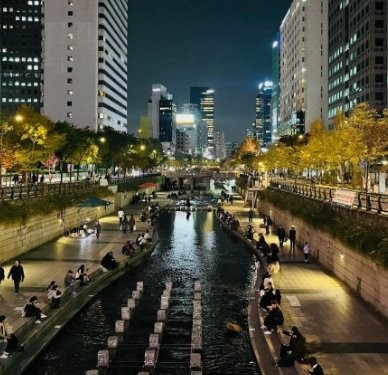
Walk through the middle of downtown Seoul on a hot summer day and you’ll find something that shouldn’t be there: a clear, cool stream running between the office towers, with people sitting along the banks and dipping their feet in the water. This is Cheonggyecheon (청계천). And here’s the twist that surprises most visitors — twenty years ago, this exact spot was a six-lane elevated highway. The stream was buried under concrete and traffic, and the city dug it back out.
From highway to stream
Cheonggyecheon has run through Seoul for some 600 years — in the Joseon dynasty it was the city’s main stream. But after the Korean War, refugees built shanties along its banks, it grew polluted, and from the 1950s the city covered it over. By the 1970s an elevated expressway ran on top, carrying around 168,000 cars a day. It was a symbol of Korea’s fast, car-first industrial boom.
By 2000 that highway was aging and unsafe, and repairing it would have cost a fortune. So in 2003 the city made a radical call: tear the highway down and bring the stream back. Traffic engineers predicted gridlock and business owners feared collapse, but the project went ahead, and the restored 5.8 km stream opened in October 2005. Because the old streambed no longer had a natural water source, the city pumps in and treats about 120,000 tons of water a day from the Han River and subway groundwater to keep it flowing. Today Cheonggyecheon is studied worldwide as a model for tearing out urban highways — and it’s simply a lovely place to be.
Why it’s a free summer escape
In summer the stream corridor runs noticeably cooler than the streets above — around 3–5°C cooler than the surrounding roads, thanks to the water, the breeze it channels, and the greenery that replaced the asphalt. On a sweltering Seoul afternoon, that gap is real.
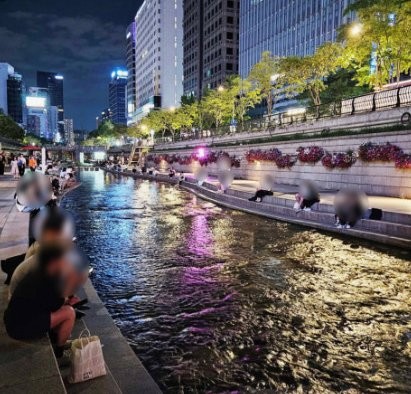
And the best part is free. Stone stepping-stones cross the water at intervals, and you’ll see people — office workers on their lunch break, families, couples — perched on them with their feet in the stream. Kids wade; herons and ducks pick through the shallows (the restored stream brought fish and birds back within months). I walked it on a summer evening, when the whole corridor was lit up and the banks were lined with people cooling off by the glowing water — it’s one of downtown Seoul’s most photogenic night walks.
From Incheon Airport to Cheonggyecheon
If Cheonggyecheon is your first stop off the plane, the good news is it’s easy to reach — it sits in the dead center of Seoul, right by City Hall.
The fastest way is the AREX Airport Railroad. The Express train runs nonstop from Incheon Airport to Seoul Station in about 43 minutes from Terminal 1 (51 from Terminal 2), with reserved seats and luggage racks. It costs 13,000 won on-site (around 11,500 if you book online), and — important — it needs its own QR ticket; a T-money or Climate Card won’t work on the Express. The cheaper option is the AREX All-stop train, which reaches Seoul Station in about an hour, costs roughly 4,150–5,350 won, and does accept T-money.
Either train drops you at Seoul Station, just two stops from the stream: transfer to Subway Line 1 and ride to City Hall or Jonggak, then walk a few minutes to Cheonggye Plaza (exits below). A taxi from the airport takes about an hour and adds a 7,900-won expressway toll. And if you land late — the last AREX leaves the airport around 10:48 PM — take the N6000 or N6001 night bus toward Seoul Station instead. For the full breakdown of every airport-to-city option, see our Incheon Airport to Seoul guide.
Getting to the stream in the city, and walking it
Once you’re in central Seoul, the subway is by far the easiest way to the stream — and because Cheonggyecheon runs 5.8 km, you can join it at different points.
For the western starting point, Cheonggye Plaza (with the tall spiral “Spring” sculpture), the closest exit is Gwanghwamun Station (Line 5), Exit 5 — about a one-minute walk. City Hall Station (Lines 1 and 2), Exit 4, and Jonggak Station (Line 1), Exit 5, are a few minutes away too. For the middle of the stream, use Euljiro 1-ga (Line 2) or Euljiro 3-ga (Lines 2 and 3) — handy from Myeongdong. For the eastern end near Dongdaemun market, use Dongdaemun Station (Lines 1 and 4), Exit 8.
Most people start at Cheonggye Plaza and walk the western stretch — about 2 km to Ogansu Bridge — which has the most to see: mural walls, carved stone reliefs, seasonal flowers, and the lit fountains at the plaza. You take steps down to stream level, about 5 meters below the road, and follow the water with the traffic left up top. It’s free, there’s no ticket, and it’s open at all hours. To ride the subway (and the all-stop AREX) you’ll need a T-money card, which works on every line and bus.
Across the seasons
Summer is for cooling off, but Cheonggyecheon works year-round. Spring brings flower installations and a festival; autumn turns the bankside willows gold; and in late autumn the Cheonggyecheon Lantern Festival lights the water with thousands of paper lanterns — one of Seoul’s most photogenic seasonal events. Whenever you come, it’s free, it’s central, and it’s a rare place to slow down in the middle of the city — cool off at the stream, then a café nearby.
Next time downtown Seoul gets too hot, head below street level and follow the water. You’ll be walking through one of the world’s best-known urban comebacks — a highway that turned back into a stream.