Gimhae Airport is not in Busan proper. It sits west of the city, and getting to where you’re actually staying takes 40 to 70 minutes depending on how you do it.
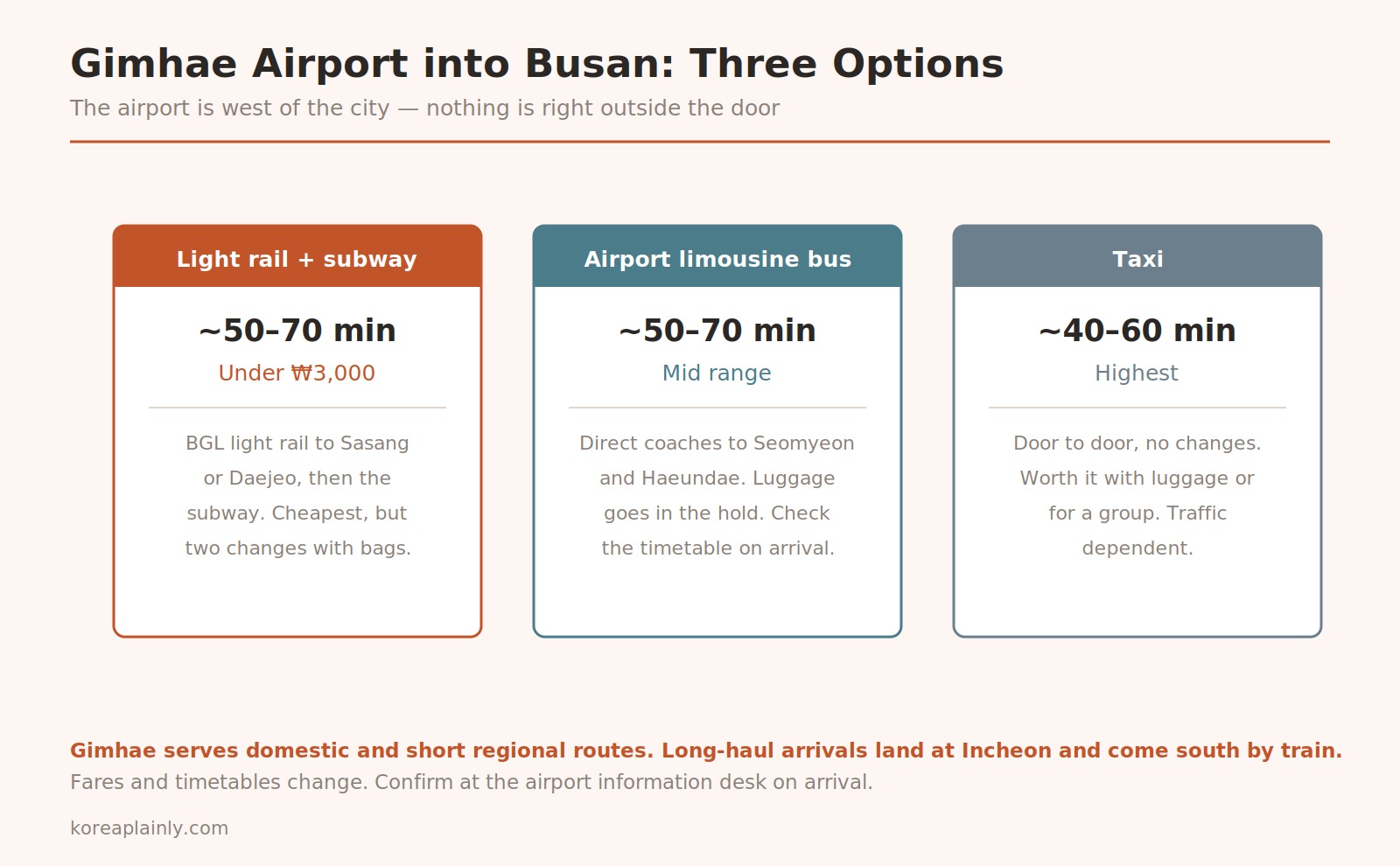
Short version: light rail plus subway if you’re travelling light, the limousine bus if you have luggage, a taxi if you’re in a group or in a hurry.
First, is this even your airport?
Gimhae (airport code PUS) handles domestic flights and short regional routes — Japan, China, Taiwan, parts of Southeast Asia. Long-haul arrivals from Europe or North America land at Incheon, not here.
So there are two ways people end up at Gimhae:
- A domestic hop from Gimpo, Seoul’s other airport
- A regional international flight from within Asia
If you’re currently planning a trip and wondering whether to fly into Busan or take the train, Incheon Airport to Busan works through that. The short answer is usually the train.
Light rail plus subway: cheapest
The Busan–Gimhae Light Rail Transit connects directly to the airport terminal and links into the city subway at two points:
- Sasang Station — subway Line 2, which runs east toward Seomyeon and on to Haeundae
- Daejeo Station — subway Line 3
Under ₩3,000 all in, and 50 to 70 minutes to most parts of the city.
The trade-off is transfers. You’ll change at least once, sometimes twice, and Korean subway interchanges involve stairs and long connecting passages. With a backpack this is fine. With two suitcases it’s the slowest and most tiring version of the journey, not the cheapest one in any meaningful sense.
Your transport card from Seoul works here — Korean transport cards are national. If you don’t have one yet, how to pay for transit in Korea covers your options.
Limousine bus: easiest with luggage
Airport coaches run from the terminal to the main destinations in the city, including Seomyeon and Haeundae. Roughly the same journey time as the light rail, at a middling fare.
This is the one to take with suitcases. Luggage goes in the hold, you sit down once, and you get off near where you’re staying. No stairs, no interchanges, no wrestling a case onto a crowded train.
The catch is frequency. Airport buses run to a timetable, not continuously, and if you’ve just landed at an awkward hour the next departure may be a while. Check the board in arrivals before committing — if it’s a 40-minute wait, the light rail will get you there sooner.
Taxi: fastest, most expensive
Straightforward. The rank is outside arrivals, and it’s 40 to 60 minutes into the city depending on traffic and destination — Haeundae is on the far side of Busan, so it’s at the longer end.
Worth it when:
- There are three or four of you. Split, the per-person cost stops being an argument.
- You’re arriving late and the light rail or bus timetable has thinned out.
- You have real luggage. The same reasoning as the bus, but faster and door to door.
Have your destination written in Korean on your phone. Hotel names in English are often recognised; street addresses usually aren’t.
Where you’re going matters more than how
Busan is spread out, and the distance from Gimhae varies a lot by district:
- Seomyeon (central, commercial) — the shortest trip, and the best-connected place to base yourself
- Busan Station area (old centre, port) — moderate, and where you’d arrive by KTX
- Haeundae (beach, resort hotels) — the longest, on the far eastern side
If you’re heading to Haeundae, that’s a real journey from Gimhae — well over an hour by public transport with transfers. The direct limousine bus, where the timing works, is the sane option. Busan Station to Haeundae covers the same destination from the train station, which is a different and shorter problem.
Frequently asked questions
How far is Gimhae Airport from Busan city centre? West of the city, about 40 to 70 minutes depending on the method and your destination.
Is there a subway from the airport? Indirectly. The Busan–Gimhae light rail connects the airport to the subway network at Sasang (Line 2) and Daejeo (Line 3).
What’s the cheapest way into the city? Light rail plus subway, under ₩3,000. It involves at least one transfer.
Is there a direct bus to Haeundae? Airport limousine buses serve the main destinations including Haeundae. Check the timetable on arrival, as they aren’t frequent.
Does my Seoul transport card work? Yes. Korean transport cards work nationally.
Do long-haul flights land at Gimhae? No. Long-haul arrivals go to Incheon. Gimhae serves domestic and short regional routes.
Fares and timetables change. Confirm at the airport information desk on arrival.