Landing at Incheon and heading straight to Busan takes about four hours whichever way you do it. The standard route is the airport train to Seoul Station, then the KTX south — roughly 3.5 to 4.5 hours, around ₩65,000–90,000 all in.
The first thing to understand, because it shapes everything else: there is no direct train from Incheon Airport to Busan. The airport railway and the high-speed network are separate systems, so every rail route involves a change. The only question is where you change.
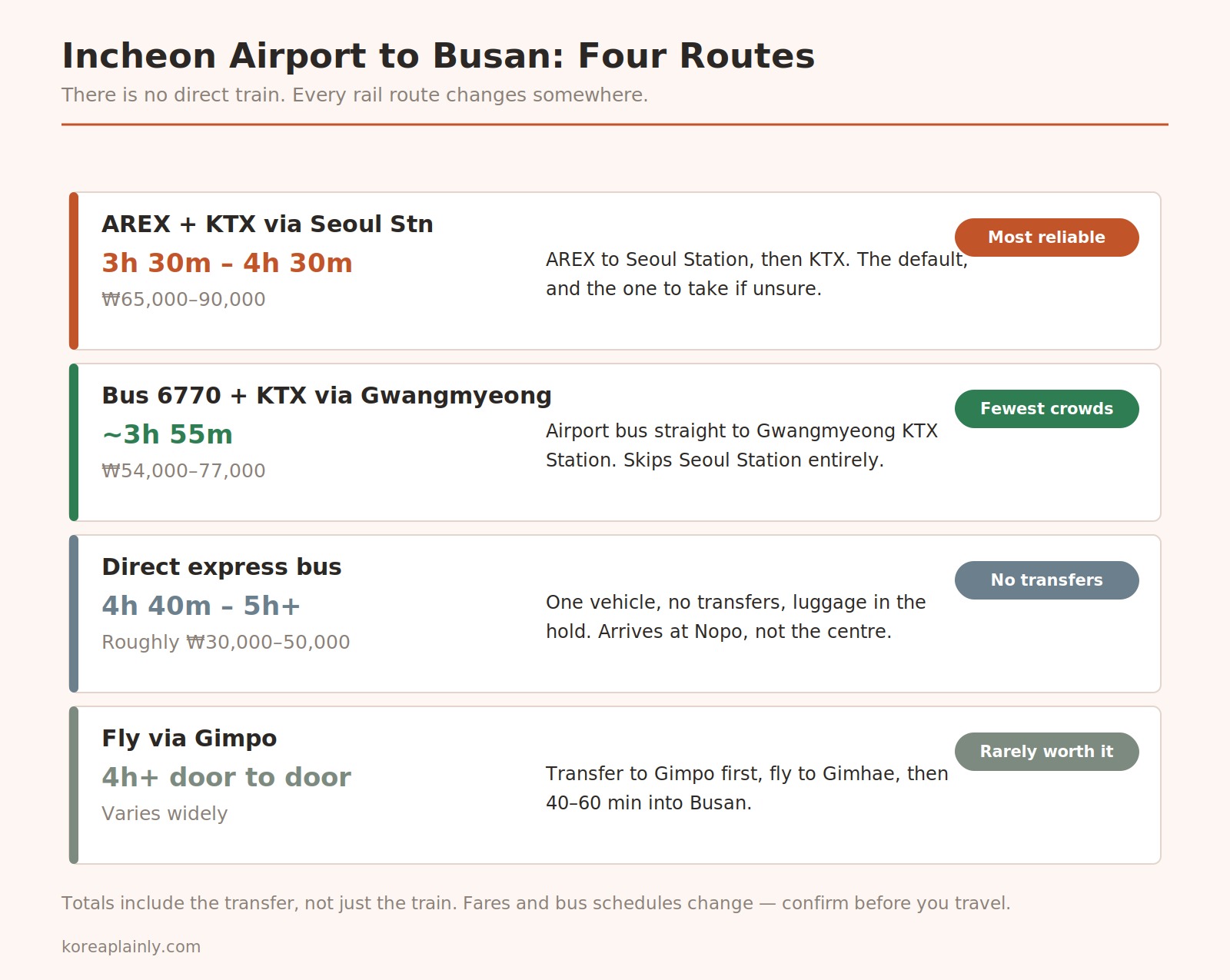
The standard route: AREX, then KTX
Follow the signs in the airport basement to the Airport Railroad, known as AREX. Two services run the same track:
- Express — around ₩9,500, about 43 minutes, no stops, reserved seating
- All-stop — around ₩4,750, roughly an hour, ordinary commuter train
Both end at Seoul Station, where the KTX platforms are in the same complex. From there it’s about 2h15m to Busan on a direct service.
Which AREX to take is a real decision, not a formality. The express costs about double and saves fifteen minutes — irrelevant on its own. What you’re actually buying is a guaranteed seat with luggage space. The all-stop is a normal commuter train, and if you land during a weekday rush hour with two suitcases, standing for an hour with your bags in the aisle is a genuinely unpleasant way to start a trip. Off-peak with one bag, take the all-stop and pocket the difference.
Budget 20–30 minutes at Seoul Station between arriving and boarding. It’s a large building, the signage is good but the distances aren’t short, and you may need to collect a ticket.
The route most guides don’t mention: Gwangmyeong
Airport bus 6770 runs directly from Incheon Airport to Gwangmyeong Station, which is a KTX station south of Seoul. Every Busan-bound KTX from Seoul Station stops there a few minutes later.
- Terminal 1 — bus stops 6A or 13B
- Terminal 2 — bus stops 17 or 28
Total journey works out around 3h55m, comparable to the AREX route and sometimes faster.
Why bother? Three reasons:
Luggage. The bus has an underfloor hold. You hand over your suitcase at the airport and collect it at Gwangmyeong. No hauling bags through Seoul Station.
No transfer inside Seoul Station. Seoul Station at 6pm on a Friday is a lot of people moving in a lot of directions. Gwangmyeong is a fraction of the size and much easier to navigate jet-lagged.
One less thing to get right. Bus, then train. That’s it.
The trade-off is frequency — the airport bus doesn’t run as often as the AREX, so check the schedule when you land. If the next departure is 50 minutes away, take the AREX instead.
Book your KTX ticket departing from Gwangmyeong, not Seoul Station, or you’ll be boarding at a station your ticket doesn’t start from.
Direct express bus: no transfers at all
Long-distance coaches run from both terminals straight to Busan. Roughly 4h40m to 5 hours depending on traffic, and fares vary by operator and class — expect somewhere in the ₩30,000–50,000 range.
This is the option for someone who has just flown fourteen hours and cannot face a transfer. Luggage goes in the hold, you sit down once, and you get off in Busan. Korean express coaches recline substantially and the premium classes are three seats across.
Two catches. Departures are infrequent compared to trains, so a long wait can wipe out the appeal. And it arrives at Nopo Terminal, at the northern edge of Busan on the end of subway Line 1, not the city centre — add 30–40 minutes to get anywhere useful.
Tickets are sold at the airport: Terminal 1 has booths inside near exits 4 and 9 and outside at several exits; Terminal 2’s ticket office is on basement level 1 on the west parking side.
Flying: usually the wrong answer
You cannot generally fly Incheon to Busan on a domestic connection without first getting to Gimpo, Seoul’s other airport. That means a transfer of 30–60 minutes, then an hour in the air, then another 40–60 minutes from Gimhae Airport into Busan proper.
Add check-in and security and you’re at four hours or more with three separate legs — no faster than the train, considerably more to go wrong, and usually more expensive.
The exception is a genuinely cheap fare on a quiet weekday when you’re travelling light. Otherwise, take the KTX. If you do end up flying, Gimhae Airport into Busan covers the arrival end.
Book the KTX before you need it
Whichever route you take, the KTX leg needs a ticket, and Korail’s payment system frequently rejects foreign cards without explaining why. Sort this out before you’re standing in a station with a suitcase.
How to book KTX tickets as a foreigner ranks the five methods by reliability. The short version: use the Korail global site in a desktop browser, not the app.
Reservations open one month before departure. For a normal weekday you can book a few days out. For a summer weekend or a holiday, book the day the window opens.
Should you go straight to Busan at all?
Worth asking. Four hours after a long-haul flight is a lot, and you’ll arrive at a hotel with nothing left in you.
If your itinerary allows it, one night in Seoul near the station and an early KTX the next morning is a better day. If it doesn’t, take the direct bus and sleep on it.
For the Seoul-to-Busan leg in detail, see Seoul to Busan compared. If you’re arriving and staying in Seoul first, the airport arrival guide covers getting into the city.
Frequently asked questions
Is there a direct train from Incheon Airport to Busan? No. You transfer to the KTX at Seoul Station or at Gwangmyeong Station.
How long does it take? About 3.5 to 4.5 hours by train including the transfer, 4h40m or more by direct bus.
How much does it cost? Roughly ₩65,000–90,000 by AREX plus KTX. The direct bus is cheaper, in the region of ₩30,000–50,000.
What is the Gwangmyeong route? Airport bus 6770 goes directly to Gwangmyeong KTX Station, letting you skip Seoul Station. Total time is similar and it’s easier with luggage.
Express or all-stop AREX? Express if you have heavy luggage or are travelling at rush hour. All-stop otherwise.
Can I fly from Incheon to Busan? Usually only by transferring to Gimpo first, which makes the total journey no faster than the train.
Fares, bus schedules and timetables change. Confirm current information before you travel.