For most people this isn’t a choice. If you’re flying long-haul, you’re landing at Incheon, because that’s where the long-haul flights go. Gimpo handles domestic routes plus a short list of regional Asian cities.
The choice only becomes real if you’re flying in from Tokyo, Osaka, Beijing, Taipei or Shanghai — and in that case, Gimpo is usually the better airport. Here’s why, and the cases where it isn’t.
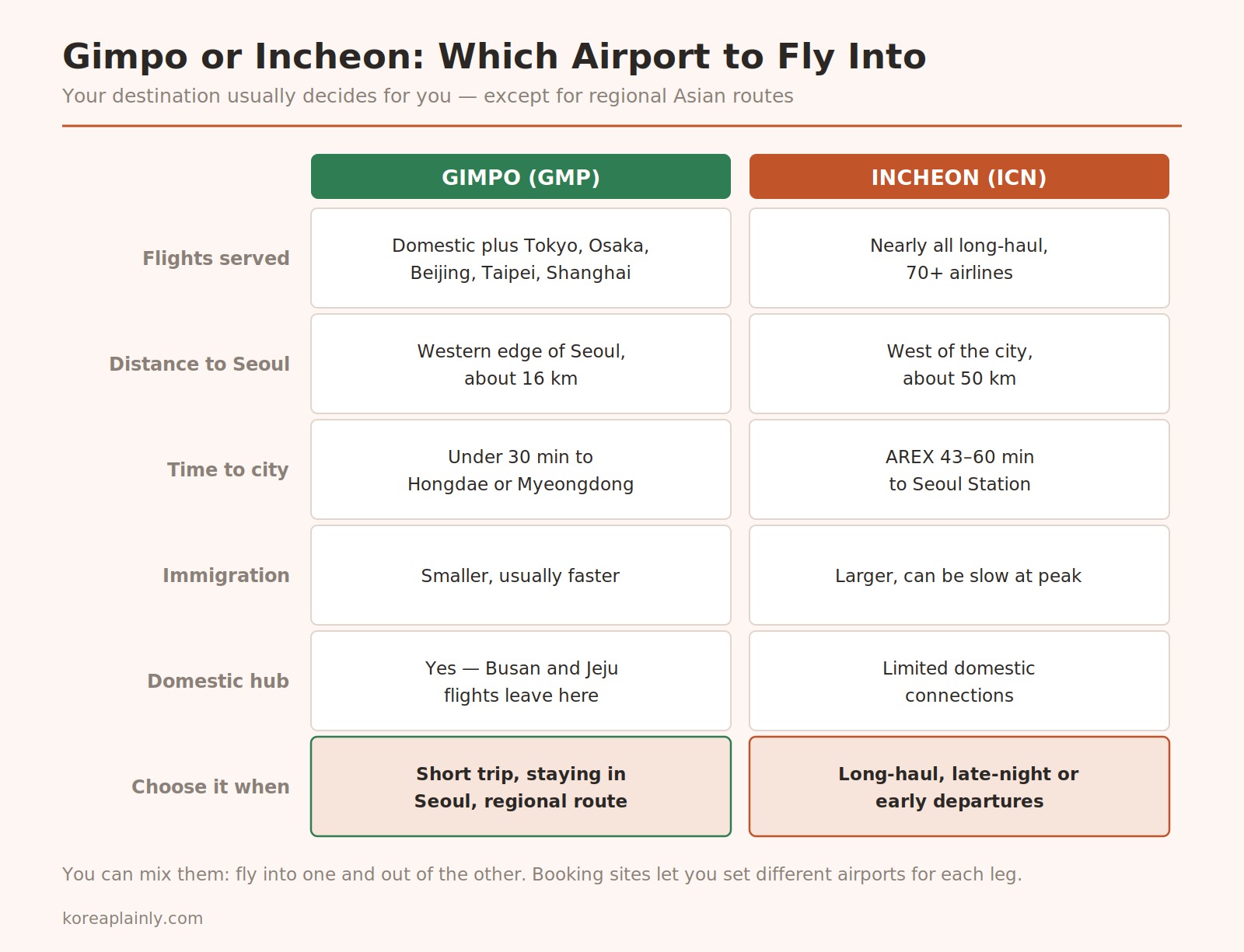
The distance difference is bigger than it looks
Gimpo sits at the western edge of Seoul, roughly 16 km from the centre. Incheon is on reclaimed land out toward the Yellow Sea, about 50 km away.
In practice:
- Gimpo to Hongdae or Myeongdong — under 30 minutes. Gimpo is on subway Lines 5 and 9, plus the AREX line, so you walk downstairs and you’re on the network.
- Incheon to Seoul Station — 43 minutes on the AREX express, about an hour on the all-stop, before you get to wherever you’re actually staying.
But the transport time isn’t the whole gap. Gimpo is a much smaller airport, so immigration and baggage are usually faster. On a bad day at Incheon the arrivals queue alone can eat 45 minutes. Add it up and Gimpo can put you in your hotel an hour to ninety minutes earlier for the same scheduled landing time.
On a three-night trip, that’s a meaningful fraction of your first day.
What Incheon gives you in return
Flights. Over 70 airlines, essentially every long-haul route, and far more frequency on the regional routes it shares with Gimpo. If your dates are fixed and awkward, Incheon will have something.
Late nights and early mornings. Incheon runs a much wider schedule. If your flight lands at 1am or leaves at 6am, it’s almost certainly Incheon, and the airport is built for it — there are rest zones, showers and 24-hour facilities.
Somewhere to be during a long layover. Incheon is consistently rated among the world’s best airports and has the shopping, dining and facilities to match. Gimpo is a functional regional airport; there’s food and there are shops, but you wouldn’t plan to spend four hours there.
Regional bus connections. Long-distance coaches leave Incheon for cities all over the country. If you’re heading somewhere other than Seoul, Incheon is often the better starting point despite being further out.
The domestic detail that catches people
Gimpo is Korea’s domestic hub, not Incheon. Flights to Busan and Jeju leave from Gimpo.
This matters if you’re planning to fly onward within Korea. Landing at Incheon and connecting to a Busan flight means transferring across Seoul to a different airport first — 30 to 60 minutes on top of everything else, which is why the train usually beats flying on that route. Incheon Airport to Busan covers the alternatives.
If your itinerary is Seoul plus Jeju, landing at Gimpo makes the onward connection considerably simpler.
You can use both
Booking sites let you set different airports for each leg, and mixing them is often the smart play.
Fly into Incheon, out of Gimpo. You arrive on whatever long-haul or cheap fare you found, and you leave from the airport twenty minutes from your hotel — which matters more on departure day, when you’re trying to squeeze in a last morning rather than leaving three hours early for a train.
Worth pricing out. The fare difference is sometimes small and the time saved isn’t.
So which one
Fly into Gimpo if: you’re coming from Japan, China or Taiwan; it’s a short trip; you’re staying in Seoul; or you have a domestic connection to Busan or Jeju.
Fly into Incheon if: you’re long-haul; your flight is late-night or early-morning; you want a specific date and time; or you’re heading somewhere outside Seoul with a direct airport coach.
And if the Gimpo fare is meaningfully more expensive, take Incheon and spend the difference. The AREX is fast, cheap and reliable, and an hour is an hour — it isn’t worth a large premium.
For getting into the city from Incheon, the airport arrival guide covers AREX, buses and taxis. To sort out a transport card before you need one, see how to pay for transit in Korea.
Frequently asked questions
Which airport is closer to Seoul? Gimpo, by a lot. About 16 km versus roughly 50 km, and it’s on the subway network directly.
Can I fly long-haul into Gimpo? Generally no. Gimpo handles domestic flights and short regional routes to Japan, China and Taiwan.
Which airport for Busan or Jeju flights? Gimpo. It’s the domestic hub.
Is immigration faster at Gimpo? Usually, simply because it’s smaller and handles fewer arrivals.
Can I fly into one and out of the other? Yes. Booking sites let you select different airports for each leg.
How do I get between the two airports? The AREX line connects them directly, or you can take a bus or taxi. Allow 30–60 minutes.