Almost everyone mixes bibimbap wrong on the first attempt. They press down with a spoon, mash everything into a uniform paste, and end up with something that tastes fine but has the texture of a thick porridge.
The dish is designed to survive being mixed. Doing it properly takes about fifteen seconds of technique and changes the result entirely.
Bibimbap (비빔밥) is bibim (mixing) plus bap (rice) — rice with seasoned vegetables, usually meat, usually an egg, and gochujang, arranged separately and combined by you at the table.
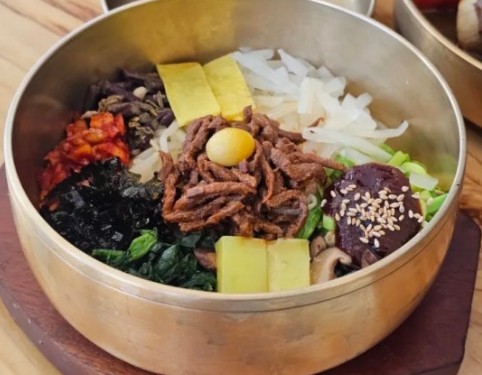
Why it arrives unmixed
Not for the photograph. The arrangement follows obangsaek (오방색), the five traditional colours — red, green, yellow, white and black — each mapped to a direction and an element in Korean cosmology. A properly composed bowl has all five, and the presentation carries the idea that a complete meal is a balanced one.
The practical consequence is that you can see every component before you destroy the arrangement. Which matters, because you are about to decide how much gochujang the bowl needs, and that judgement depends on what is in it.
How to mix it
Use chopsticks, not the spoon.
This is the whole thing. A spoon has a flat face and a bowl, so mixing with it means pressing rice against the side of the dish. Rice pressed repeatedly turns sticky, then gluey, then into a single mass. Korean short-grain rice is especially prone to this because of its starch content.
Chopsticks held upright and used in a lifting, folding motion do the opposite. You are turning the bowl over on itself and letting air in, rather than compressing it. Each grain stays separate, which is the texture the dish is supposed to have.
Add sesame oil before the gochujang.
Standard restaurant practice, and the reason is mechanical. Sesame oil poured over the rice first coats the grains in a thin film. Gochujang added afterwards spreads across that oiled surface instead of clumping onto bare rice.
Skip it and gochujang tends to gather in one spot and stay there — you end up with a section that is too hot and another with almost no seasoning.
Add gochujang in stages.
Start with roughly half what you think you need, mix, taste, add more. Gochujang cannot be removed once it is in, and the components are already seasoned — the paste is an adjustment, not the sauce.
Mix everything, but don’t overwork it.
Once the colour is even, stop. Continuing past that point only compresses the rice.
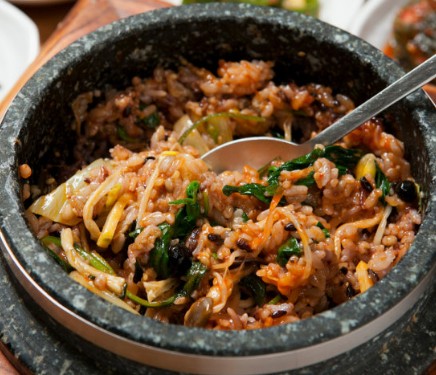
Dolsot or not
The one real choice on the menu.
Regular bibimbap comes in a metal or ceramic bowl at eating temperature. Vegetables stay crisp, the flavours stay distinct, and you taste each component. If you want to know what bibimbap is, order this.
Dolsot bibimbap (돌솥비빔밥) arrives in a stone bowl heated until it hisses. The rice touching the stone crisps into nurungji — a browned, crunchy layer at the bottom — and the raw egg cooks against the sides as you mix.
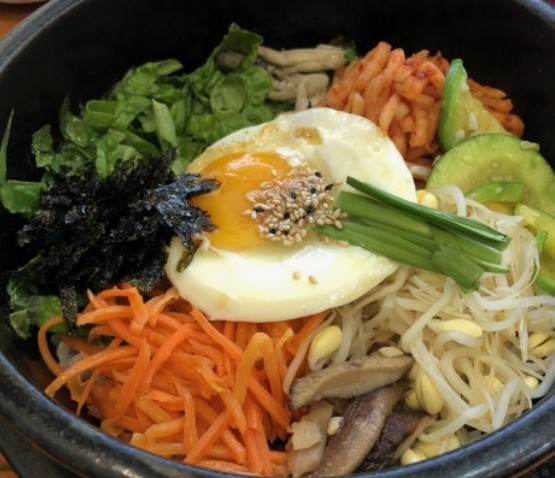
The trade-off is real. Dolsot gives you texture contrast and stays hot to the last bite. It also cooks the vegetables slightly, so they soften, and everything moves toward one blended flavour rather than staying distinct.
Two practical points:
- Mix dolsot immediately — the bottom keeps cooking whether you are ready or not.
- Then leave it alone for a minute before eating. That pause is what builds the crust.
The crust at the bottom is what most people order dolsot for, and scraping it up at the end is part of the meal.
Jeonju, and why one city owns this dish
Bibimbap exists everywhere in Korea. Jeonju bibimbap is the version that became a national brand, and there are specific reasons.
The rice is cooked in beef bone broth. Some Jeonju restaurants cook the rice in sagol broth rather than water, so every grain carries savoury depth before anything is added to it. This is the single biggest difference and it is immediately noticeable.
Local ingredients define it. Jeonju’s hwangpomuk — mung bean jelly tinted yellow with gardenia — is a component you rarely see elsewhere, along with locally grown bean sprouts. The classic version tops it with yukhoe, raw seasoned beef.
The count is high. A traditional Jeonju bowl can involve around thirty ingredients. Which is why an authentic one costs several times a canteen bibimbap, and why the comparison is roughly cafeteria pasta against a restaurant kitchen.
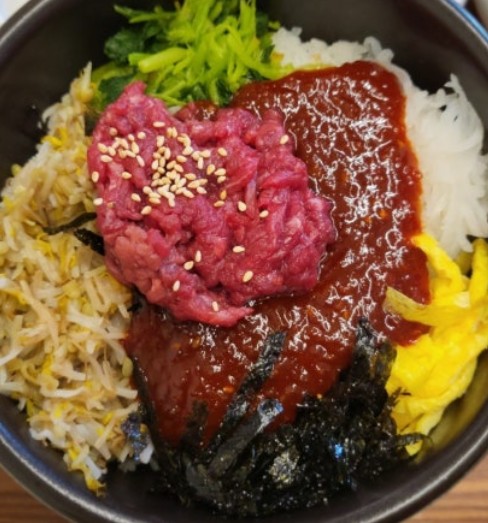
Worth knowing: there is no single fixed Jeonju recipe. In the 1960s and 70s a cluster of bibimbap restaurants formed near the old provincial office, each competing on its own version — one pre-frying the rice with gochujang, one building a stone-bowl version, one cooking rice in bone broth. The recipe diversity is the tradition.
And Jeonju is not the only claim. Jinju, in the south-east, has its own bibimbap topped with yukhoe and served with a blood-sausage soup, using gochujang fried with beef and beef fat. The oldest surviving bibimbap restaurants in Korea are in Jinju and Ulsan, not Jeonju.
What is actually in it
Namul — the seasoned vegetables — are the substance. Bean sprouts, spinach, fernbrake, courgette, radish, carrot, mushroom. Each is prepared separately, most blanched briefly and dressed individually. That separate preparation is why the components taste distinct rather than merging.
Meat is usually seasoned minced or sliced beef, or raw yukhoe in the premium version. Frequently omitted.
The egg comes fried on top for regular bibimbap, raw for dolsot.
Gochujang goes on the side or on top, and you control the amount.
Sesame oil either arrives on the table or is already dressed through the vegetables.
Ordering it
It is genuinely easy to eat vegetarian. Ask for it without meat and without egg and most restaurants will manage it without difficulty — bibimbap is one of the easiest Korean dishes to adapt. Temple cuisine versions are entirely plant-based. Do check whether the gochujang or the namul seasoning contains anchovy or shrimp if that matters to you.
It is not spicy unless you make it so. All the heat is in the gochujang, which you add yourself. Order it with the paste on the side and you control it completely. So is bulgogi mild, if you want another safe option.
It comes with soup. Usually a light soybean paste soup, and it is not an extra — it is meant to be eaten alongside as the bowl is dry.
Cheap bibimbap and Jeonju bibimbap are different products. A ₩7,000 lunch version and a ₩20,000 traditional bowl are not the same dish scaled. Expect to pay for the real thing.
The kimchi matters here. Bibimbap is savoury and slightly sweet with no acidity of its own. The kimchi on the side is what balances the bowl.
Frequently asked questions
Am I supposed to mix bibimbap? Yes, thoroughly. It arrives arranged so you can see the components, not so you can eat them separately.
Spoon or chopsticks? Chopsticks for mixing — a spoon compresses the rice and turns it gluey. Then eat it with the spoon.
Is bibimbap spicy? Only from the gochujang you add. Ask for it on the side and it is entirely mild.
What is the difference between bibimbap and dolsot bibimbap? Dolsot is served in a heated stone bowl that crisps the bottom layer of rice and cooks the raw egg as you mix.
Can I get it vegetarian? Usually yes — ask for no meat and no egg. Check the seasoning if you avoid seafood entirely.
Why is Jeonju bibimbap more expensive? More ingredients, local specialities like hwangpomuk, and in some restaurants rice cooked in beef bone broth rather than water.