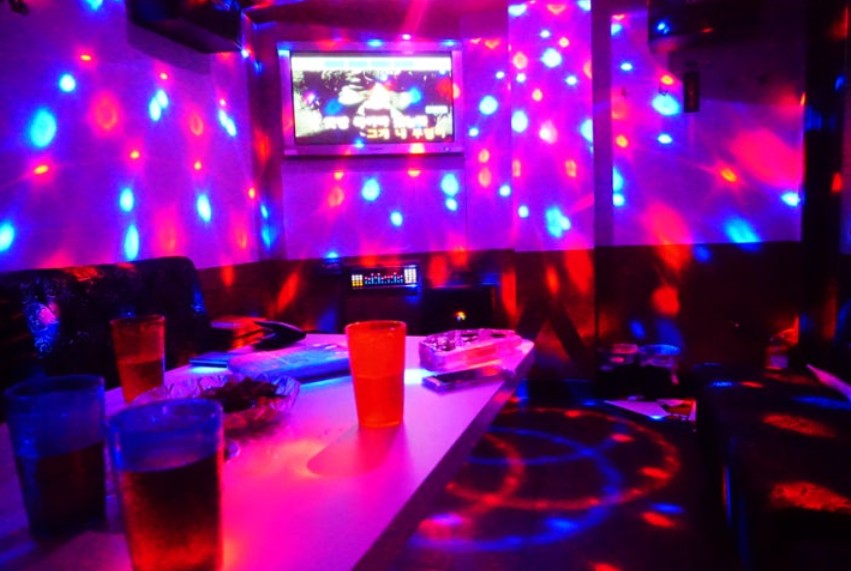
A noraebang (노래방) is a private karaoke room you rent by the hour — and that word private is the entire difference between this and karaoke as most Westerners know it. You are not singing in front of strangers at a bar. You and your friends get a closed room with a sofa, two microphones, a screen, and a tambourine. Nobody outside hears you. Nobody is judging. The name is literal: norae means song, bang means room.
That single structural difference changes everything about how it feels — and it’s why Koreans of every age do it constantly, and why bad singers love it most.
The thing nobody tells you: there are two kinds
This trips up almost every first-timer, because they look similar from the street but work completely differently.
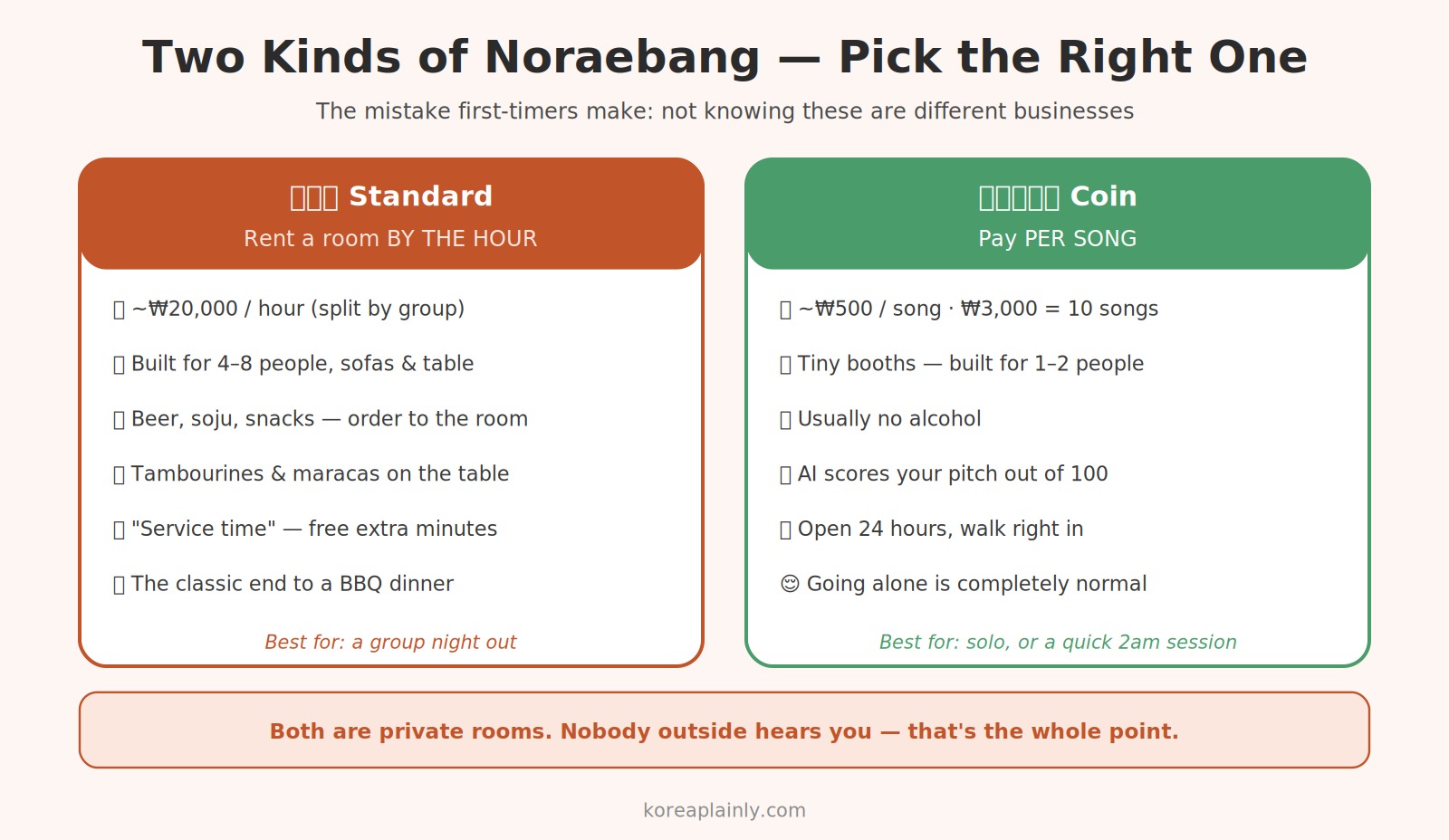
Standard noraebang (노래방) — you rent a room by the hour, roughly ₩20,000. It’s built for groups: sofas, a table, two or more mics, mood lighting, tambourines and maracas. You can order beer, soju, and snacks to the room. This is the classic end to a Korean BBQ dinner, and split among six people it’s cheap.
Coin noraebang (코인노래방) — you pay per song, about ₩500 each, or ₩3,000 for ten. The booths are tiny — often a single chair, a mic, and a screen. Usually no alcohol. Open 24 hours, walk-in, no booking.
Here’s the part that surprises foreigners most: going to a coin noraebang alone is completely normal. It even has a name — hon-noraebang (혼노래방), solo singing. There’s zero stigma. Many booths are literally designed for one person. Koreans go after work to decompress, the same way you might go for a run.
So: group night out → standard. Solo, or a spontaneous 2am session → coin.
The rules nobody writes down
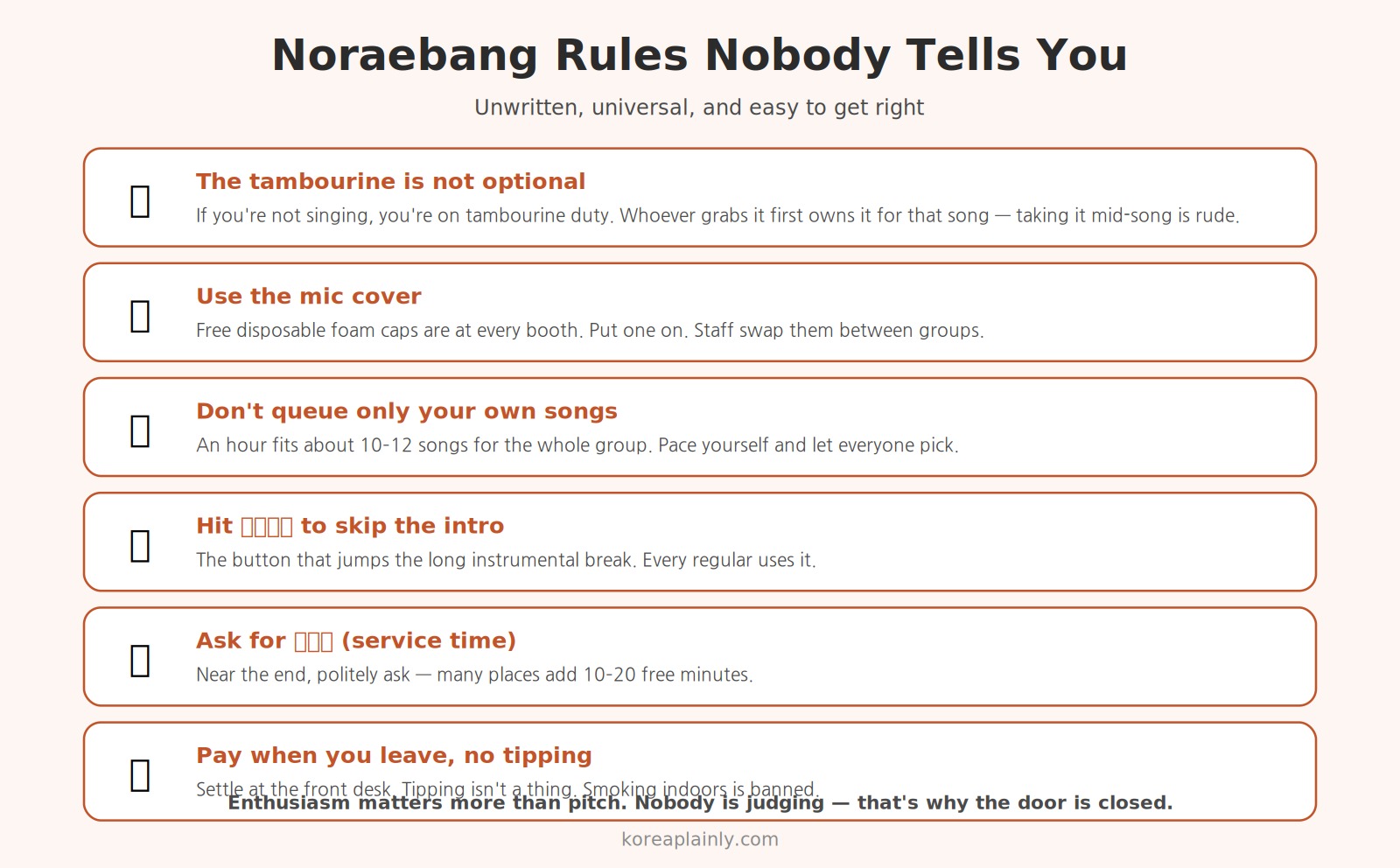
The tambourine is not optional. This is the one to internalize. If you’re not the one singing, you’re on tambourine duty — shaking on the beat, cheering, reacting. It’s unwritten but universal.
And this is genuinely useful if you’re a foreigner who doesn’t know a single Korean song: the tambourine is your passport. You don’t need to know the lyrics. Shake on the beat, react to every high note, cheer loudly, and you’ll be considered an excellent noraebang companion. Enthusiasm outranks talent here by a wide margin.
There’s a small hierarchy to it: whoever picks the tambourine up first owns it for that song. Taking it from someone mid-song is slightly rude. New song, fair game.
The rest:
- Use the mic cover. Free disposable foam caps are provided. Put one on.
- Don’t queue only your own songs. An hour fits maybe 10–12 songs across the whole group.
- Hit 간주점프 (ganju-jump). The button that skips the long instrumental intro. Every regular uses it.
- Ask for 서비스 (service). Near the end, politely ask for extra time — many places throw in 10–20 free minutes. This is such a standard ritual that your paid hour usually stretches well past sixty minutes.
- Pay when you leave. At the front desk. No tipping. No smoking indoors.
The AI score, and why you’ll care
Most machines (the TJ Media systems dominate) score your pitch and vibrato out of 100 in real time. On some machines a perfect 100 earns a free bonus song.
It sounds like a gimmick. It is. You will care about it far more than you expect to, and so will everyone else in the room.
What to actually sing
Song books are enormous, and the major chains carry English, Japanese, Chinese, Spanish, and Vietnamese sections — so you’re not stuck. Search by number from the tablet or the book.
If you’re with Koreans, know that the room is a generosity machine: someone will queue a song for you, and everyone will sing along with whoever’s holding the mic. Being off-key is not a problem. Sitting silently is the only real mistake.
Where to go your first time
Hongdae is the easiest entry point — the density is unmatched, there are coin booths on nearly every block, most are open all night, and the international crowd means staff are used to non-Korean speakers. Gangnam skews more upscale and pricier. Look for glowing signs up narrow staircases; a lot of noraebang are on upper floors, and you follow the music.
Filming yourself inside is standard practice — the disco lighting was basically designed for it.
Go in, close the door, pick something you can’t actually sing, and let the room do the rest. That closed door is the whole invention.