You’ve seen it in every K-drama: someone takes a shot of soju, and instead of drinking straight ahead, they twist their whole upper body away from the table and drink toward the wall, often covering the glass with one hand. The short answer: they’re drinking with someone older or more senior, and turning away is a gesture of respect. Drinking face-to-face with an elder — where they’d see you tip your head back, open your mouth, and swallow — reads as too bold, almost like turning your nose up at them. Turning your head creates a small screen of modesty.
That’s the answer. But the why behind the why is more interesting, and it explains almost everything else that looks strange at a Korean drinking table.
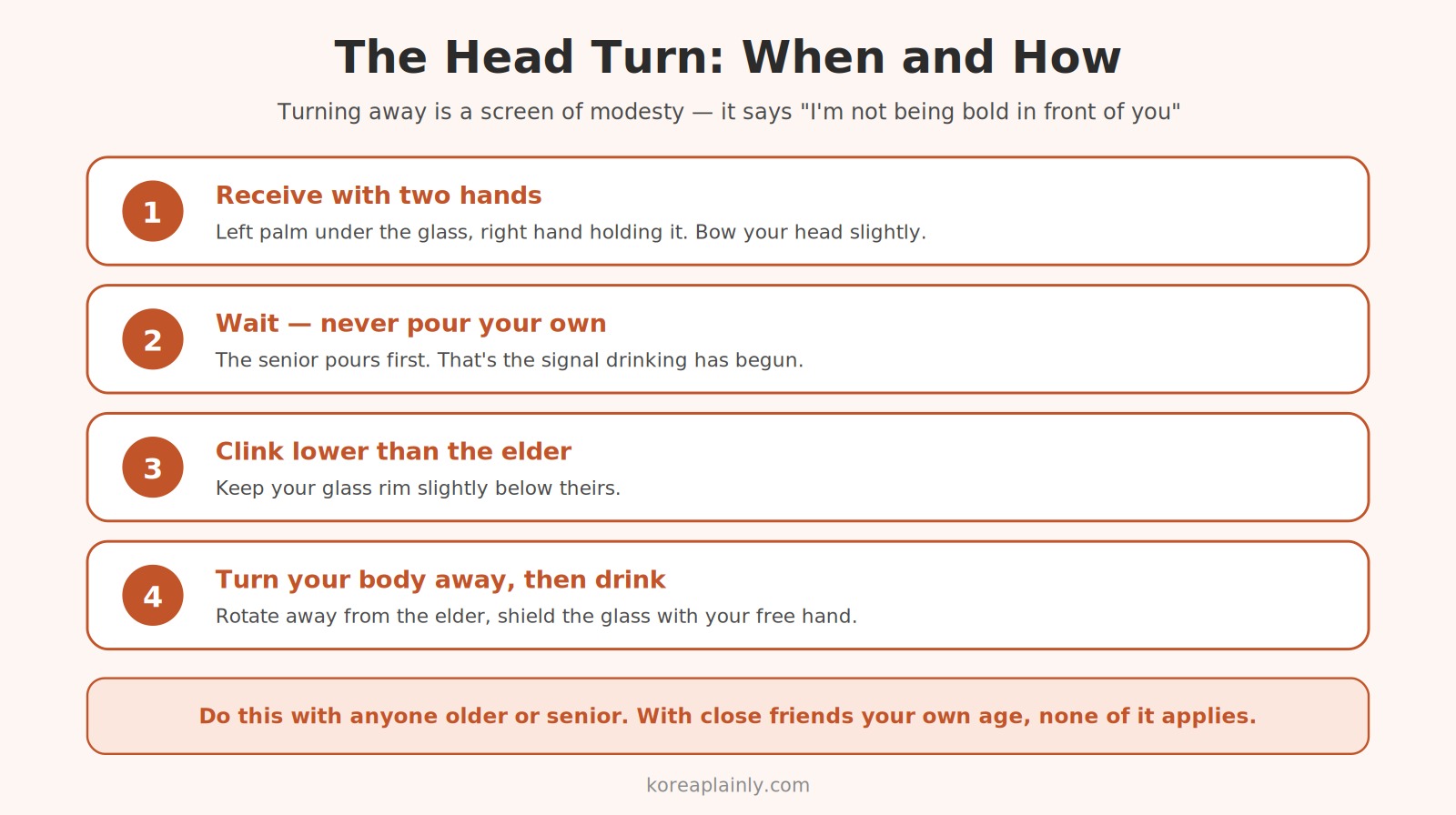
Where the rule comes from
Korean drinking etiquette isn’t random politeness — it’s Confucianism, still running in the background. Confucian teaching held that society stays peaceful when relationships are ordered by hierarchy, and that respect flows toward parents, elders, and superiors. Koreans built that principle into daily life, which is why you see it in bowing, in honorifics, and in how people drink.
The drinking rules specifically are believed to trace back to hyangeumjurye (향음주례), one of six important Confucian rituals — a formal gathering where scholars honored their elders, and where younger people learned how to drink properly in the presence of seniors. Korean even has a word for the whole system: judo (주도), literally “the way of alcohol.” Same “do” as in taekwondo. Drinking has a way.
So the head turn isn’t a quirk. It’s the visible tip of a 600-year-old social operating system.
The rules that go with it
The head turn never travels alone. If you’re at a table with elders or seniors, these come as a set:
- Never pour your own drink. This is the golden rule — jajak (자작, self-pouring) is frowned on, and some consider it bad luck. You pour for others; someone else pours for you. In K-dramas, when someone drunk starts pouring their own glass and another character snatches the bottle away, that’s not rudeness — that’s them being polite.
- The senior pours first. The most senior person starting the pour is effectively the signal that the drinking has begun.
- Receive with two hands. Left palm under the glass, right hand holding it, with a slight bow of the head. If you’re pouring, hold the bottle in your right hand and support your right wrist or elbow with your left.
- Keep your glass lower. When clinking, hold your glass slightly below the elder’s rim. Raising yours higher can feel presumptuous.
- Then turn and drink — usually shielding the glass with your free hand.
- Return the glass. Traditionally, when your glass is empty, you hand it back to whoever poured for you and fill it for them. That kicks off a chain of cup-and-bottle passes around the table.
Notice the pattern: every rule is about the other person. Nobody serves themselves. Your glass being full depends entirely on someone else paying attention to you.
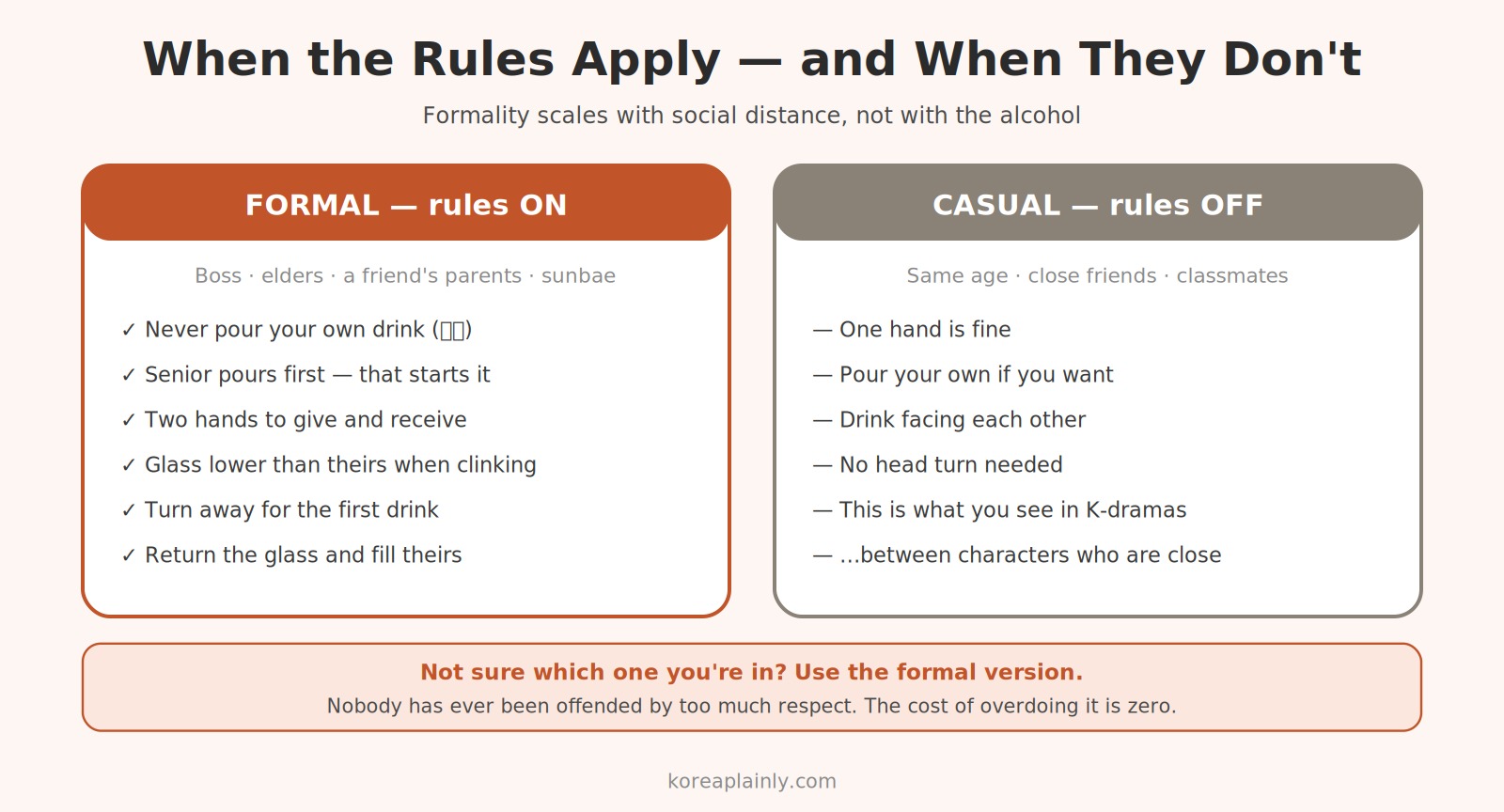
When the rules switch off
Here’s what most guides skip, and it’s the part that actually matters in real life: these rules relax almost completely among close friends and peers.
Watch closely and you’ll see K-drama characters accept a drink with one hand, pour their own, and drink facing each other — because they’re the same age or close friends. Nobody’s being rude. The formality scales with social distance: strict with your boss or a friend’s father, nearly zero with your university classmates.
The practical rule for a visitor: if you’re not sure whether you’re “close,” use the formal version. Two hands, turn away. Nobody has ever been offended by too much respect. The cost of overdoing it is zero; the cost of underdoing it with someone’s grandfather is not.
Why any of this exists
To an outsider this can look like a drill — turning heads, supporting wrists, watching whose glass is empty. Why make relaxing so complicated?
Because in Korea, drinking isn’t primarily about alcohol. It’s a machine for building relationships. The reason you don’t pour your own drink is that the pour is the point: it’s an act of attention, a small way of saying “I’m looking out for you.” A table where everyone keeps an eye on everyone else’s glass is a table where nobody is alone.
This is also why hoesik (회식) — the company dinner — is such a fixture of Korean work life, and why ordering alcohol without anju (안주, food to go with it) seems stingy: you’re not there to drink, you’re there to stay, eat, and talk.
What you actually need to remember
If you take one thing to a Korean table: two hands, and turn away for the first drink with anyone older. That’s 90% of it. Koreans are genuinely delighted when a foreigner does this — not because they expected it, but precisely because they didn’t.
And if you get it wrong, you’ll be forgiven instantly. The gesture matters more than the execution.