Korean table manners aren’t hard, but they’re specific — and a few of them are the exact opposite of what you’d do in Japan or China, which is where most foreigners get caught. The single most useful rule: watch the oldest person at the table and follow their lead. That one habit covers most of what follows.
Here are the eight that actually trip people up, why each exists, and how much it really matters.
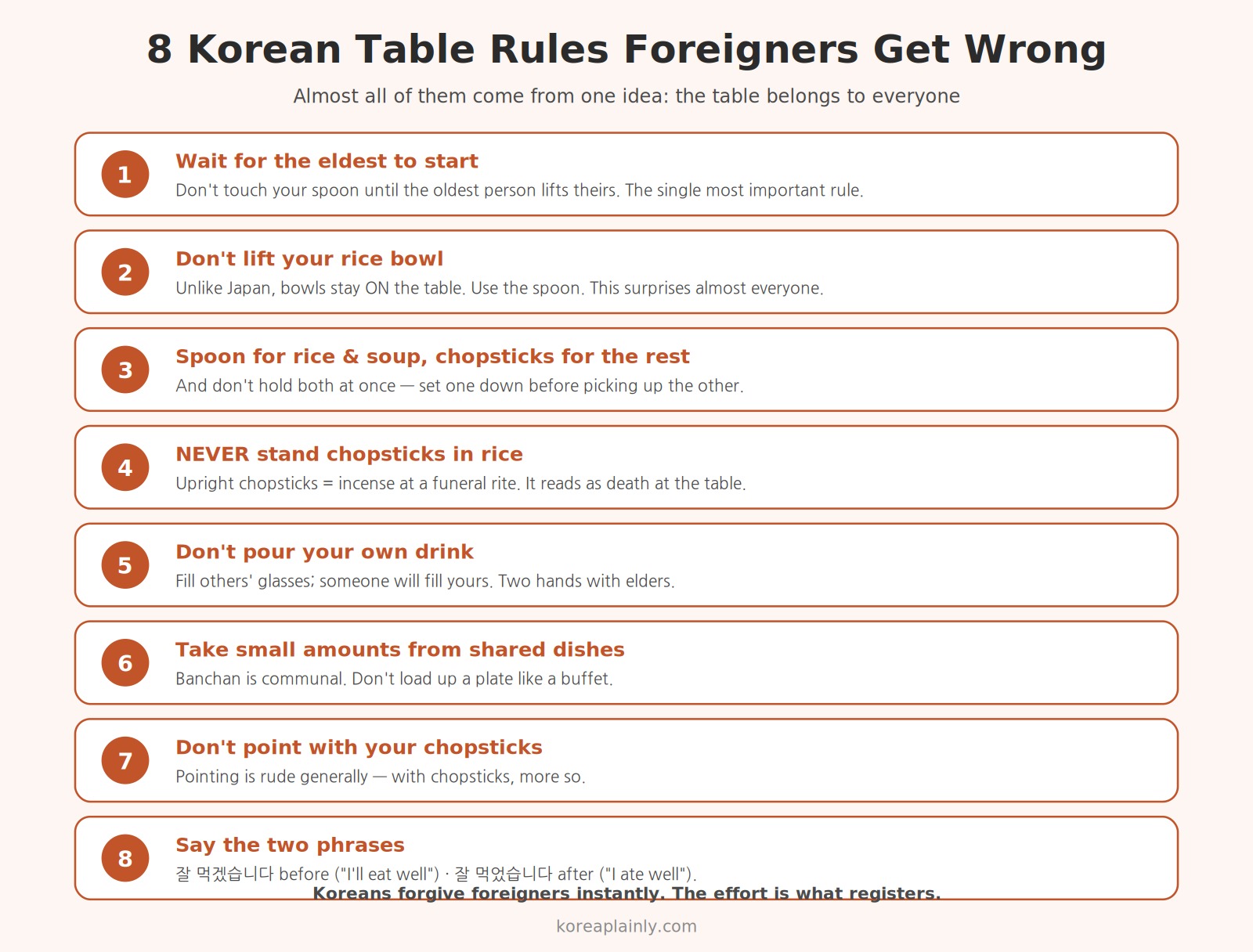
1. Wait for the eldest to start
Don’t pick up your spoon until the oldest person at the table has picked up theirs. This is the most emphasized rule in Korean dining, and it’s pure Confucian hierarchy — age gets deference, and the elder starting the meal is the signal everyone else can begin. If they say “go ahead, eat,” that counts as the signal.
The same logic applies loosely at the end: try not to finish and bolt long before the eldest does.
2. Don’t lift your rice bowl
This is where Japan and China veterans go wrong. In Japan, raising the bowl to your mouth is normal. In Korea, bowls stay on the table — you lean toward the food, not the other way around. Use the spoon to scoop rice.
The reason is structural: the Korean table setting was designed with rice and soup bowls placed directly on the table, so lifting them was never necessary, and it came to read as rushed or ill-mannered. Among close friends, tipping a soup bowl at the very end to drink the last of the broth is more forgivable — read the room.
3. Spoon for rice and soup, chopsticks for everything else
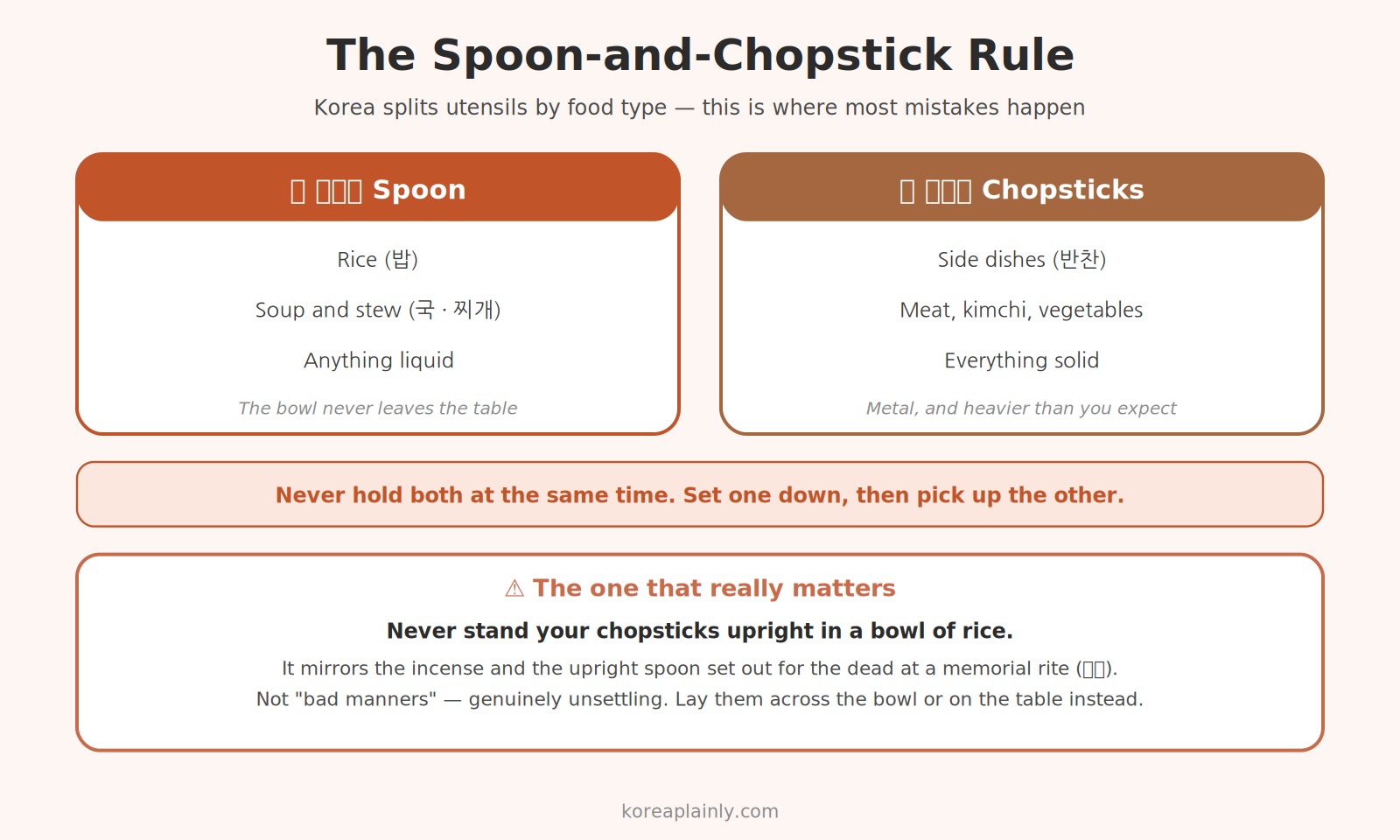
Korea splits its utensils by food type, and this genuinely differs from its neighbors. Rice and soup are spoon territory. Banchan, meat, kimchi — chopsticks. Eating rice with chopsticks looks off here, even though it’s standard elsewhere.
The sub-rule people miss: don’t hold both at once. Set the spoon down before you pick up the chopsticks. Holding one in each hand looks greedy and unrefined.
4. Never stand chopsticks upright in rice
This is the one that isn’t just “bad manners” — it’s genuinely unsettling. Chopsticks standing vertically in a rice bowl mirror the incense and upright spoon set out for the dead at a memorial rite (jesa). Doing it at dinner drops a funeral image onto the table.
Lay them across the rim of your bowl or on the table instead. And don’t use them as skewers to stab food, or tap them against bowls — that reads as childish.
5. Don’t pour your own drink
If there’s alcohol, this rule activates: you fill other people’s glasses, and someone else fills yours. Pouring your own (jajak) is frowned on. Receive with two hands from anyone older, and turn your head away for the first drink.
Among close friends of the same age, this relaxes almost completely — which is why K-drama characters casually pour their own with friends and it isn’t rude.
6. Take small amounts from shared dishes
The banchan in the middle of the table are communal and get refilled free. Take a couple of bites’ worth, alternate between rice, banchan, and soup, and come back for more. Don’t load a plate like a buffet or hoard the one dish you like — and don’t dig around in a shared dish hunting for the good bits.
7. Don’t point with your chopsticks
Pointing at people is rude in Korea generally, and pointing with utensils compounds it. Gesture with your hand or just say the thing. Related: keep your elbows off the table, and don’t reach across it — if a dish is far, ask for it to be passed.
8. Say the two phrases
Before eating: 잘 먹겠습니다 (jal meokgesseumnida), “I will eat well.” After: 잘 먹었습니다 (jal meogeosseumnida), “I ate well.” They’re directed at whoever cooked or is paying. They cost nothing and land every time — especially from a foreigner nobody expected to know them.
How much does any of this matter?
Honestly: less than you fear, and more than you’d think.
Less, because Koreans are genuinely forgiving with foreigners. Nobody expects you to know this, and an honest mistake gets waved off instantly. You will not ruin a dinner by using the wrong utensil.
More, because the rules aren’t arbitrary etiquette — they encode what a Korean meal is. Notice the pattern running through all eight: you wait for others, you serve others, you share from a common center, you don’t fill your own glass. The whole system points away from yourself. That’s the underlying value — a meal is something a group does together, not something individuals do in parallel.
Which is why the effort registers. Waiting for the eldest to lift their spoon isn’t a rule you followed. It’s a sentence you spoke without words.