Ask two Koreans about tteokbokki and you may find they are describing different foods. One is remembering a paper cup of rice cakes bought with a 500-won coin outside a school gate. The other is talking about a wide pan with four kinds of topping, ordered for the table, costing more than a plate of pasta.
Both are tteokbokki. The gap between them is about thirty years, and it explains most of what a visitor needs to know about the dish.
Tteokbokki (떡볶이) is cylindrical rice cakes cooked in a sweet-spicy gochujang sauce. Tteok is rice cake, bokki is stir-frying — though almost nobody stir-fries it now.
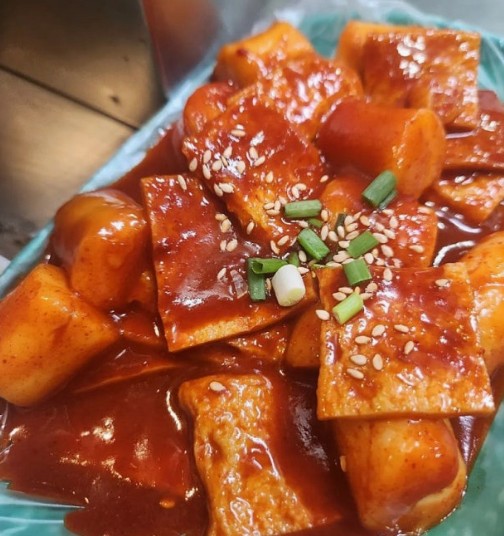
The old version
Through the 1980s and 90s, tteokbokki lived on a single large iron pan, usually at a street stall or a bunsik shop near a school. Rice cakes, fish cake sheets, spring onion, a red sauce heavy with gochujang and corn syrup, kept over low heat and stirred occasionally all day long.
Because it sat there for hours, the sauce thickened and clung. The rice cakes went soft and absorbed it. Nothing was made to order, and that was the point — you handed over a coin, got a paper cup with a few pieces and a toothpick, and ate it standing up on the way home.
That is the tteokbokki that raised a generation, and it is why Koreans in their thirties and forties talk about it in the same tone people elsewhere reserve for childhood sweets.
The stalls still exist. If you find one, this is the version to try — the slow-cooked sauce is a different thing from the made-to-order kind, and it is not something a franchise can reproduce.
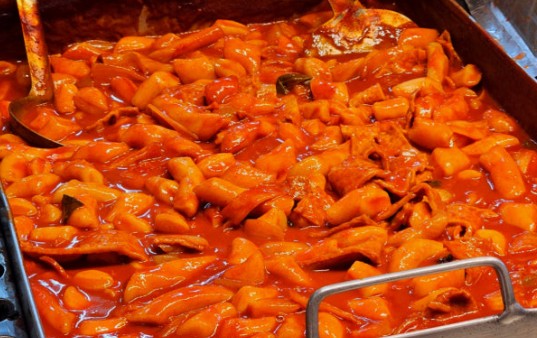
What replaced it
Modern tteokbokki is cooked when you order it, and everything follows from that.
It arrives in a pan for the table. Three or four portions at once, often cooked on a burner in front of you, which makes it a shared meal instead of something one person eats standing up.
The price moved accordingly. From a coin to five figures. It is a main course now, not a snack, and it is ordered for dinner rather than eaten between things.
The toppings became the point. The old pan had rice cakes, fish cake and egg. A franchise menu now offers Chinese-style glass noodles, bunmoja (chewy tapioca balls), sausages, dumplings, ramyun noodles, and cheese — sometimes as a melted layer over the whole pan.
Heat became a setting. Most chains let you pick a level, typically one to five. This did not exist before; the pan had whatever heat it had.
And the sauce diversified. Which is where most visitors will actually start.
How spicy is it, really
The honest answer: it depends entirely on what you order, and the mild versions are genuinely mild.
Standard gochujang tteokbokki reads as sweet first, then hot. Gochujang is a fermented paste that is savoury and sweet before it is spicy, and the corn syrup in the sauce pushes further in that direction. Most people find the standard version manageable.
But there are two now-mainstream alternatives that remove the problem entirely:
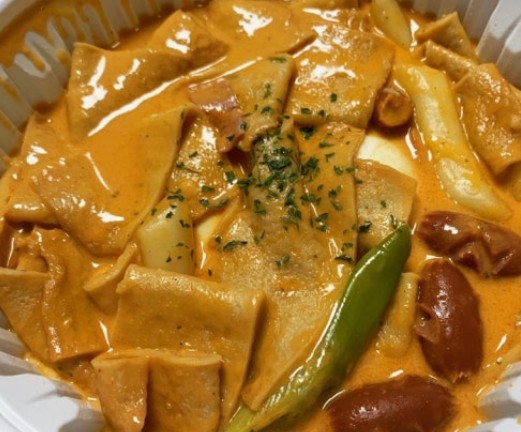
Rosé tteokbokki is made with cream and milk alongside the gochujang, producing a pink sauce. The dairy blunts the capsaicin directly, so it is meaningfully milder rather than just tasting milder. It went from novelty to standard menu item in a few years and is now what a large share of Koreans order.
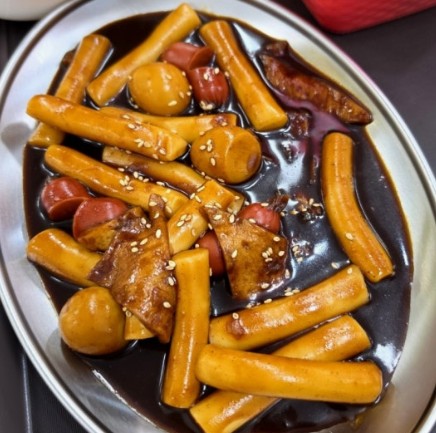
Jjajang tteokbokki uses black bean sauce instead of gochujang. Savoury, slightly sweet, no heat at all. This is the version to order for someone who cannot handle chilli.
If you are ordering at a franchise, ask for level one. If you are at a street stall, the phrase is “an maepge haejuseyo” (안 맵게 해주세요) — though a stall with one pan may not be able to do much about it.
Where it came from, and one correction
You will read in English that tteokbokki descends from a royal court dish. That is not quite right, and the accurate version is more interesting.
Court tteokbokki existed — gungjung tteokbokki, rice cakes stir-fried with beef and vegetables in soy sauce. No chilli, because gochujang was not used in that context. It was banquet food, and it still exists today as a distinct dish.
But the red one is not descended from it. Korean food historians are fairly direct about this: the two share a technique and a name, not a lineage. The gochujang version did not evolve out of the court recipe.
The red version emerged in the 1950s, in Sindang-dong in Seoul. The widely told origin story credits Ma Bok-rim, who is said to have dropped a piece of rice cake into black bean sauce at a Chinese restaurant in 1953 and worked from there — her early version reportedly mixed gochujang with chunjang, the black bean paste. Her shop and the alley around it became the centre of Seoul tteokbokki, and a radio programme in the 1970s carried it nationwide.
Ma Bok-rim is also credited with two things that shaped every bunsik shop in the country: adding ramyun noodles to the pan, and the jeukseok — cook-it-yourself-at-the-table — format that modern franchises still use.
So the dish most Koreans think of as ancient is roughly seventy years old, and the thing that made it feel traditional happened within living memory.
What to eat with it
Tteokbokki is rarely eaten alone, and the accompaniments are half the experience.
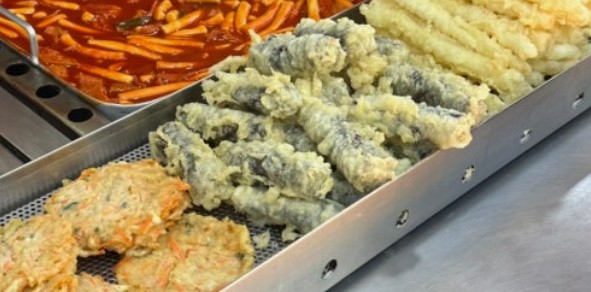
Twigim — battered and fried vegetables, squid, sweet potato, or dumplings — is the standard partner. And there is a specific way to eat it: dunk the fried pieces in the tteokbokki sauce. Not on the side. The sauce is thick enough to coat, and the contrast of crisp batter against sweet-hot sauce is the reason twigim exists on the same menu.
Many stalls will chop a piece of twigim into the pan for you if you ask.
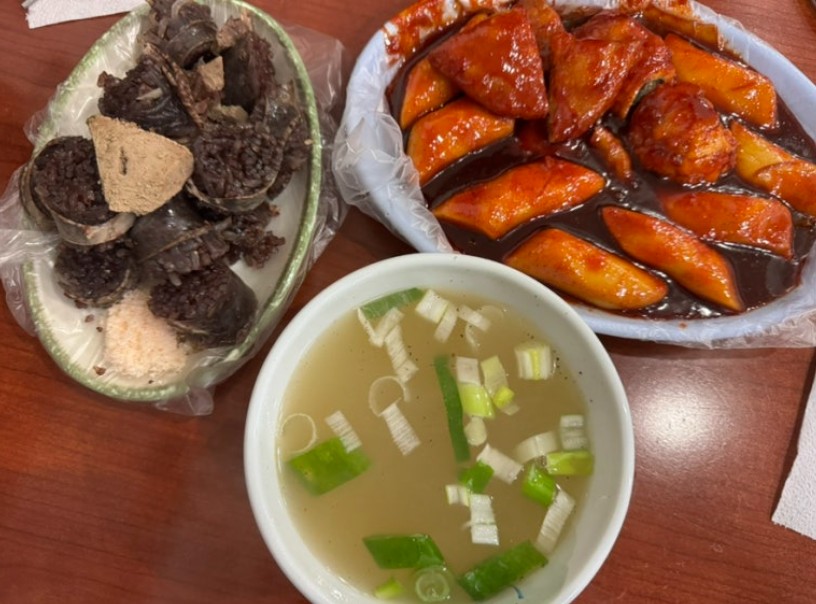
Sundae — Korean blood sausage, usually steamed and served with a salt-and-pepper dip — is the other classic. It is milder and more savoury than it looks, and its density balances the sauce.
Kimbap works for the same reason a plain rice dish always does next to something intense. Gimbap is not sushi, and knowing the difference helps when ordering.
Eomuk broth — the clear fish cake soup, usually free at street stalls, ladled into a paper cup. Drink it between mouthfuls. It is savoury and clean and resets your mouth.
Fried rice at the end. At restaurants with a tabletop burner, ordering bokkeumbap to be fried in the leftover sauce is standard, and it is the best part of the meal. The sauce that has thickened at the bottom of the pan is exactly what fried rice wants.
Ordering it
Street stall or franchise are different experiences, and worth doing both. The stall gives you the slow-cooked sauce and a paper cup; the franchise gives you a shared pan and topping choices.
Portions are large at franchises. A single order is usually built for two to three people.
Rice cake or wheat cake. Ssaltteok (rice) is chewier and more common; miltteok (wheat) is softer and holds sauce differently. Older stalls often use wheat, and some people prefer it specifically for nostalgia.
It goes cold fast. Tteokbokki hardens as it cools and does not travel or reheat well. Eat it where you get it.
If chilli is a problem, order jjajang or rosé. Not a compromise — both are standard menu items that Koreans order by choice. And if you want to know how spicy Korean food actually is more generally, most of it isn’t.
Frequently asked questions
How spicy is tteokbokki? The standard version is sweet first and moderately hot. Rosé and jjajang versions have little or no heat.
What is rosé tteokbokki? A cream-and-milk version of the sauce, pink in colour, meaningfully milder because dairy blunts the chilli.
Is tteokbokki a snack or a meal? Both, depending on where you buy it. Street stall portions are a snack; franchise pans are a full meal for several people.
What do I order with it? Twigim for dunking, sundae, and fried rice made in the leftover sauce at the end.
Did tteokbokki come from the royal court? Court tteokbokki existed as a soy-sauce dish, but the modern red version is not descended from it. It emerged in Seoul in the 1950s.
Rice cake or wheat cake? Rice is chewier and more common. Wheat is softer and associated with older-style stalls.