Most of what visitors get wrong about Korea isn’t wrong because someone lied to them. It’s wrong because the things Koreans never bother to say out loud are exactly the things a visitor most needs to hear. Nobody explains that the side dishes are free, in the same way nobody in Italy explains that bread comes with the meal.
So here are the assumptions I most often see people arrive with, and what the reality is.
“Korean BBQ” is not a special occasion
Abroad, Korean BBQ is an event. You book it. You take people there when they’re visiting. It costs a lot.
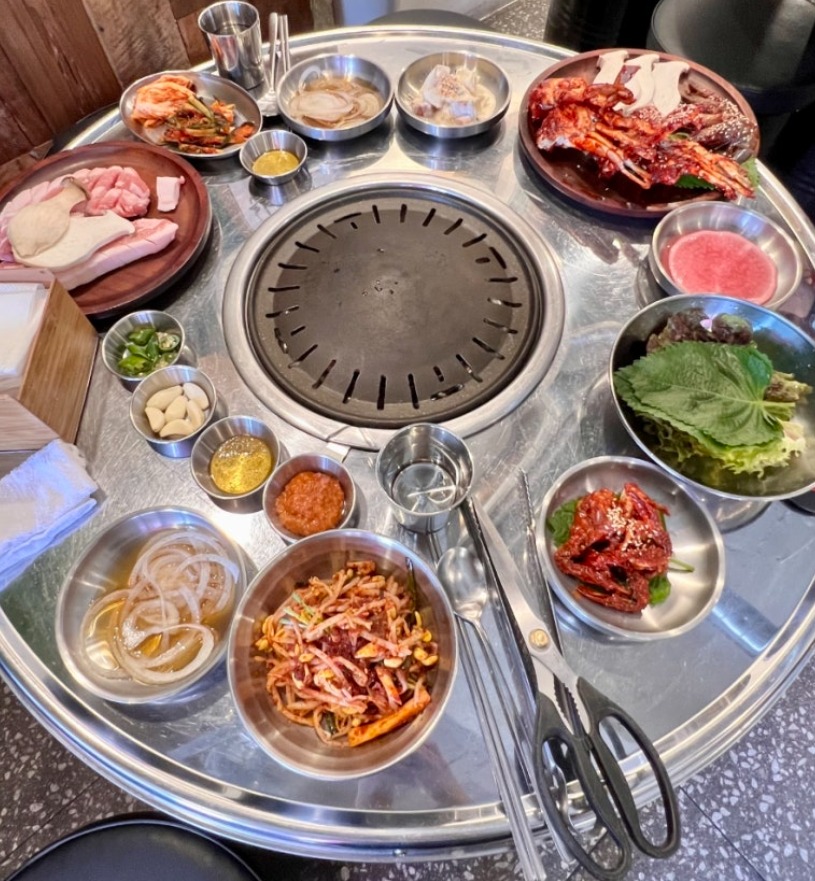
In Korea it is a Tuesday. A gogijip (고깃집, “meat house”) is where a family goes when nobody wants to cook, where a team goes after work because it’s easy to feed eight people, where students go because pork belly is one of the cheaper ways to eat properly. There is nothing ceremonial about it. The plastic aprons and the extractor hood over the table exist because this is ordinary food that happens to spit fat.
Two practical consequences:
You don’t order “Korean BBQ.” You order a cut. Samgyeopsal (pork belly), moksal (pork shoulder), galbi (marinated ribs), chadolbaegi (thin-sliced brisket). The menu is a list of cuts and prices per portion, and portions are usually priced for a minimum of two. A table of one can be awkward at older places, though this is changing.
The meal has a second half. After the meat, most people order something starchy to close — cold noodles, a small stew, or fried rice made in the same pan. Leaving after the meat is fine, but you’ve stopped halfway through what Koreans consider the shape of the meal. If you want the full mechanics of ordering, grilling and wrapping, Korean BBQ for beginners covers it properly.
The side dishes are free, and they are not a starter
Look at the photograph above. Everything surrounding the grill — the kimchi, the pickled onion, the seasoned bean sprouts, the salad, the sauces — arrived without being ordered and costs nothing.
These are banchan (반찬), and the two most common errors are treating them as a first course to be finished before the main food arrives, and being too polite to ask for more.
They are neither. Banchan are there to be eaten alongside the meat, all the way through, in small amounts. And they are refillable. Ask, and they get refilled, usually without comment. At many places there’s a self-serve station where you refill them yourself.
The thing worth understanding is why. A Korean meal isn’t structured as one dish you eat from start to finish. It’s a central item plus a rotating set of counterpoints — salty, sour, fermented, fresh — that you move between bite by bite. The banchan aren’t decoration around the meal. They are half of the design.
Fried chicken is dinner, not a snack
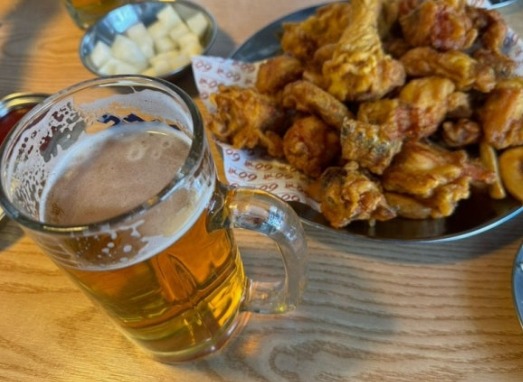
Chimaek — chicken plus beer — gets described in English as a snack, a bar food, something you have while drinking. In Korea a whole fried chicken is dinner for two or three people, and it is one of the most ordinary things a household orders on a Friday.
Notice the small white cubes in the corner of that photo. That’s chikin-mu (치킨무), pickled radish, and it is not a garnish. It comes with every order and exists as a palate reset between pieces of fried chicken — sharp, cold, and sweet against the fat. Skipping it changes the experience more than you’d think.
The other thing visitors underestimate is how many kinds there are. “Korean fried chicken” abroad usually means one sweet-spicy glazed version. In Korea the default order is often plain fried, and the menu will offer soy-garlic, sweet-and-spicy, snow-cheese, and half-and-half so you don’t have to choose. Ordering banban (반반), half of each, is completely standard.
Cafes are not for coffee
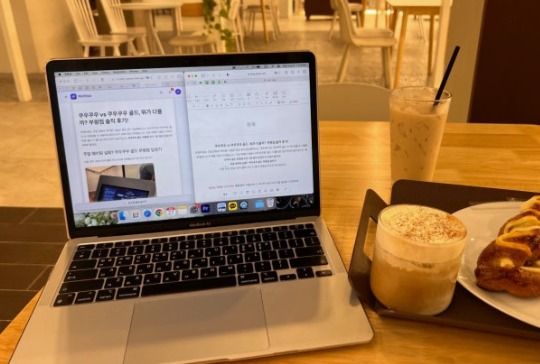
This is the one that confuses people most, because the surface reading is obvious — Korea has an enormous number of cafes, therefore Koreans must love coffee.
Koreans do drink a lot of coffee. But that is not why the cafes are there.
Cafes in Korea function as rented space. Housing is small, most people live with family or in compact apartments, and there is nowhere at home to meet a friend, spread out study materials, work for four hours, or have a conversation nobody else hears. A ₩5,000 drink buys you a table for as long as you want it, and nobody will come and ask if you’d like anything else. Students study in them. Freelancers work in them. Couples go there because the alternative is a family living room.
Once you see it that way, the rest follows. Cafes are large, well-lit, and full of solo tables with power outlets. There are chains built specifically around study seating. Prices are higher than the coffee alone justifies, because you are paying rent. And the coffee itself is often secondary — the drink in that photo is as much a seat licence as a beverage.
Practically, this means you should feel no pressure to leave. Sitting for two hours with one drink is completely normal and nobody is counting.
Most Korean food is not spicy
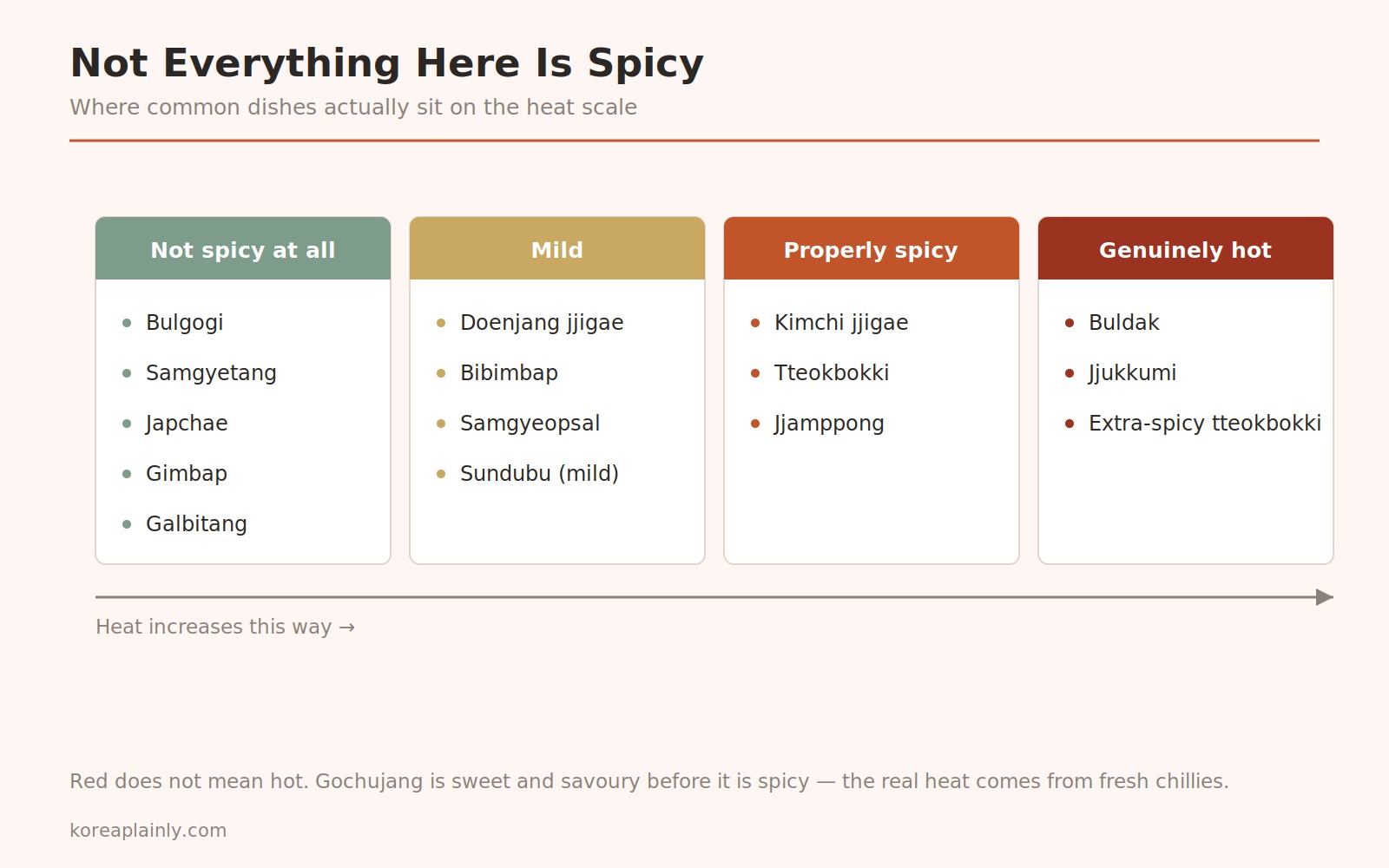
The reputation is out of proportion. A large share of everyday Korean cooking has no chilli in it at all — bulgogi, japchae, gimbap, the whole family of clear beef soups, steamed egg, grilled fish, samgyetang.
Two things get mixed up here.
Red does not mean hot. Gochujang, the fermented chilli paste, is sweet and savoury before it is spicy, and dishes built on it — most bibimbap, plenty of stews — read as mildly warm rather than burning. The heat that actually hurts comes from fresh green chillies (cheongyang gochu) and from chilli powder used in quantity.
“Spicy” in Korea is a wider scale than most visitors’ scale. When a Korean says something is not spicy, they mean it against a range that has buldak at the top. If you’re sensitive, the useful phrase isn’t “is it spicy?” but “an maepge haejuseyo” (안 맵게 해주세요) — please make it not spicy — which many places can do, especially with tteokbokki and jjigae.
A night out moves; it doesn’t stay put
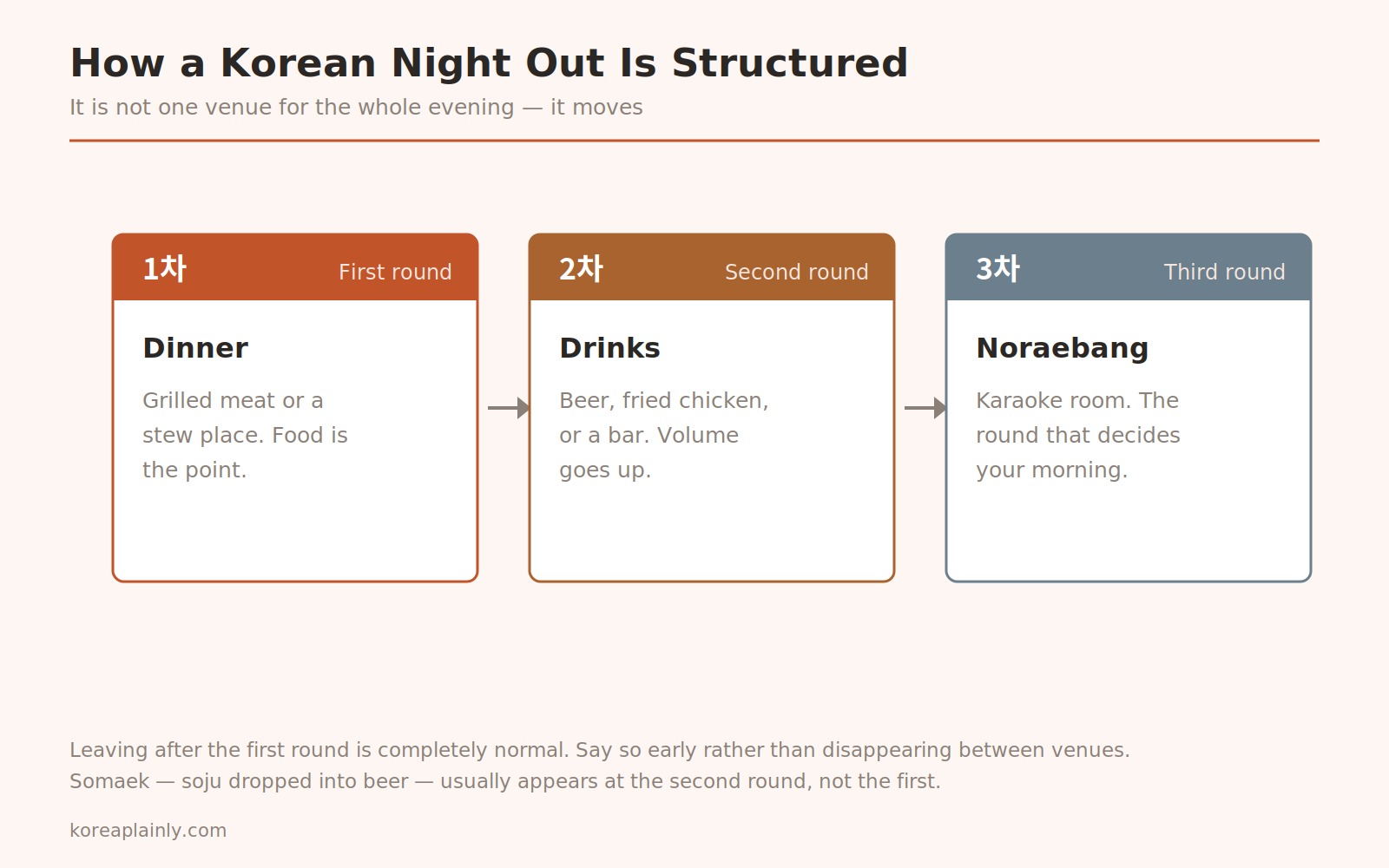
Visitors often expect one venue for the evening. Korean nights out are structured in cha (차) — rounds — and each round is a different place with a different function.
First round is food. Second round is drinking proper, often chicken and beer or a bar. Third round is frequently noraebang, a private karaoke room. There is a fourth round, and people who have reached it do not usually remember planning to.
Two things this explains:
Leaving early is fine, but announce it. Saying “I’ll go after the first round” at the start is completely normal. Vanishing between venues is what reads as rude.
Somaek arrives in round two. Soju dropped into beer isn’t a novelty for tourists — it is the standard drink of the middle of the evening, mixed at the table, and it is paced with food rather than taken as shots. Which connects to the etiquette layer: why Koreans turn their heads when drinking and the table manners around pouring are worth reading before you’re in it.
A few smaller ones
Convenience stores are not a last resort. A GS25 or CU meal is a legitimate choice that adults make on purpose, not a fallback when everything is shut. The convenience store guide has the details, but the short version is that the food is designed to be eaten, not endured.
Street food is no longer the cheap option. It used to be. Tteokbokki and hotteok have risen sharply, and a sit-down meal at a gimbap or kalguksu place is often cheaper than assembling dinner from a market stall. Eat street food because you want it, not to save money.
Korean age has legally changed. Korea moved to international age counting in 2023, so official documents and most formal contexts now use the age you’d expect. The traditional system survives in conversation, which is why you may still be asked what year you were born rather than how old you are. How Korean age works explains what’s still in use.
Don’t over-bow. A small nod is right in almost every situation a visitor will encounter. Deep bows from a foreigner read as theatrical, not respectful. Nobody expects you to perform the etiquette; they notice that you’re being unobtrusive, which is the actual point.
The pattern underneath
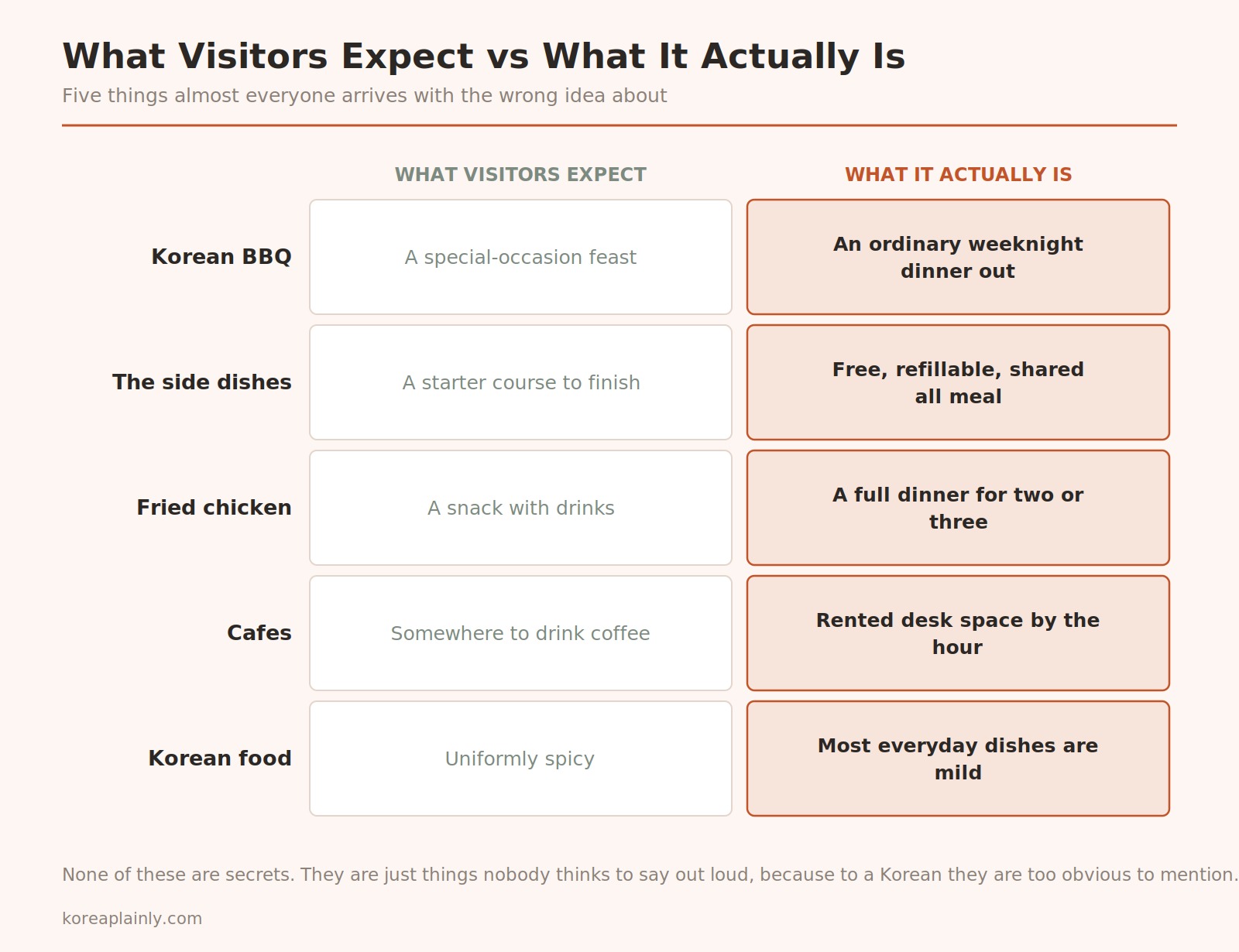
Almost everything on this list is the same error in different clothes: assuming that things which are notable abroad are also notable here.
Korean BBQ is exotic in London, so it must be an occasion in Seoul. Cafes are for coffee everywhere, so they must be for coffee here. Korean food is famous for being spicy, so all of it must be spicy.
The version of Korea most visitors have met is the version that travelled — the parts distinctive enough to be exported. That’s a real Korea, but it’s the highlight reel, and the highlight reel is not what a Tuesday looks like. The useful adjustment is smaller than it sounds: assume most of what’s in front of you is ordinary, and ask what it’s ordinarily for.
Frequently asked questions
Are the side dishes really free? Yes, at almost every Korean restaurant, and they’re refillable. A handful of places charge for premium ones, which will be marked on the menu.
Do I need to tip in Korea? No. Tipping isn’t practised and can cause confusion. The price on the menu is the price.
Can I eat Korean BBQ alone? Increasingly yes, though many places price meat by two portions. Solo-friendly grill restaurants have become common in Seoul.
Is it rude to sit in a cafe for hours? No. It’s the normal use of the space. One drink, several hours, no pressure.
What if I can’t handle spice at all? You’ll be fine. Order from the non-spicy half of the menu, which is larger than the reputation suggests, and learn an maepge haejuseyo.