If you’re planning a trip to Korea in 2026, you’ve probably run into two confusing terms — K-ETA and the e-Arrival Card — and a lot of conflicting advice about whether you need one, the other, or both. The short version is simpler than most sites make it sound, and getting it wrong mostly costs you a few minutes, not your trip. Here’s exactly who needs what this year, how to do it, and how to avoid the sites that try to charge you for something that’s free.
Short answer: Most tourists in 2026 do not need a K-ETA — the exemption for visa-free countries has been extended through December 31, 2026. What you almost certainly do need is the e-Arrival Card: a free online entry form you submit within 72 hours before you land. If you happen to hold a valid K-ETA, you’re exempt from the e-Arrival Card. Only use the official .go.kr sites — anything charging a big fee is a scam.
K-ETA vs e-Arrival Card — what’s the difference?
They sound similar but do different jobs:
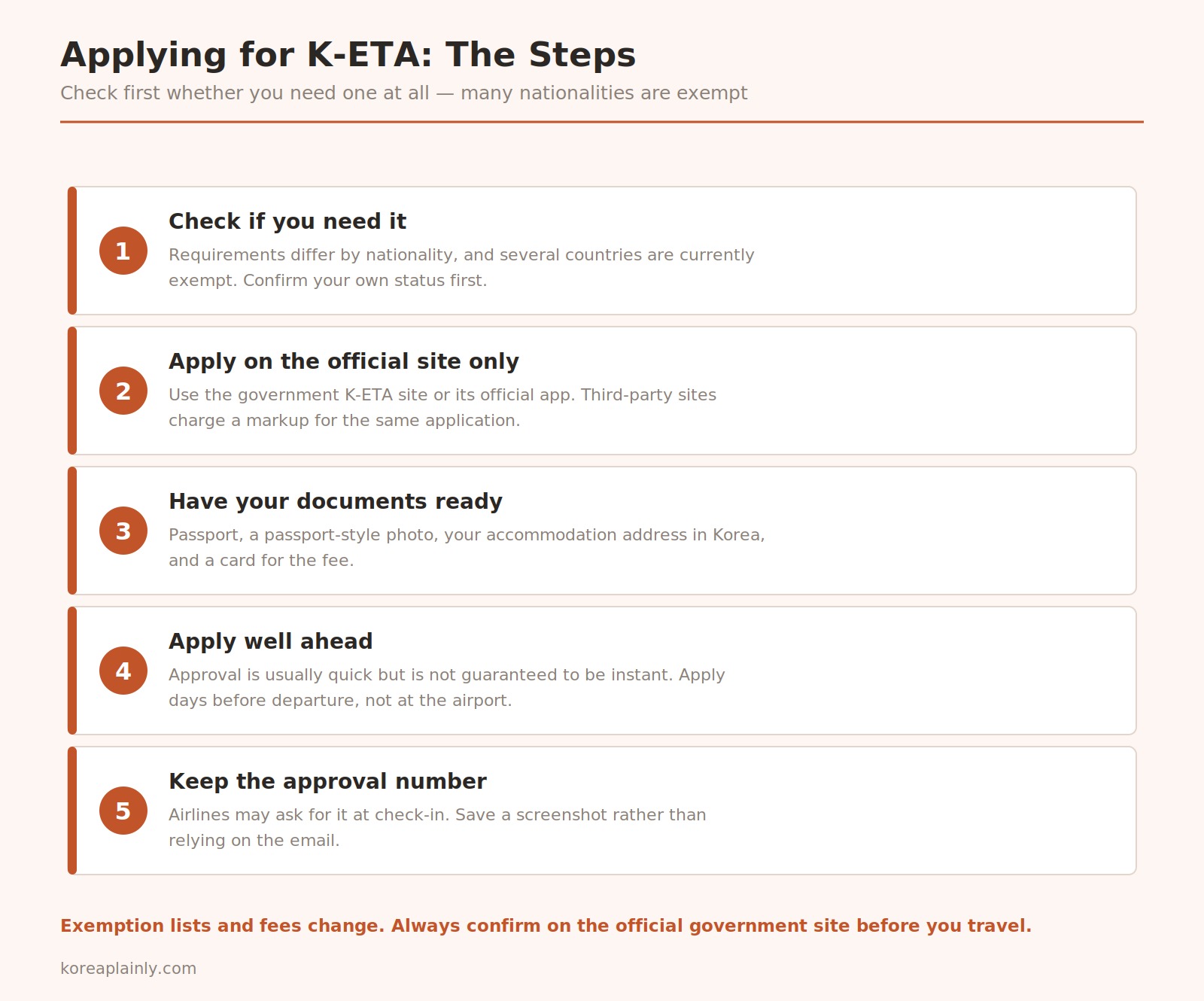
- K-ETA (Korea Electronic Travel Authorization) is a travel authorization for visa-free visitors — like the US ESTA. It costs about 10,000 won, lasts 3 years, and is applied for at k-eta.go.kr.
- e-Arrival Card is an entry declaration — the digital replacement for the paper form flight attendants used to hand out. It’s free, takes about five minutes, and is submitted at e-arrivalcard.go.kr.
The key link between them: if you hold a valid K-ETA, you don’t need the e-Arrival Card. And if you’re K-ETA-exempt (most tourists in 2026), you simply do the e-Arrival Card instead.
Do you need a K-ETA in 2026?
For most visitors this year: no. Korea has extended its temporary K-ETA exemption for citizens of around 67 visa-free countries — including the US, UK, Canada, Australia, New Zealand, Japan, Singapore, and most of the EU — through December 31, 2026. If you’re from one of those countries and visiting short-term, you can enter without applying for or paying for a K-ETA.
Two things worth knowing:
- Frequent visitors can still choose to get a K-ETA voluntarily. Since it’s valid for 3 years and exempts you from the e-Arrival Card, it can be convenient if you come to Korea often.
- The exemption is temporary. It’s currently set to end on December 31, 2026, and K-ETA is expected to become mandatory again from 2027 — so this is a 2026-specific answer. Always confirm your own nationality’s status on the official site before you fly.
The e-Arrival Card: what most 2026 tourists actually need
Since paper arrival cards were fully phased out, the e-Arrival Card is digital-only as of January 1, 2026 — there’s no paper form to fill out on the plane anymore. Nearly all foreign visitors entering for a short stay must submit it, with a few exceptions below.
Who is exempt from the e-Arrival Card:
- Registered foreign residents (permanent residents and those with domestic residence registration)
- Holders of a valid K-ETA
- Airline crew
What you need before you start:
- A valid passport (good for at least 6 months beyond your arrival)
- A working email address (for your confirmation)
- Your flight number and arrival date
- Your exact accommodation address in Korea — not just “a hotel in Seoul.” A hotel or Airbnb front-desk number is fine for the contact field; you don’t need a Korean phone number.
How to fill out the e-Arrival Card, step by step
- Go to the official site — e-arrivalcard.go.kr — on a PC or phone, and agree to the terms.
- Add your passport. You can photograph the passport’s photo page and upload it; the site reads it automatically (OCR) and fills in your details. Make sure the dotted line at the bottom of the page is included in the photo. If the upload won’t work, you can just type the details in.
- Enter your travel information — arrival date and flight, your planned departure, your purpose of visit, and your accommodation address and contact.
- Submit. That’s it — there’s no approval step and no fee. You can download the confirmation as a PDF or screenshot it.
- At the airport, you don’t need to print or even show the file — immigration officers pull up your submission when they scan your passport. A screenshot is still handy as a backup.
The rules that trip people up
- The 72-hour window. You can submit starting 3 days (72 hours) before arrival, based on Korea Standard Time. If you don’t actually enter Korea within 72 hours of submitting, the card expires and you have to submit a new one. Submitting the day before or the day of your flight is the sweet spot.
- You can edit it — log back in with your issue number or email and change details up until immigration. One catch: the arrival date can only be changed within 3 days of your original submission.
- Each traveler needs their own. One person can add up to 9 travelers in a single group submission (10+ uses the group function on the PC site), but every passport gets its own card. For children under 14, a parent or guardian submits on their behalf.
- Accuracy matters. False or inaccurate information can lead to penalties or entry problems, so fill it out truthfully — and if your plans change after submitting, update it before immigration.
Watch out for scam sites
This is the part that catches honest travelers. The e-Arrival Card is completely free, and a K-ETA (when you need one) is about 10,000 won — roughly $7. But search results are full of third-party sites that charge $50–100 to “process” these for you. They’re not official, and they’re not necessary.
The rule is simple: only trust addresses ending in .go.kr — e-arrivalcard.go.kr for the arrival card, k-eta.go.kr for the K-ETA. If a site asks for a large fee, close the tab.
Faster immigration: the e-gates (SES)
One more 2026 update: Korea expanded its Smart Entry Service (SES), so as of March 2026, short-term visitors from around 42 eligible countries — including the UK, US, Canada, Australia, Japan, Singapore, and most of the EU — can use the automated e-gates at Incheon instead of the manual immigration lines. It’s worth checking whether your nationality qualifies; it can save you a long wait after a long flight.
FAQ
Do I need a K-ETA to visit Korea in 2026? Most likely no. Visa-free nationalities are exempt through December 31, 2026 — you just do the e-Arrival Card instead. Always confirm your own country’s status on k-eta.go.kr.
Do I need both the K-ETA and the e-Arrival Card? No. If you have a valid K-ETA, you’re exempt from the e-Arrival Card. If you’re K-ETA-exempt, you only do the e-Arrival Card.
Is the e-Arrival Card free? Yes — it’s free on the official site (e-arrivalcard.go.kr). Any site charging a fee is a third-party reseller, not the government.
When should I submit the e-Arrival Card? Within the 72 hours before you arrive — ideally the day before or the day of your flight. It expires 72 hours after submission if you haven’t entered Korea.
Do I have to print my e-Arrival Card? No. Immigration retrieves it when they scan your passport. Keep a screenshot as a backup.
What if I’m just transiting? If you stay airside and don’t cross immigration, you don’t need it. If you go through immigration (to collect bags or stay overnight), you do.
Once you’re through immigration
With entry sorted, the next things to line up are getting online and getting into the city. Google Maps can’t navigate in Korea, so install Naver Map or KakaoMap first — here’s how to set them up in English. Then sort your ride into Seoul with our Incheon Airport to Seoul guide, and grab a transit card with our guide to paying for transit in Korea.
Entry rules change, and exemptions are set by nationality and date — this reflects the situation for 2026. Always confirm your own status on the official sites (k-eta.go.kr and e-arrivalcard.go.kr) before you travel.