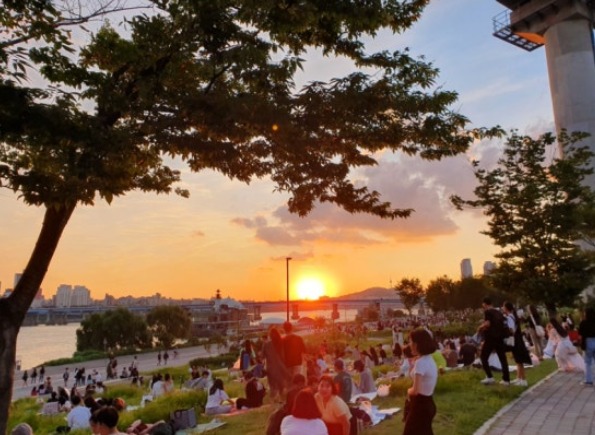
On a warm night, a large part of Seoul relocates to the riverbank. Not for a festival or an event — just to sit on the grass, order chicken, and stay until the trains stop running. If you are visiting in summer and looking for one evening that shows you the city as residents actually use it, this is it, and it costs almost nothing.
The two things worth deciding before you go are which park and what time you arrive. Everything else sorts itself out once you are there.
Getting there
There are eleven Han River parks. Three of them account for nearly all visitor traffic, and all three are a straightforward subway ride from where most people are staying.
From Myeongdong. You are on Line 4. Yeouido and Banpo are both about 25–30 minutes with one transfer; Ttukseom takes a little longer. Myeongdong is central enough that no park is genuinely far.
From Seoul Station. Slightly better placed than Myeongdong for Yeouido, slightly worse for Ttukseom. If you have just arrived on the airport train and dropped your bags nearby, Yeouido is the easy choice.
From Incheon Airport. Don’t. Not because it is impossible — the AREX gets you into the city and you transfer from there — but because you will be dragging a suitcase across a lawn in the dark. Check in somewhere first. If you have just landed and are working out how to reach the city at all, the airport arrival guide covers that part.
A note on fares: every route above is a normal subway journey on a transit card, which is also the cheapest way to move around Seoul in general. If you have not sorted a card yet, how to pay for transit in Korea covers the options.
Which park
The three differ more than the guides usually admit. Picking the wrong one for your evening is the most common way to end up disappointed.
Yeouido is the default, and the default is correct for a first visit. It has the widest skyline view, the most rental stalls, three delivery zones, and direct subway access from Yeouinaru Station. It is also the most crowded park in the city on a summer weekend, and after about eight o’clock, finding a patch of grass with a decent view becomes a real problem.
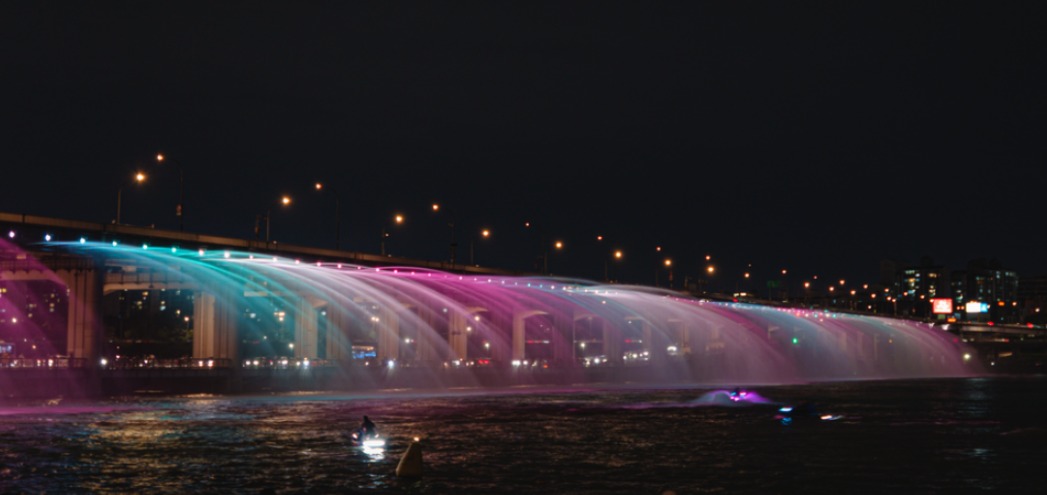
Banpo exists for one reason on a summer night: the Banpo Bridge fountain. Water arcs off both sides of the bridge, lit in colour, for a set of scheduled shows after dark. It is genuinely worth timing your evening around — but note the phrasing. It runs on a schedule, it is seasonal, and it does not run in bad weather. Check the current times before you commit your night to it.
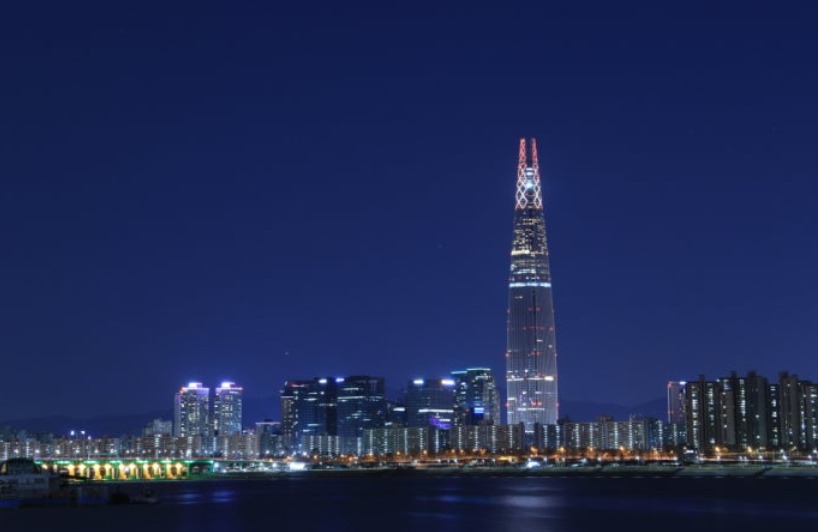
Ttukseom is the one to pick if crowds are the thing you are trying to escape. The view across the water is Lotte World Tower rather than the Yeouido skyline — a single enormous spike of light instead of a wall of buildings. There is more room, less noise, and correspondingly fewer shops and stalls.
How the night actually goes
Arriving at the wrong hour is the difference between a good evening and forty minutes of walking around looking for space.
Before 7pm the grass is still half empty and you can take whatever spot you want. In August the heat has not fully broken yet, which is why it is empty.
Around 7:40pm the sun goes down, and for roughly forty minutes the sky holds colour while the bridge lights and the buildings across the water come on. This is the part people are actually there for, and it is the only window where phone photos come out well. After it goes fully dark, a phone camera will give you grain and little else.
By 8:30pm the park is at maximum density. Convenience store queues are longest, delivery times are longest, and the mat rental stalls are busiest. Order food before this, not during it.
After 10pm families and groups with children start leaving and the park empties by maybe a third. In my opinion this is the best hour of the night — the temperature has dropped, you can hear the water, and there is space again.
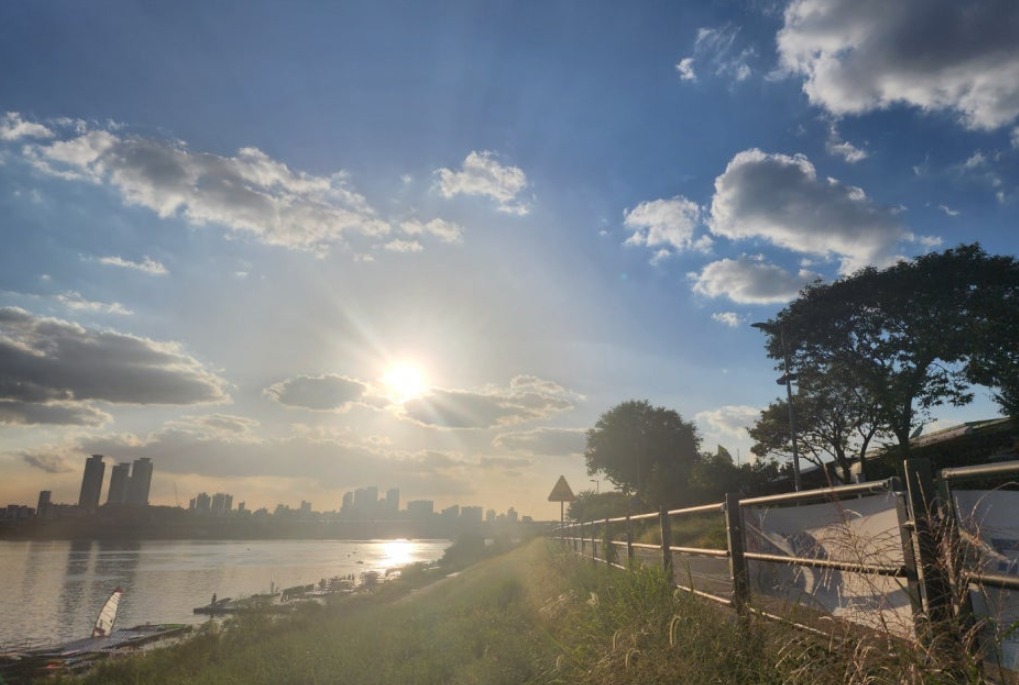
The same riverbank in daylight is a completely different place — cyclists, joggers, windsurfing boards pulled up on the bank, and almost nobody sitting still.
Food delivery: the part that confuses everyone
You can have food delivered to a riverside park. This surprises visitors more than anything else about the Han River, and it is true — with one detail that most write-ups skip.
The rider does not bring it to your mat. The parks are enormous and motorcycles are not allowed to weave through crowds of seated people, so Seoul designated fixed pickup points called delivery zones (배달존). You set the delivery zone as your address, and when the food arrives, you get up and walk over to collect it.
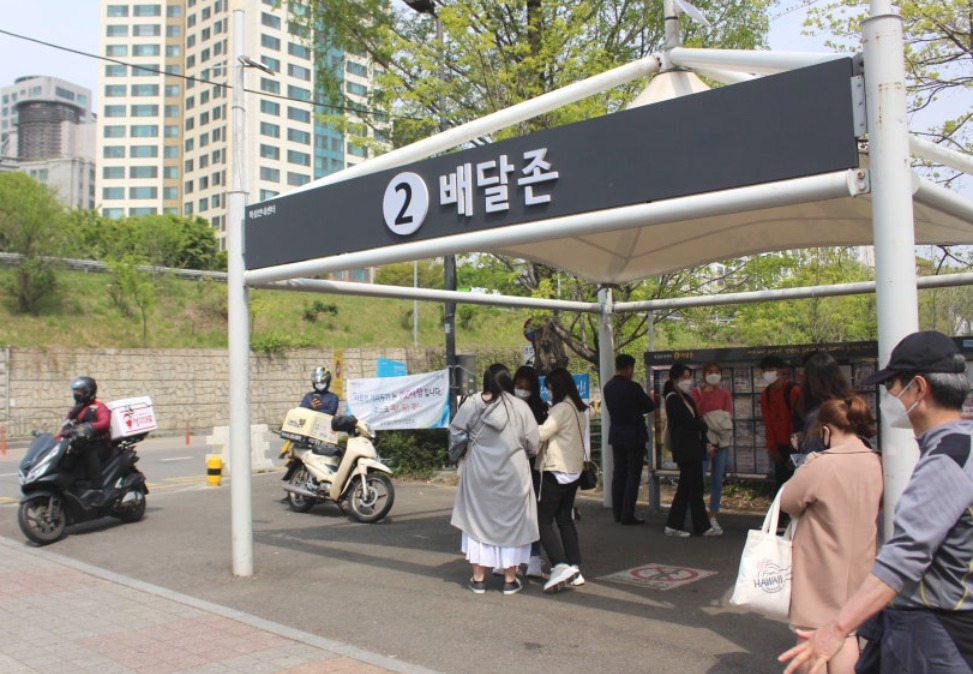
That sign is what you are looking for. Yeouido has three of them; Ttukseom has two. Before you settle on a spot, look around and note which zone is closest — you do not want a ten-minute walk each way with a box of fried chicken going cold.
The practical obstacle for visitors is usually not the zone system but the apps themselves, which have historically wanted a Korean phone number. That has been loosening, and there are now foreigner-oriented options. The full picture is in how to order food delivery in Korea.
If the app route defeats you, there is a low-tech fallback that has existed at the Han River for decades: people hand out fried chicken flyers along the paths, and they will place the call for you.
The ramyeon machine
Inside the convenience stores in the parks there are automatic ramyeon cookers. You buy a packet of instant noodles and a paper bowl, put the noodles in, set the bowl on the machine, and it fills the water and runs the timer for you. Four minutes, roughly ₩4,000–5,000, and you eat it at an outdoor table with the river in front of you.
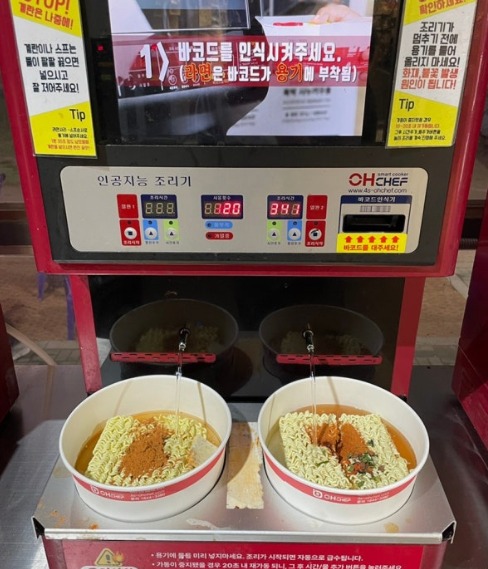
Two things worth knowing. Put the soup powder on top of the noodles, not underneath — powder sitting on the bottom of a paper bowl can scorch. And eat it immediately; instant noodles do not survive being carried far, which is why people eat them standing at the tables rather than taking them back to a mat.
If you want to know why this specific food carries the weight it does in Korea, how Koreans cook Shin Ramyun goes into it.
Renting your setup
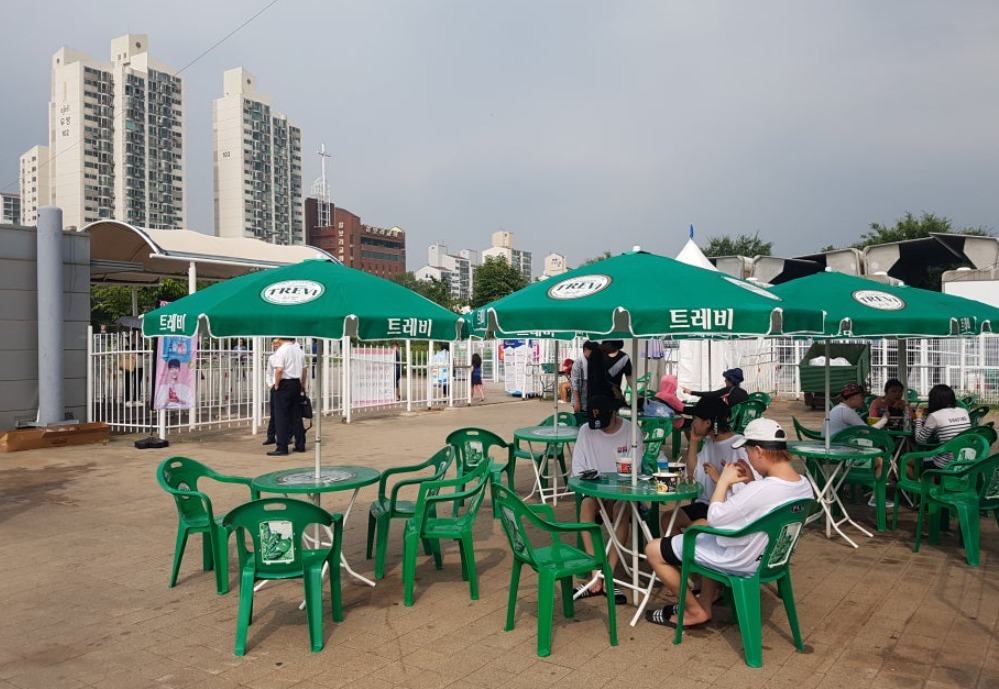
You do not need to bring anything. Rental stalls near the park entrances hire out mats, low tables, folding chairs, small pop-up tents, and — increasingly — wagons to haul it all in one trip.
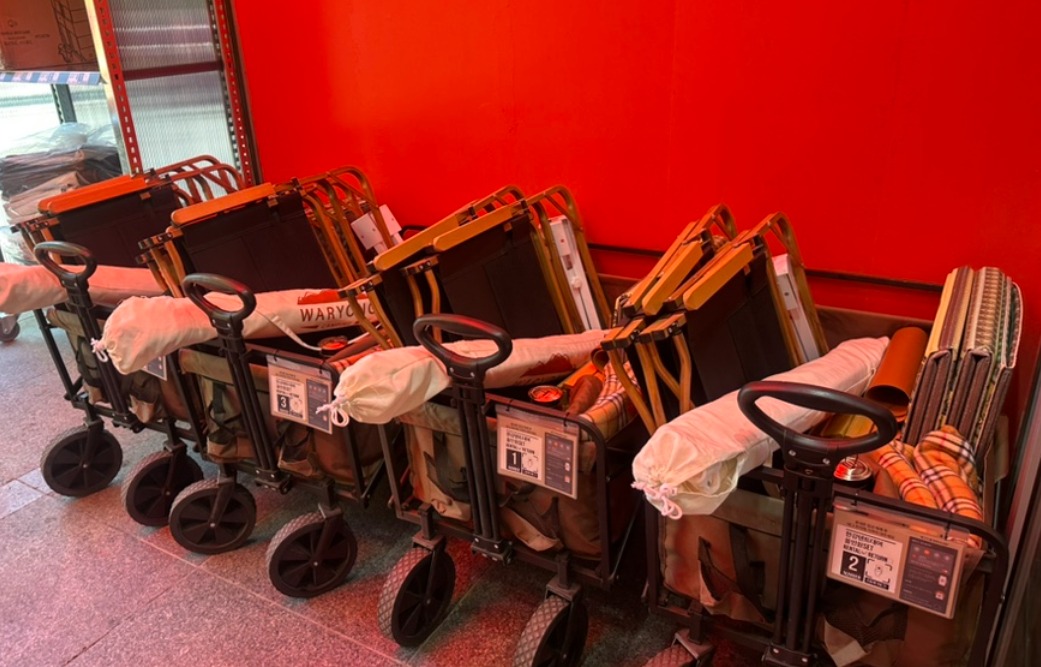
Two rules that catch people out. Tents in Han River parks have to be small, have to keep sides open rather than being fully enclosed, and are only permitted during posted daytime hours — so a tent is not something you can sit inside late into the evening. And rental stalls have closing times. Check when yours shuts before you decide to stay until midnight, or you will be carrying a mat onto the subway.
Things nobody mentions
Mosquitoes. It is a riverbank in August. Bring repellent, or buy some at the convenience store when you arrive. This is the single most common reason a good evening ends early.
The grass gets damp after sunset. Not from rain — the ground cools and holds moisture. A thin mat soaks through. If you are renting, take the thicker one.
Toilets are at fixed buildings, not scattered around, and there are queues at peak. Locate the nearest one when you arrive rather than at eleven at night.
You carry your rubbish out, or to the marked collection points. Korea separates waste aggressively and the parks are cleaned every morning by people who should not have to pick up after you.
Drinking outdoors is normal here. Alcohol in a public park is legal in Korea and the Han River is the most visible example of it. What is not tolerated is getting loud enough that the families twenty metres away notice you.
There is no lighting on the grass itself. The bridges and paths are lit; where you are sitting is not. People bring small LED lanterns, and the rental stalls sell or hire them.
Getting home
This is where evenings go wrong. Seoul’s last trains are earlier than visitors expect — generally somewhere around midnight depending on the line and direction, and the last train from a given station is not the same as the last train of the whole system. Check your specific line before the sun goes down, not after.
Buses run later than trains, and taxis are available but surge in demand at closing time on a summer weekend, when several thousand people leave the same riverbank within the same half hour. If you are relying on a taxi, walk away from the park entrance before you try to get one.
Frequently asked questions
Is the Han River free? Yes. The parks are public and open around the clock. You pay only for food and rentals.
Which park is best for a first visit? Yeouido. Best access, most facilities, the classic skyline view. Go to Banpo instead if you specifically want the bridge fountain, or Ttukseom if you want space.
Can I really get food delivered to the park? Yes, but to a designated delivery zone, not to your mat. You walk over and collect it.
Do I need to bring a picnic mat? No. Rental stalls near the entrances have mats, tables, chairs and tents. You can arrive with nothing.
What time should I get there? Aim to be sitting down by 7pm in summer. Sunset is the reason to be there, and the good spots go before it.
Is it safe at night? The parks are busy, well-used and heavily trafficked until late. Standard city sense applies; nothing beyond that.