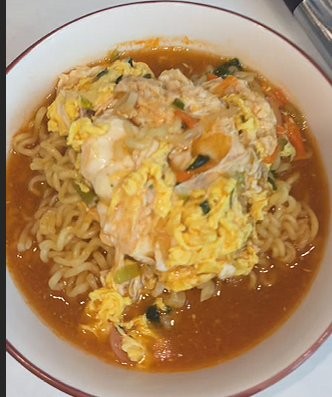
Samyang Ramen is the one Korean instant noodle that almost no foreigner has heard of, and the one every Korean over forty grew up on. It is not the spiciest, not the most exported, and not the one on the Netflix show. It is simply the first — the packet that started the entire Korean instant noodle industry in 1963, and the flavour every other brand was measured against for the next twenty years.
If you have only had Shin Ramyun, this tastes wrong at first. That is the point.
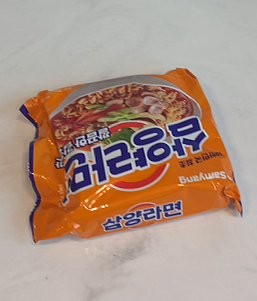
What it actually tastes like
Mild, savoury, slightly sweet, and faintly smoky — the flavour Koreans describe as ham-mat (햄맛), a ham taste. There is chilli in it, but not much. If your reference point for Korean noodles is the burn of Shin Ramyun or the assault of Buldak, this will read as strangely gentle.
That gentleness is historical rather than accidental. Through the 1960s and 70s, the assumption in Korean food manufacturing was that instant noodles should not be spicy — spicy was something you got from a stew at home, not from a packet. Shin Ramyun broke that assumption in 1986 and effectively rewrote the category. Samyang Ramen is what the category looked like before.
The 1963 story
Samyang Foods launched Korea’s first instant ramyun on 15 September 1963, using noodle machinery imported from Japan. The founder had reportedly watched people queueing at a Namdaemun market stall for a cheap gruel made from scraps, and set out to produce something filling and cheap enough to sell for ten won a packet.
It did not work at first. Koreans didn’t recognise instant noodles as food — some thought ramyun was a kind of fabric — and the original chicken-based broth was unfamiliar in a country that cooked with beef. The company ran at a loss for roughly three years, propped up by free tastings and government support.
Then it changed the broth to beef, added a little heat, and Samyang Ramen became the national noodle. It held the number one position in the Korean market until the 1980s.
Why you have never heard of it
Two things happened.
Nongshim’s run in the 1980s. Yukgaejang cup noodle in 1981, Neoguri in 1982, Ansungtangmyun in 1983, Chapagetti in 1984, Shin Ramyun in 1986 — one after another, all hits, all still selling today. Samyang went from the default to one option among many.
The beef tallow scandal of 1989. An anonymous tip led prosecutors to charge Samyang and several other companies over the use of industrial-grade beef tallow in frying. The products were later cleared, but the damage was done and the recovery took years. Anyone in Korea over fifty remembers this; nobody outside Korea has heard of it.
The current ham-forward flavour is itself a product of that period — a reformulation from the mid-1990s as the company looked for a way back. So the “original Korean ramyun” you buy today does not taste like the 1963 original, and Koreans who say they miss the old flavour are usually remembering a version that no longer exists.
The one trick
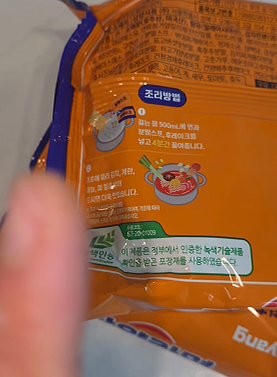
The packet tells you to boil everything together — noodles, soup base, dried flakes, all at once, for about four to five minutes.
Koreans mostly don’t do this.
Bring the water to a rolling boil first, add the soup base, then the noodles. The reason is that soup powder added to cold water dissolves slowly and drags the boil down, and noodles that spend their first thirty seconds in lukewarm water go soft on the outside before the inside has cooked. You get a slightly mushy strand with a firm core — the opposite of what you want.
Salt in the water also raises the boiling point marginally, which helps the noodles firm up rather than swell.
Two more things that matter more than they should:
The pot matters, and so does whether you leave it there. A wide, shallow, thin-metal pot — the yellow ones in every Korean kitchen — heats fast and keeps the broth hot. At home, most people eat straight out of it, which is why those pots come with lids that double as plates for the kimchi.
Restaurants do the opposite, and for a reason. They lift the noodles out first and pour the broth over them in the bowl, which stops the noodles cooking further in the residual heat of the pot and gives you a firmer strand. It costs you some heat and buys you texture. If you have ever wondered why restaurant ramyun has more bite than yours, that is most of the answer.
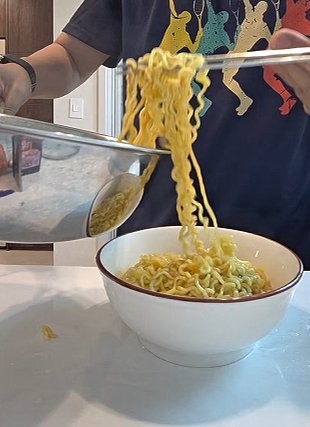
Take it off the heat about thirty seconds early. The noodles keep cooking in the residual heat. Cooking to the point where they look right in the pot means they are overcooked by the time you eat them.
What to add
Samyang’s mildness is why it takes additions better than the spicier brands. There is room in the flavour rather than a wall.
-
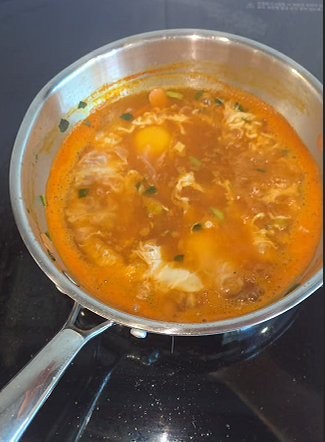
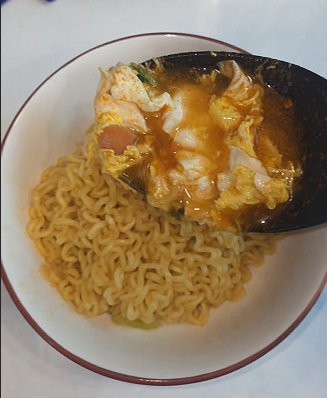
An egg — cracked in whole for a soft yolk, or stirred through in the last thirty seconds for a cloudy broth. Koreans argue about which is correct. Both are correct.
-
Spring onion — added at the end, not the start. It should still be sharp.
-
A slice of processed cheese — melted in off the heat. This sounds wrong and is genuinely good, and it works better here than with spicier noodles.
-
Kimchi — added in the last minute, or eaten alongside. The sourness cuts the fat.
What Koreans do not generally add is more soup base “for flavour.” Samyang is a mild noodle. Turning it into a salty one just makes it a worse version of something else.
Where it sits now
Samyang Foods is currently better known abroad for Buldak, the fire-noodle line that became a global phenomenon and now drives most of the company’s exports. The irony is not lost on Koreans: the company that invented Korea’s mildest, most nostalgic noodle is now famous everywhere else for the most aggressive one on the shelf.
Samyang Ramen itself remains on every convenience store shelf, cheap, and mostly bought by people who have been eating it for decades. It is a specific kind of comfort food — the noodle equivalent of a dish your grandmother made, which is exactly why it rewards eating it the way it was meant to be eaten rather than dressed up.
If you want the noodle that defines modern Korean taste instead, that is Shin Ramyun. If you want the one that broke the internet, that is Buldak. And if you want to see what Koreans do to instant noodles when they get creative, jjapaguri is the answer.
Frequently asked questions
Is Samyang Ramen spicy? Barely. It is one of the mildest mainstream Korean instant noodles — savoury and slightly sweet rather than hot.
What is the difference between Samyang Ramen and Shin Ramyun? Samyang is the older, milder, ham-flavoured original from 1963. Shin Ramyun arrived in 1986 as a deliberately spicy product and became the market standard.
Is Samyang Ramen the same company as Buldak? Yes. Samyang Foods makes both — the mildest classic and the most famous spicy noodle in the world.
Why doesn’t it taste like the packet instructions suggest? Because most Koreans ignore them. Boil the water first, then add the soup base, then the noodles.
Is it the oldest Korean instant noodle? Yes. Launched 15 September 1963, it was the first instant ramyun made in Korea.