Every country’s military invents its own food hacks, but Korea’s might be the most elegantly stupid one ever devised: you cook the ramyun inside its own bag. No pot. No stove. No bowl. No dishes. Pour hot water into the packet the noodles came in, clamp it shut with chopsticks, wait five minutes, and eat straight out of it. This is bboggeul-i (뽀글이) — named after the bubbling sound, 뽀글뽀글 — and for one generation of Korean men, it tastes like being twenty years old and freezing at 3am.
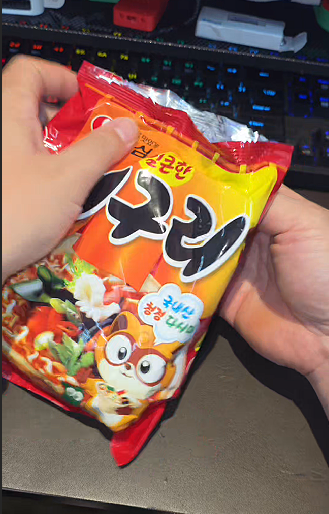
Why anyone would cook ramyun in a bag
The reason is more interesting than the hack itself. Ramyun started being issued to Korean conscripts as a food ration around the early-to-mid 1980s. Great news — except barracks don’t have kitchens. Soldiers had the noodles and no way to cook them. The mess hall wasn’t somewhere you could wander into to boil a pot at midnight.
So they improvised. Early versions involved the pechka — the coal stove that heated the barracks — with soldiers laying a wet sheet of paper on top so the ramyun bag wouldn’t burn, then heating it directly. Some cooked in their mess tins. Eventually the method simplified into what it is now: just hot water, poured into the bag.
That’s the real story of bboggeul-i. It isn’t a recipe someone designed. It’s what happens when you give a nineteen-year-old a packet of noodles, no equipment, and a lot of time to think about it.
How it’s actually done
The method is specific, and the details matter more than they look:
- Open the bag carefully. Tear the top cleanly — you need the bag intact, because it’s about to become your pot.
- Take the soup packets out first. Then crush the noodle block into two to four pieces while it’s still in the bag. This isn’t optional: you can’t fill the bag with water, so an unbroken block leaves you with a raw section in the middle.
- Put the powder back in and add hot water — roughly half the bag, about 300–350ml. Less water than usual, because a bag doesn’t extract flavor the way a boiling pot does, so a standard amount comes out watery and thin.
- Clamp the top shut. In the army, the classic move is wedging the folded opening into the gap of an unsplit pair of wooden chopsticks. Then stand it upright and keep it upright — as the noodles soften, the whole thing goes floppy and a leaning bag becomes a scalding disaster.
- Wait, by preference. Three minutes for chewy, five for normal, seven for fully soft.
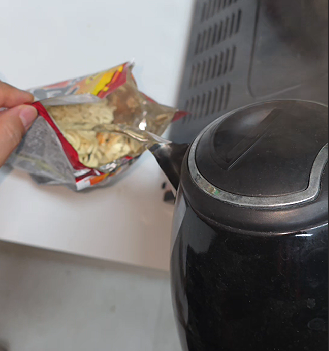
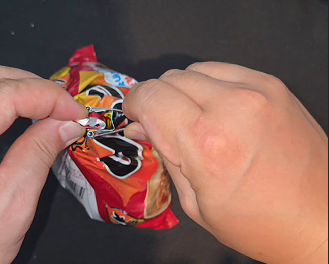
Why doesn’t the bag melt? Because ramyun packaging is PP/PE coated on the inside — it holds up to boiling water fine. What it does not survive is a microwave: metallic layers in the packaging will spark. Never do that.
Which ramyun works (and which famously doesn’t)
Any ramyun meant to be boiled can be made bboggeul-i, but the army had favorites. Soup-based ones like Shin Ramyun and Mupama, plus Ojingeo Jjamppong, Gan Jjamppong, and even Jjapaghetti (a stirred noodle, but it works hot) were the go-to picks. Paldo Bibimmyeon has its fans too.
And there’s one notorious loser: Ansungtangmyun is famously bad as bboggeul-i. It just doesn’t come together in the bag.
The luxury version involves adding canned tuna or a sausage — the kind of upgrade that, in a barracks, counts as fine dining.
The taste of a night shift
Here’s the honest part: bboggeul-i is not better than ramyun cooked in a pot. It isn’t even better than cup ramyun. The noodles soak rather than boil, the flakes don’t fully rehydrate, and the broth is thinner. Judged purely as food, it’s a downgrade.
That’s not the point, and that’s exactly what makes it interesting. Bboggeul-i tasted incredible because of when you ate it: coming off a night guard shift in the middle of winter, having burned through your calories standing at a post for hours, at an hour when nothing else on earth was available. Soldiers stashed a few packets in their lockers specifically for that moment. Officers on overnight duty ate them too — even they couldn’t fire up a gas burner in the duty room.
Food eaten in the right circumstances stops being about flavor. Every Korean man who did his service in that era can tell you exactly what a 3am bboggeul-i tasted like.
The generation gap nobody expects
Here’s the twist that surprises even Koreans: bboggeul-i is disappearing from the very place it came from. Since the 2010s, cup ramyun is issued and available at the base convenience store, and better-equipped units have actual ramyun cookers and microwaves. The two things bboggeul-i solved — no pot, no dishwashing — were solved better by a cup.
The result is that plenty of soldiers now finish their entire service without ever making one. A younger Korean man might know bboggeul-i as a thing he tried once out of curiosity, or never at all. It’s sliding from “universal shared experience” into “something your uncle talks about.”
So if you see a Korean man in his thirties or older describe bboggeul-i with a strange fondness, understand what’s happening: he isn’t recommending a recipe. He’s remembering a specific 3am.
Actually useful for travelers
One practical afterlife: bboggeul-i solves a real problem abroad. Bag ramyun packs flat and travels well, while cup ramyun is bulky and awkward in a suitcase — but almost no hotel room has a stove, and buying a pot for one meal is absurd. Every hotel room, however, has an electric kettle.
That’s bboggeul-i. Bring the flat packets, use the kettle, cook in the bag. A military improvisation from 1980s barracks turns out to be the perfect hotel-room hack forty years later.
One safety note: you’re handling a soft plastic bag full of boiling water. Check the bag for holes before you start, set it flat and pour slowly, use a towel or glove, stir immediately to distribute heat, and hold it with a cloth while eating. The bag is safe; the physics of a floppy container full of scalding broth is what gets people.