If you like spicy food, put jjamppong (짬뽕) near the top of your Korea eat-list. It’s a fiery red seafood noodle soup, and along with jjajangmyeon (짜장면) it’s one of the two dishes Koreans reach for again and again at a 중국집 (junggukjip) — a Korean-Chinese restaurant. Today I took my kids out for muneo-jjamppong (문어짬뽕), the octopus version, and honestly, eating it fresh at the restaurant beats delivery every time. The broth is hotter, the seafood is springier, and the whole thing just lands better than it does out of a takeout bowl.
Here’s what to order, what each dish actually is, and where these two Korean icons came from.
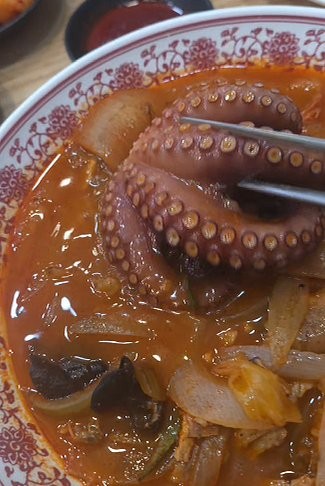
Jjamppong: the spicy one
Jjamppong is a bright red noodle soup built on gochugaru (Korean chili flakes) and chili oil, loaded with seafood — squid, mussels, shrimp, sometimes octopus — plus pork and vegetables in a hot, savory broth. It’s what Koreans crave on a cold day, and what many swear clears a hangover. It’s spicy, but not punishing — if you don’t handle heat well, you’ll feel it, and that’s your cue to read the next section.
Here’s what most people don’t know: jjamppong isn’t purely Korean. Its noodle-soup roots trace back to Shandong-style Chinese chǎomǎmiàn, and its name comes from champon, a dish created by Chinese cooks in Nagasaki, Japan in the late 1800s. But Japanese champon is white, mild, and creamy. The fiery red version is Korea’s own — Korean cooks started adding chili in the 1960s, and the spicy bowl took over. If you want to go bigger, order samseon-jjamppong (삼선짬뽕), which piles on extra seafood; muneo-jjamppong swaps in octopus.
Jjajangmyeon: the crowd-pleaser
If the heat isn’t for you, order jjajangmyeon instead — and nobody will judge you, because it’s just as beloved. Thick wheat noodles under a glossy black sauce made from chunjang (춘장), a dark, savory-sweet fermented bean paste stir-fried with pork and onions. It’s rich, a little sweet, completely non-spicy, and kids devour it. Fair warning: the black sauce splatters, so maybe don’t wear white.
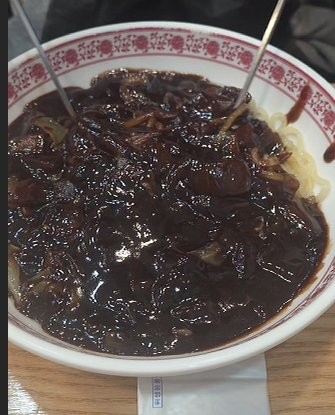
Jjajangmyeon has real history. Chinese laborers from Shandong brought an early version to the port of Incheon in the late 1800s, and it’s widely said to have first been served in 1905 at a restaurant called Gonghwachun (공화춘) in Incheon’s Chinatown — the building is now a jjajangmyeon museum you can visit. After the Korean War it was cheap enough for anyone, and it spread nationwide as Korea’s first real “eating out” meal. There’s even a holiday: on April 14th, “Black Day,” single people gather to eat black jjajangmyeon together and joke about being alone. That’s how woven-in this dish is.
Can’t decide? Order jjamjjamyeon
The eternal Korean dilemma is jjajang or jjamppong. Restaurants solved it: jjamjjamyeon (짬짜면) is a split bowl — half black-bean noodles, half spicy soup — so you don’t have to choose.
Get tangsuyu on the side
If two of you are eating, add a small (소, so) order of tangsuyu (탕수육) — Korean sweet-and-sour pork: crispy fried pork in a glossy, tangy sauce. It comes in 소 / 중 / 대 (small / medium / large), and a “so” is right for two people alongside your noodles.
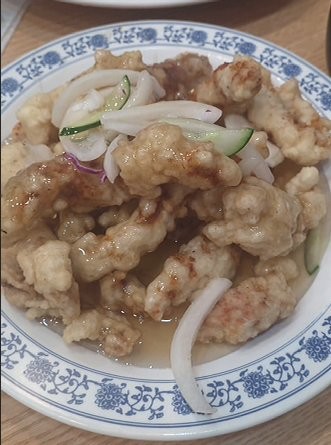
Tangsuyu has its own famous debate: buseok vs jjigeok. Buseok (부먹) means pour the sauce over the pork; jjigeok (찍먹) means keep the sauce on the side and dip each piece so it stays crunchy. Koreans hold strong opinions here — pick a side, it’s part of the fun. Your meal will also come with danmuji (단무지), yellow pickled radish, and usually raw onion with a little chunjang to dip; both cut the richness.
A few first-timer tips
- Love spice? Jjamppong. Prefer mild? Jjajangmyeon. Can’t choose? Jjamjjamyeon.
- Two people: two noodle dishes plus a small tangsuyu is the classic combo.
- Eat in if you can. Korea’s delivery is famously fast, but a fresh bowl at the restaurant genuinely tastes better — the noodles haven’t gone soft on the way over.
Korean-Chinese food is its own thing: invented in Korea by Chinese immigrants, and unlike what you’ll find in China. Start with these, and you’ve unlocked one of the most everyday, most-loved corners of how Koreans actually eat.
If you like the instant side of Korean noodles, here’s how Koreans turn Chapagetti into jjapaguri (ram-don), cook the original Samyang Ramen, and take on Buldak fire noodles.