Walk down a side street in Hongdae, Seongsu, or Gangnam after dark and you’ll pass a glowing storefront full of mirrors, ring lights, props, and short lines of friends in matching outfits. These are Korea’s self-photo studios — insaeng necut (인생네컷), “life’s four cuts.” You step into an unmanned booth, pose through a one-minute countdown, pick your best four shots, and walk out ninety seconds later holding printed photo strips.
Why four? Because the name comes from insaeng sajin (인생사진) — “the photo of your life,” the shot so good it might be the best one ever taken of you — fused with necut, four frames. Four chances at your life photo. That’s the entire pitch, and Korea has gone completely, measurably insane for it.
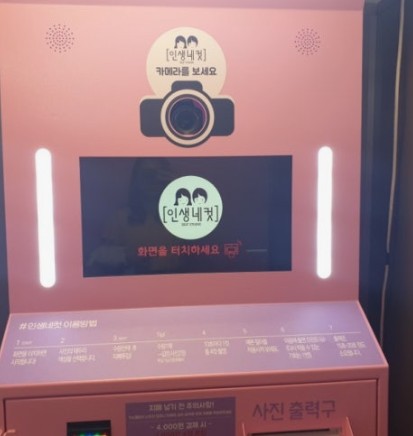
This is not a nostalgia thing — it’s an industry
The numbers are genuinely startling. Life Four Cuts started as a single brand in Daegu in 2017. It now runs roughly 410 stores, reports over 120 million visits since launch, and estimates about 2 million people walk into its studios every month. Korea’s self-photo booth segment was worth around $400 million in 2024 and is projected to hit $1.2 billion by 2033.
And “인생네컷” stopped being a brand name years ago — it’s now the generic word. Ask a Korean teenager to “go take necut” and which company runs the booth is irrelevant, the same way nobody asks which brand of tissue you mean when you say Kleenex.
Foreign demand is climbing fast too: card spending by foreign tourists at instant photo booths jumped 65% year-on-year between January and July 2025.
Why Koreans are obsessed
The obvious answer — “it’s cute” — misses it. Three things actually explain it.
It’s physical. Your phone holds ten thousand photos you will never look at again. A photo strip is an object. You put it in your wallet, in your phone case, on your wall, in a mini binder. You trade them. Digital abundance made the printed thing rare, and rarity is the product.
It’s fast and cheap. ₩4,000 for two strips. Four minutes. That’s less than a coffee for a physical memento of a specific evening.
It’s a way of communicating, not just documenting. This is the part foreigners miss. Taking necut together is a small ritual that says this hangout counted. It’s what you do at the end of a night, on a first date, when friends visit from out of town. The strip is a receipt for the relationship.
There’s also a design detail worth naming: Korean booths lean on natural retouching, not heavy filters. The machines smooth and brighten rather than reshape — the goal is “you, on a good day,” not a cartoon. That’s a deliberate aesthetic choice, and it’s why the results still look like you.
How it actually works
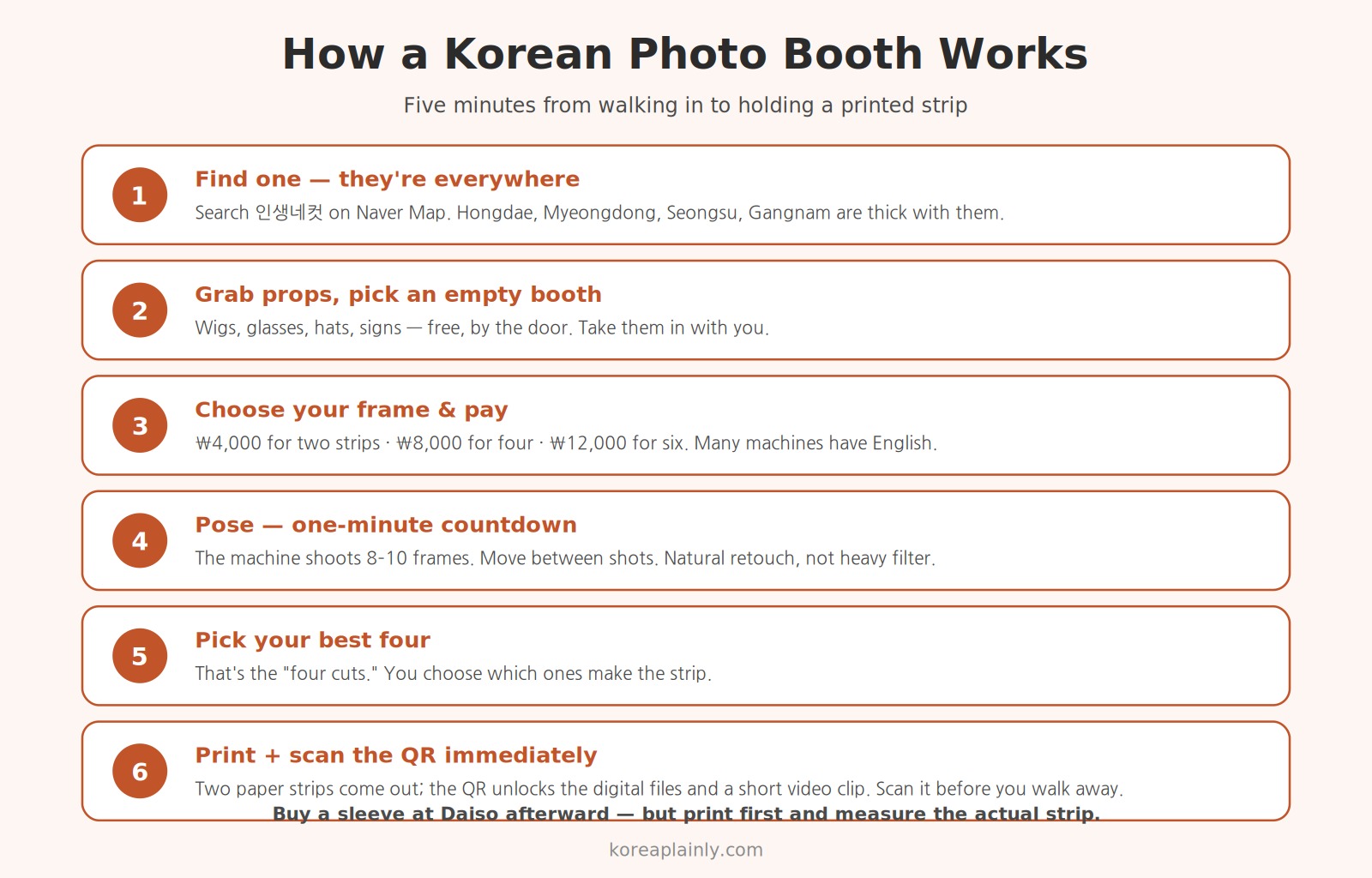
Find one on Naver Map by searching 인생네컷 — they cluster around Hongdae (Hongik University Station Exit 9 and the main walking street), Myeongdong, Seongsu, and Gangnam. No booking; you just walk in.
Grab props on the way — wigs, sunglasses, hats, signs, all free by the door. Pick an empty booth, choose your frame, and pay: ₩4,000 for two strips, ₩8,000 for four, ₩12,000 for six. Many machines have English on the welcome screen.
Then the countdown: the machine shoots 8–10 frames over about a minute, and you move between shots. Afterward you pick your favorite four — that’s the “four cuts” — and it prints two strips while a QR code unlocks the digital files and a short video clip.
Scan the QR immediately, before you walk away. This is the mistake everyone makes once. The paper is the souvenir; the QR is the part you’ll actually post.
Which brand to pick
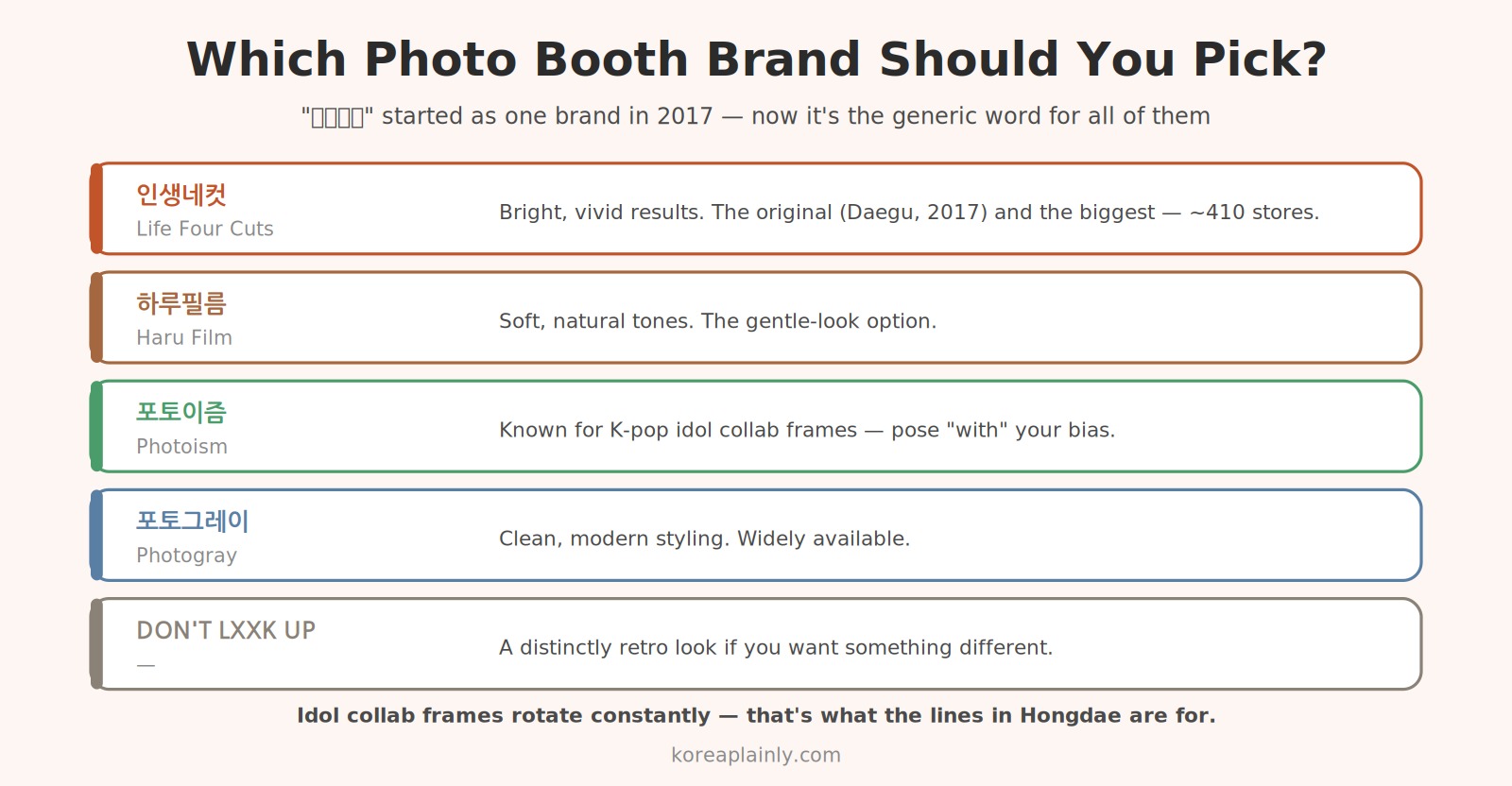
They’re not interchangeable, and locals have strong opinions:
- 인생네컷 (Life Four Cuts) — bright, vivid results. The original and the biggest.
- 하루필름 (Haru Film) — soft, natural tones. The gentle look.
- 포토이즘 (Photoism) — known for K-pop idol collab frames.
- 포토그레이 (Photogray) — clean, modern, widely available.
- DON’T LXXK UP — distinctly retro if you want something different.
And here’s the one that matters if you’re a K-pop fan: the booths run idol collaboration frames — Seventeen, aespa, and rotating soloists — where the printed strip comes out looking like your bias posed alongside you. This is a large part of why there are lines in Hongdae at midnight. The collabs rotate constantly, so what’s available this month won’t be next.
Small practical notes
The classic 4CUTS frame is a tall vertical strip, roughly 5cm wide — similar in feel to a 2×6 inch booth strip. Don’t buy a sleeve or binder based on that number: print first, then measure the actual strip. Daiso and Korean stationery shops sell photo-strip sleeves, mini albums, and clear holders for a few hundred won.
Four thousand won, four minutes, four frames. It’s the cheapest souvenir in Korea and the only one that proves you were actually there — with the people you were there with.