Let’s be honest about something first: you can travel Korea with zero Korean. Signs are bilingual, subway announcements are in English, younger Koreans often speak some English, and Papago translates a menu in two seconds. So this isn’t a survival guide — it’s something better. Learning ten phrases won’t get you around Korea; it’ll change how Korea treats you. The moment a foreigner says gamsahamnida with a small bow, faces change. Not because it was necessary — because you tried.
Here’s the short list that actually earns its keep, and how to use each one without overthinking.
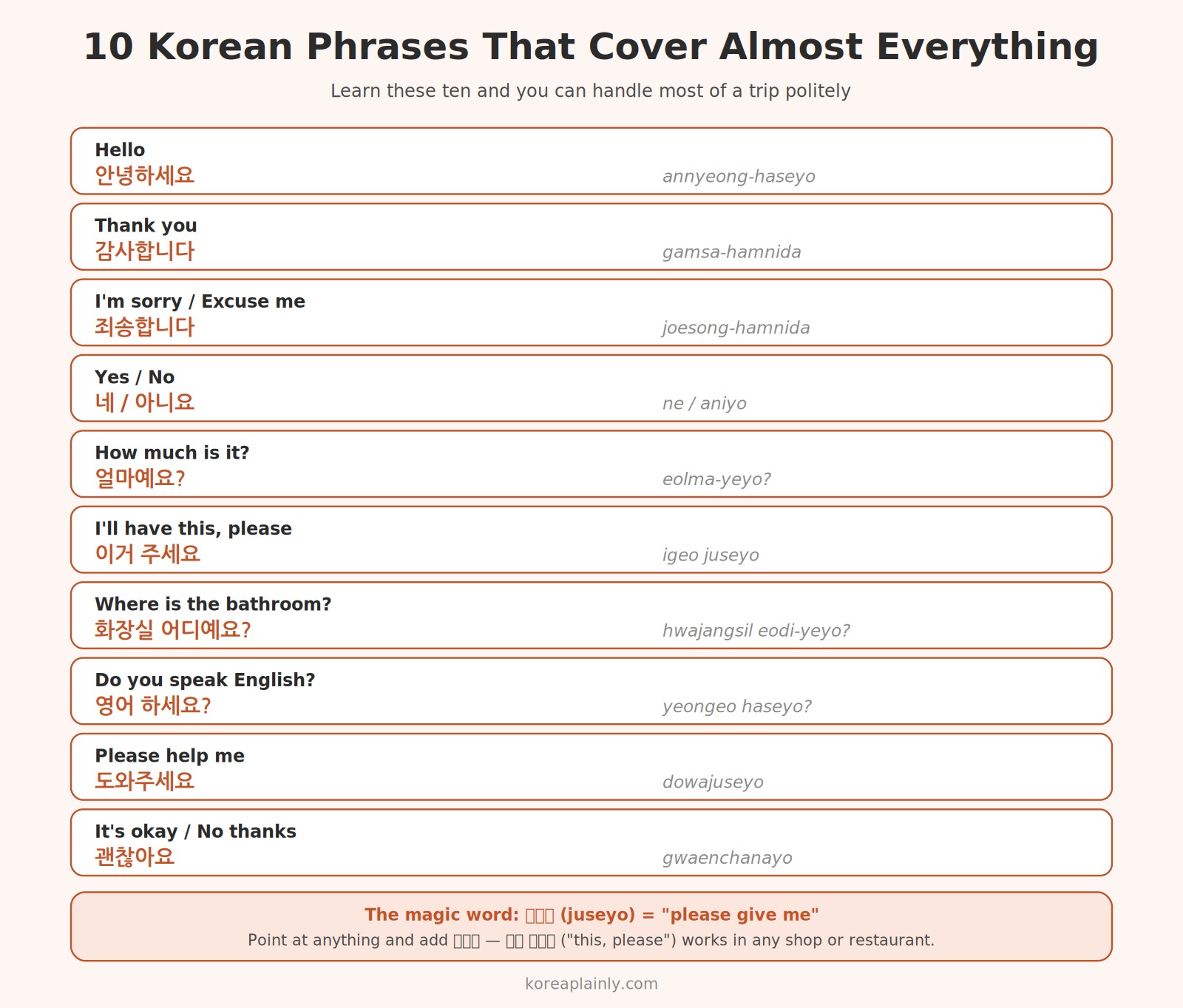
The magic word: 주세요
Start here, because this single word does more work than the other nine combined. Juseyo (주세요) means “please give me.” Bolt it onto anything, or onto nothing at all:
- 이거 주세요 (igeo juseyo) — “this, please,” while pointing. This one phrase orders any dish on any menu in the country.
- 물 주세요 (mul juseyo) — water, please.
- 메뉴 주세요 (menyu juseyo) — menu, please.
Point and juseyo. That’s a functioning ordering system.
The core ten
Annyeong-haseyo (안녕하세요) — hello. Works morning to night, formal to casual. Say it walking into any shop. Gamsahamnida (감사합니다) — thank you. The highest-value phrase in the language for a visitor. Joesong-hamnida (죄송합니다) — sorry / excuse me (when you bump someone). Ne / Aniyo (네 / 아니요) — yes / no. Eolma-yeyo? (얼마예요?) — how much is it? Igeo juseyo (이거 주세요) — I’ll have this. Hwajangsil eodi-yeyo? (화장실 어디예요?) — where’s the bathroom? Yeongeo haseyo? (영어 하세요?) — do you speak English? (Ask this before launching into English — it’s the polite move.) Dowajuseyo (도와주세요) — please help me. Gwaenchanayo (괜찮아요) — it’s okay / no thanks. Doubles as a gentle decline.
At a restaurant: the one thing that feels wrong but isn’t
Here’s where foreigners hesitate the most. In Korea, you call the server out loud. Yeogiyo! (여기요!) or Jeogiyo! (저기요!) — “over here!” Say it clearly across the room. Many tables also have a call button; press it.
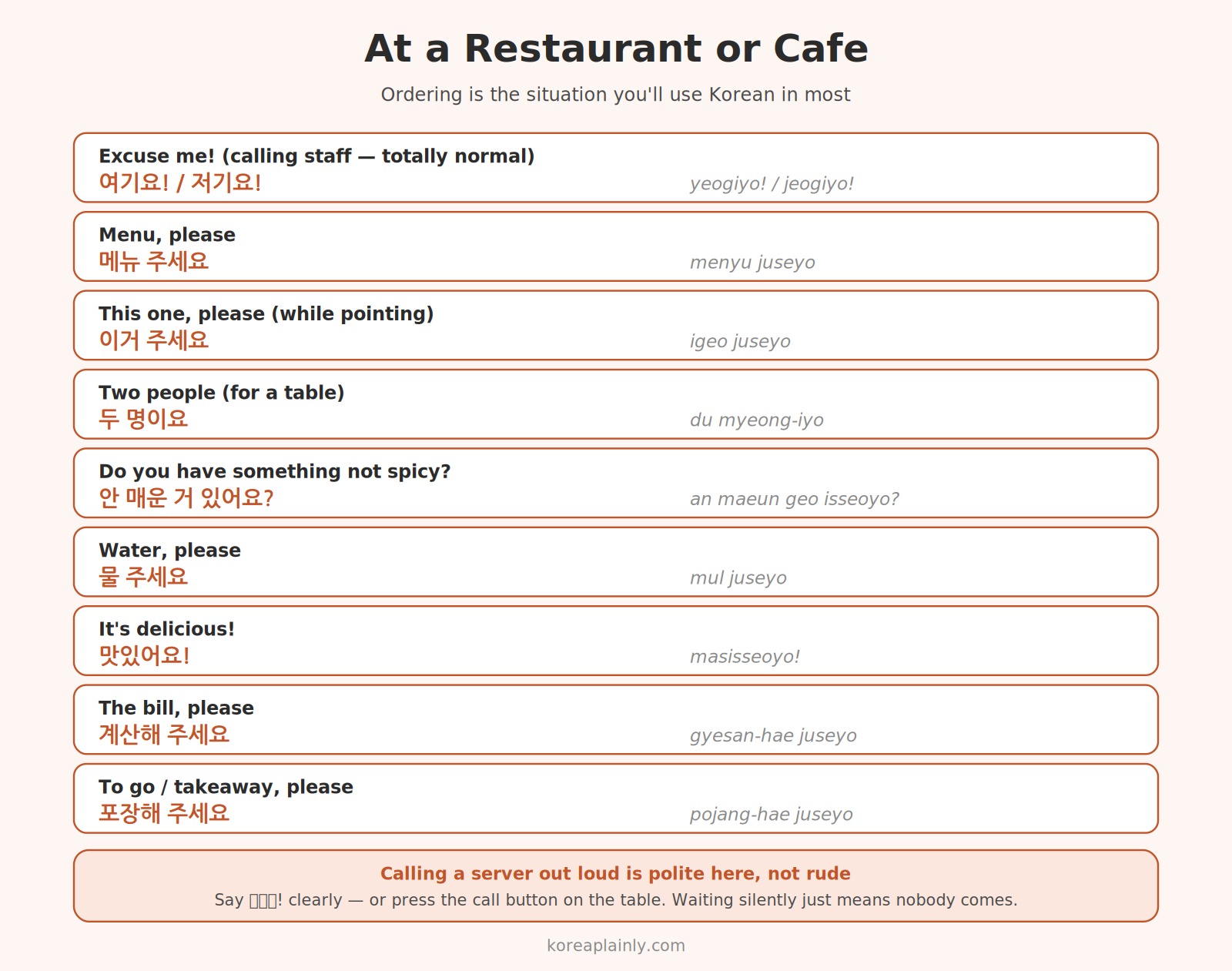
Western instinct says this is rude. It isn’t. Servers here don’t hover or check in — the expectation is that you’ll signal when you need something. Waiting politely and making eye contact just means nobody comes and your food never arrives. This is genuinely the single most useful cultural adjustment in Korean dining.
Then: 두 명이요 (du myeong-iyo) for a table for two. 안 매운 거 있어요? (an maeun geo isseoyo?) — “do you have something not spicy?”, worth memorizing if you’re spice-cautious. 맛있어요! (masisseoyo!) — “it’s delicious!”, which will make someone’s day. And 계산해 주세요 (gyesan-hae juseyo) — the bill, please. Though often you’ll just walk to the counter to pay, which is normal.
Taxis, directions, and shopping
For taxis, the honest advice is: don’t pronounce, show. Korean place names are hard to say accurately and a mispronounced destination helps nobody. Pull it up on Naver Map and show the screen. If you want the phrase anyway: 여기로 가주세요 (yeogiro gajuseyo) — “please go here,” while showing the address. 여기서 세워주세요 (yeogiseo sewojuseyo) — “stop here, please.”
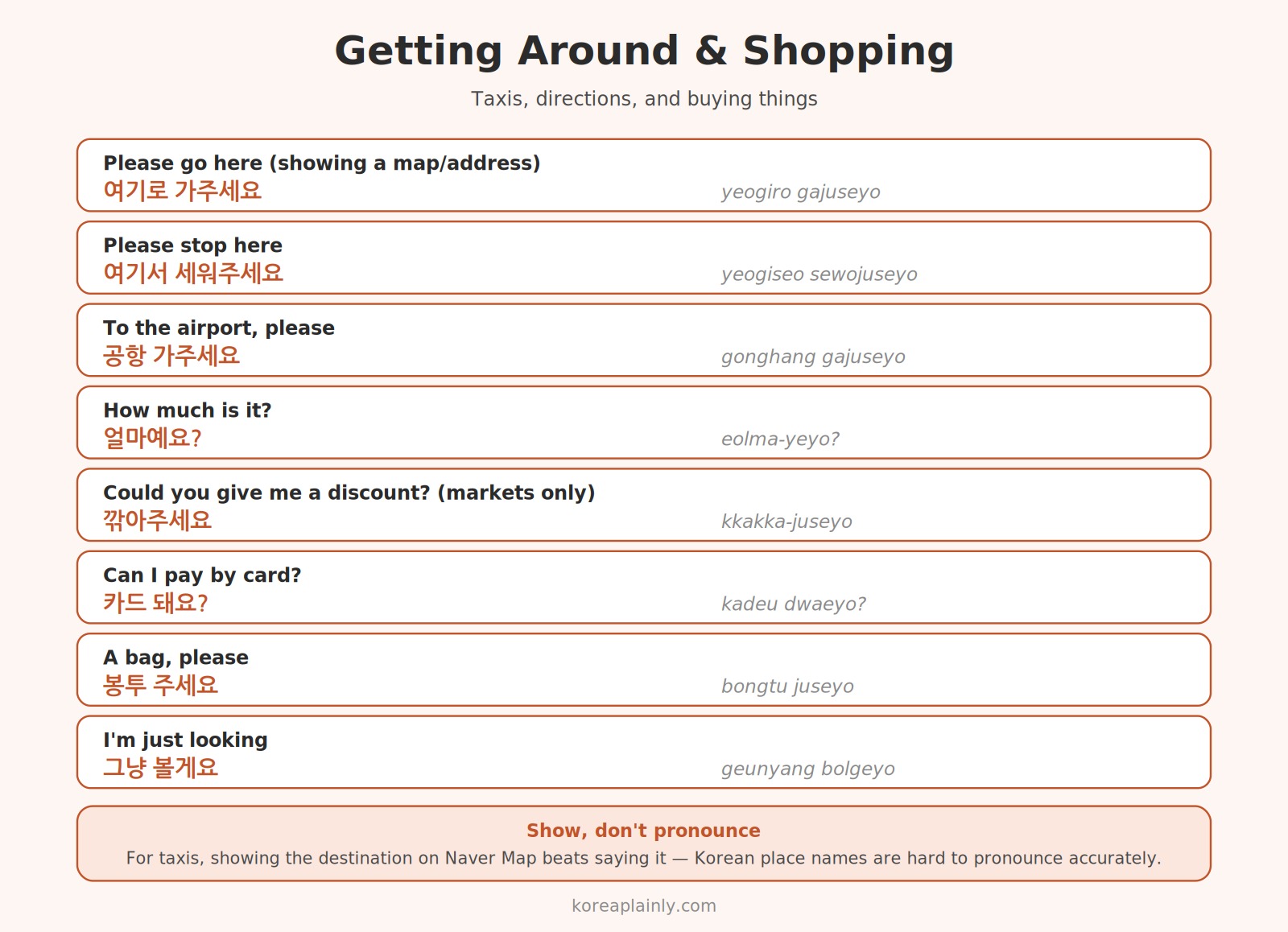
For shopping: 얼마예요? for price, 카드 돼요? (kadeu dwaeyo?) — “can I pay by card?” (almost always yes; Korea is extraordinarily card-friendly). 그냥 볼게요 (geunyang bolgeyo) — “I’m just looking,” to browse in peace. And 깎아주세요 (kkakka-juseyo) — “a discount, please” — but only at traditional markets. Try it at a department store and you’ll get a very confused look.
Two things that make you sound better than your vocabulary
Add -yo. Korean politeness runs on levels, and the simplest tool is the -요 (-yo) ending. Gwaenchana → gwaenchanayo. Masisseo → masisseoyo. It’s the difference between talking to a friend and talking to a stranger, and it costs one syllable. When in doubt, add it.
Bow slightly. A small nod with gamsahamnida isn’t ceremonial theatre — it’s the everyday punctuation of Korean politeness, and it lands.
A realistic expectation
You will mispronounce things. Koreans will be delighted anyway. Foreigners attempting Korean are met with genuine warmth, not correction — the effort is the entire point, and the bar is on the floor. Nobody expects fluency; they notice that you bothered.
So learn ten phrases. Not to survive — you don’t need to. Learn them because annyeonghaseyo walking into a shop, masisseoyo to a restaurant owner, and gamsahamnida on the way out will get you a version of Korea that people who only speak English never quite see.