There is a rule about kimchi jjigae that sounds like a mistake: the fresher your kimchi, the worse the stew.
Korean households deliberately let kimchi go sour before making this dish. Some keep a separate container of it for exactly this purpose. The stew you get in a restaurant is built on kimchi that has been aging for months, and that is not a shortcut or a way of using up something past its best. It is the requirement.
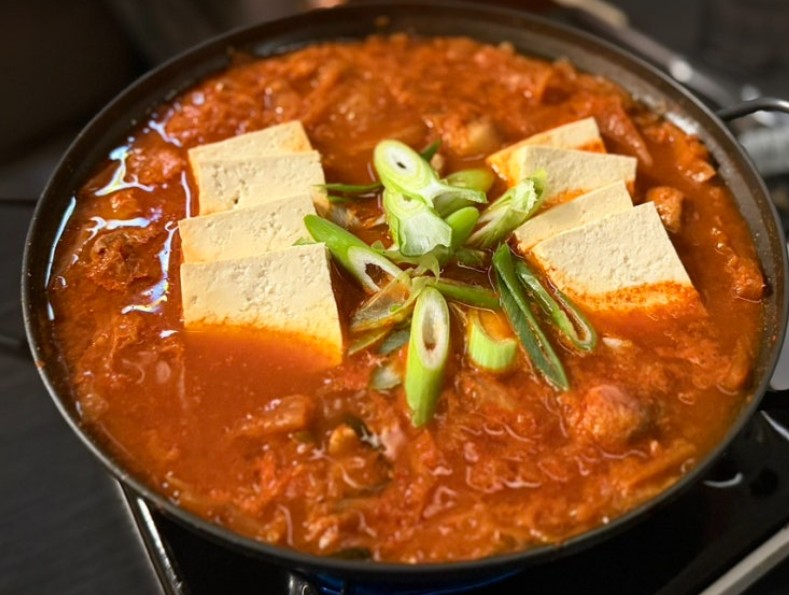
Kimchi jjigae (김치찌개) is aged kimchi simmered with pork, tofu, onion and spring onion into a red, sour, deeply savoury stew, eaten with rice. It is probably the single most-cooked dish in Korean homes.
Why the kimchi has to be sour
When kimchi ferments, lactic acid bacteria consume the sugars in the cabbage and produce lactic acid — the source of the sourness. Alongside that, proteins break down into free amino acids, which are what the tongue reads as savoury depth.
So aged kimchi arrives at the pot carrying two things fresh kimchi does not have: acid, and glutamates.
What this means in the pot:
Fresh kimchi in hot broth stays fresh kimchi in hot broth. The cabbage is still crisp, the seasoning sits on the surface rather than in the liquid, and you get a soup that tastes like water with kimchi floating in it. Nothing has combined.
Aged kimchi does the opposite. It has already softened, so it releases its seasoning into the liquid. Its acid cuts through pork fat and pulls it into the broth instead of leaving it sitting on top. And its amino acids give the stew a savouriness the ingredients could not produce on their own in twenty minutes of cooking.
Sourness in the finished stew is not the same as sourness in the jar. Raw sour kimchi tastes sharp and one-note. Cooked, with fat and heat, that same acid turns into depth. This is why Koreans throw away almost no kimchi.
When the kimchi has gone too far
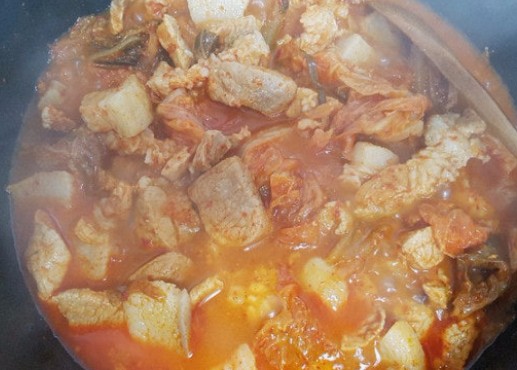
Sometimes kimchi crosses from properly sour to aggressively sour — the kind that makes you squint. It is still usable, but you cannot just put it in a pot.
Fry it first. In sesame oil or rendered pork fat, over medium heat, with a small amount of sugar. Give it several minutes before any liquid goes in.
Two things happen. The fat coats the kimchi and rounds off the edge of the acidity — sharpness you taste immediately becomes something that arrives later and softer. And the sugar balances the acid directly, without making the stew sweet.
The frying step also concentrates the kimchi’s flavour before it dilutes into broth, so the finished stew comes out heavier and darker rather than thin and sour.
Skipping this step is the most common mistake when cooking with very old kimchi, and it is why home versions sometimes come out tasting like hot sour water.
Why every family’s is different
Ask Koreans what goes in kimchi jjigae and you will get an answer delivered with total confidence, because everyone’s version is the correct one.
Pork is the most common. Fatty cuts — pork belly, shoulder, front leg — because the fat is doing the work. It renders into the broth and gives the stew its weight and gloss. This is the version most restaurants serve and what most people picture.
Canned tuna — chamchi kimchi jjigae — is the fast weeknight version, and genuinely different rather than a downgrade. The oil from the tin behaves differently from pork fat, and the result is lighter, cleaner, and slightly nutty. Common in homes and student cooking because it takes fifteen minutes.
Spam or other processed meat pushes the stew toward the salty, direct flavour profile of army stew. Some households make it this way permanently and their children grow up assuming that is what kimchi jjigae tastes like.
Rice water — the cloudy water from rinsing rice — instead of plain water. The starch gives the broth body and slightly mutes the acidity. Older cooks do this automatically.
Tofu is near-universal, added late so it stays intact. Onion for sweetness. Spring onion at the end.
The point is that there is no authoritative recipe. Whatever your mother made becomes your baseline for life, and Koreans will defend that baseline more firmly than they would defend most opinions. If you eat kimchi jjigae at three Korean homes you will get three different stews, and each household will be quietly certain theirs is how it should be done.
How it is eaten
With rice, and the rice is not a side. Kimchi jjigae is aggressively seasoned — salty, sour, savoury — because it is built to be eaten in alternation with plain white rice. On its own it is too much. With rice it is exactly right.
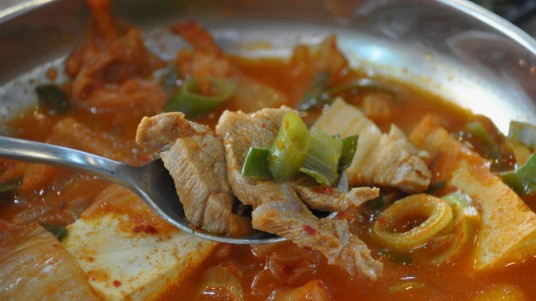
From the shared pot. The stew arrives in a ttukbaegi — an earthenware pot that holds heat and keeps the stew bubbling at the table — and everyone eats from it directly with their own spoon. This is normal and not considered unhygienic; refusing to share the pot would be the odd behaviour.
Spoon in the stew, chopsticks for everything else. The one rule that matters: do not leave your spoon or chopsticks standing upright in the rice. It resembles incense at a funeral and reads badly. Rest them on the table or the bowl’s edge. Fuller etiquette in Korean table manners.
With the side dishes, not before them. Kimchi jjigae comes with the standard spread, including — sometimes confusingly — more kimchi. That is fresh kimchi for eating, distinct from the aged kimchi in the pot.
Ordering it
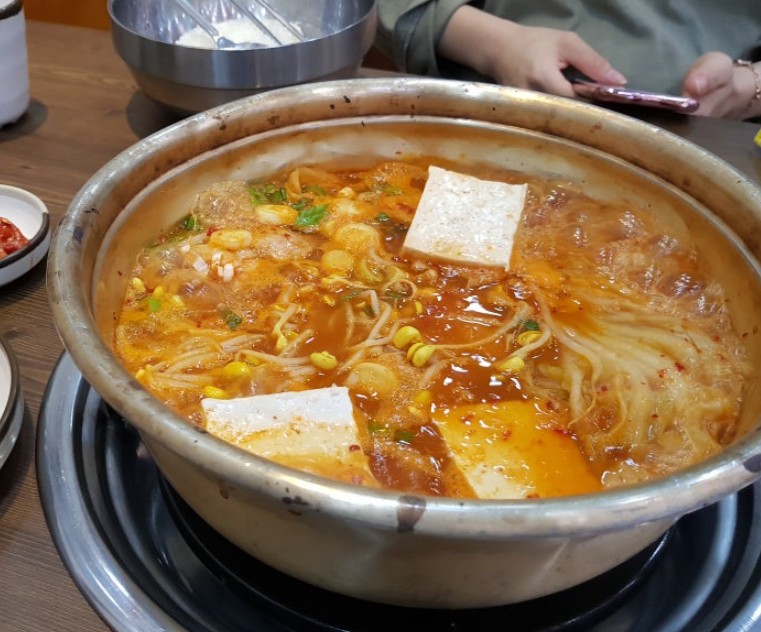
It is on almost every menu. Kimchi jjigae is one of the most reliable orders in Korea, available at any ordinary restaurant and usually one of the cheapest things on the list.
Usually one portion per person, served in individual ttukbaegi at lunch places, or one larger pot for the table at dinner.
It is spicy, but moderately. The heat comes from the kimchi and any added gochugaru, and it registers as sour-hot rather than sharp-hot. It sits well below buldak-level. If you want something in the same category with no heat at all, that would be doenjang jjigae.
“Mugeunji” on the menu means very aged kimchi, and a mugeunji jjigae will be sourer, darker and deeper than the standard version. Worth ordering if you like the sourness.
For the fermentation behind all of this — including why kimchi never really spoils — see what kimchi actually is. If pork is what you came for, samgyeopsal is the grilled version of the same cut that goes into this stew.
Frequently asked questions
Why does kimchi jjigae need old kimchi? Aged kimchi has developed lactic acid and free amino acids, which give the stew its sourness and savoury depth. Fresh kimchi produces a thin, disconnected soup.
How spicy is it? Moderately. The heat is sour-hot rather than sharp, and comes mainly from the kimchi itself.
Can I make it without pork? Yes. Canned tuna is a standard alternative and produces a lighter, cleaner stew. Tofu-only versions work too.
My kimchi is too sour. Can I still use it? Yes, and it will make a better stew than fresh kimchi. Fry it in oil with a little sugar before adding liquid.
What is mugeunji jjigae? The same dish made with long-aged kimchi. Sourer, darker, and deeper.
Do we all eat from the same pot? Yes. Shared stew pots are standard in Korea and not considered unhygienic.