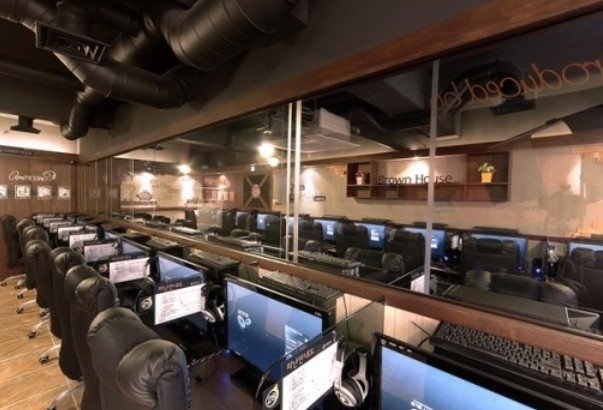
A PC bang (PC방, literally “PC room”) is a 24-hour gaming cafe where you rent a high-end computer by the hour for about ₩1,000–2,000 — less than a coffee. But calling it an “internet cafe” badly undersells it, and that’s the mistake most foreigners make. They picture tired machines and slow browsing. The reality is RTX-class graphics cards, 10Gbps internet, curved monitors, chairs that recline nearly flat, and hot food delivered to your desk that you ordered from a screen without speaking to anyone.
It’s less a cafe than infrastructure — and it’s one of the most distinctly Korean spaces that exists.
Why it exists at this scale
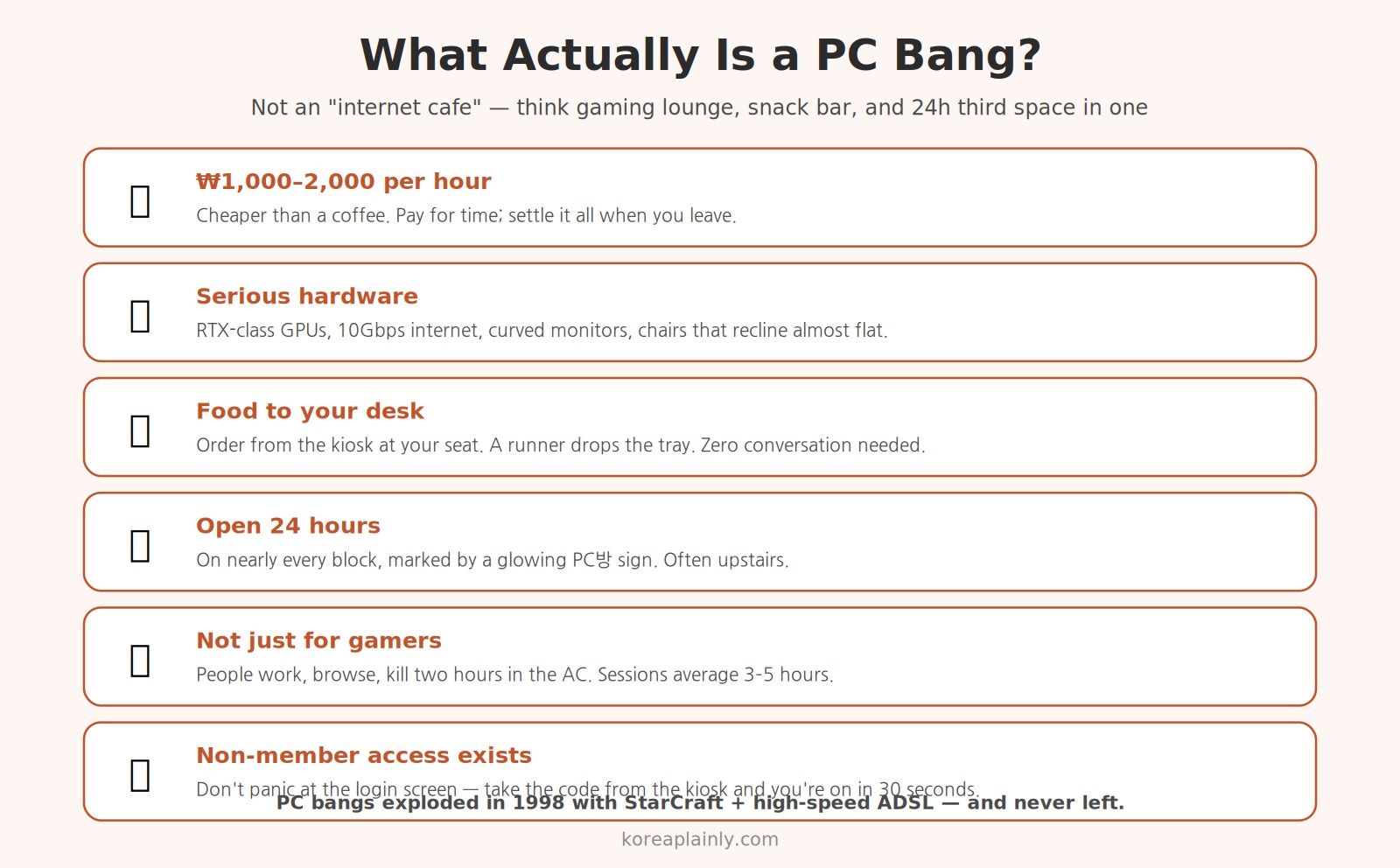
PC bangs aren’t a novelty; they’re the room Korea’s gaming culture was built in. The turning point was 1998, when StarCraft and Lineage landed at the same moment high-speed ADSL arrived. PC rooms turned into gaming hubs almost overnight, esports leagues grew out of them, and even after home internet became universal, they never went away.
The reason they survived is the whole point: it was never only about the computer. It’s the seat, the food, the hours, the fact that your friends are three chairs down, and the fact that it costs about a dollar.
What it costs and how you pay
Time is billed by the hour, roughly ₩1,000–2,000. Most places let you prepay a block of hours at a discount, and locals keep member accounts so unused time carries over.
You don’t need an account. The login screen is the moment most foreigners panic — don’t. Nearly every PC bang has non-member access: take the code from the payment kiosk, type it in, and you’re online in under 30 seconds. Everything you spend inside — time plus food — goes on one tab, settled at the counter when you leave. Foreign Visa and Mastercard work at most newer places.
The food is half the reason
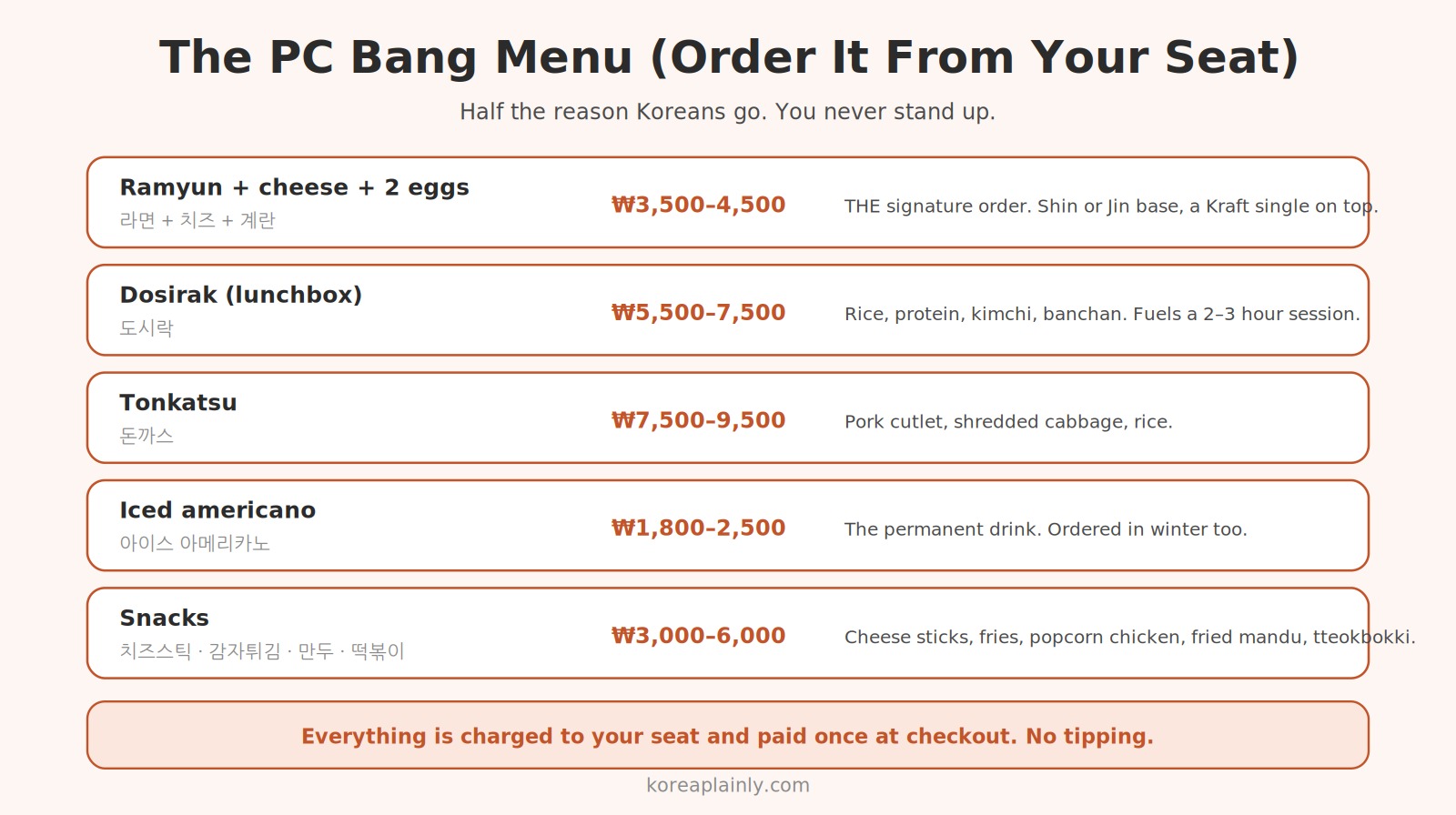
This is what people don’t expect. PC bangs hold restaurant permits and the kitchens are real. You order from a kiosk at your own seat, tap to pay, and a runner sets the tray down next to your mouse with a small nod. No conversation required — which, for a jet-lagged foreigner with no Korean, is a feature.
The signature order is ramyun with a slice of cheese and two eggs (₩3,500–4,500) — Shin or Jin base, a Kraft single melting on top. This is the default, the one Koreans will tell you to get, and it’s genuinely good. Beyond that: dosirak lunchboxes (₩5,500–7,500) that fuel a three-hour session, tonkatsu (₩7,500–9,500), cheese sticks, fries, fried mandu, tteokbokki. And an iced americano (₩1,800–2,500) — ordered year-round, winter included, without exception.
The unwritten etiquette
The floor is quieter than you’d guess — closer to a library with mechanical keyboards than an arcade:
- Don’t talk loudly. Use push-to-talk on Discord.
- Don’t wake the person asleep in the corner seat. They’re fine.
- No tipping, no haggling. Not a thing here.
- Smoking is banned indoors; premium branches have separate ventilated smoking rooms.
One legal note: the old midnight shutdown rule for under-16s was repealed in 2022 and replaced with a parental-choice system, so there’s no blanket lockout — though individual venues can set their own policies.
You don’t have to be a gamer
This is the part worth saying plainly: PC bangs are not just for gamers. They’re a functioning third space. People go to work, to print something, to escape a heatwave, to kill three hours between plans, to sit somewhere air-conditioned and cheap at 4am. Sessions average three to five hours because the seat is genuinely comfortable and nobody is pushing you out.
For a traveler, that makes it quietly useful: reliable internet, a real chair, hot food, open all night, on nearly every block — look for the glowing PC방 sign, usually up a staircase.
One honest caveat for gamers: some Korean games require a Korean account or identity verification, so your usual title may not launch. Global platforms like Steam generally work fine.
You came to Korea for temples and BBQ. Spend ₩2,000 on two hours in a PC bang anyway. It’ll tell you more about how the country actually lives than most museums will.