Korea is surrounded by water on three sides, and most foreign visitors skip the coast entirely. They stay in Seoul, discover that August in the city is above 30°C and humid, and retreat indoors. That’s a mistake. Korean summer belongs at the beach — and the three best options are so different from each other that the only real question is which kind of day you want: a city beach, a surf town, or somewhere genuinely quiet.
First: when the beaches are actually open
Korea’s official beach season runs roughly early July to late August, with some beaches opening in late June. That window is when lifeguards, showers, changing rooms, and rental parasols are all in service. Outside it you can still walk the sand, but swimming is unsupervised and most facilities are closed. Peak crowds hit from late July through mid-August.
1. Haeundae, Busan — where the city meets the sea
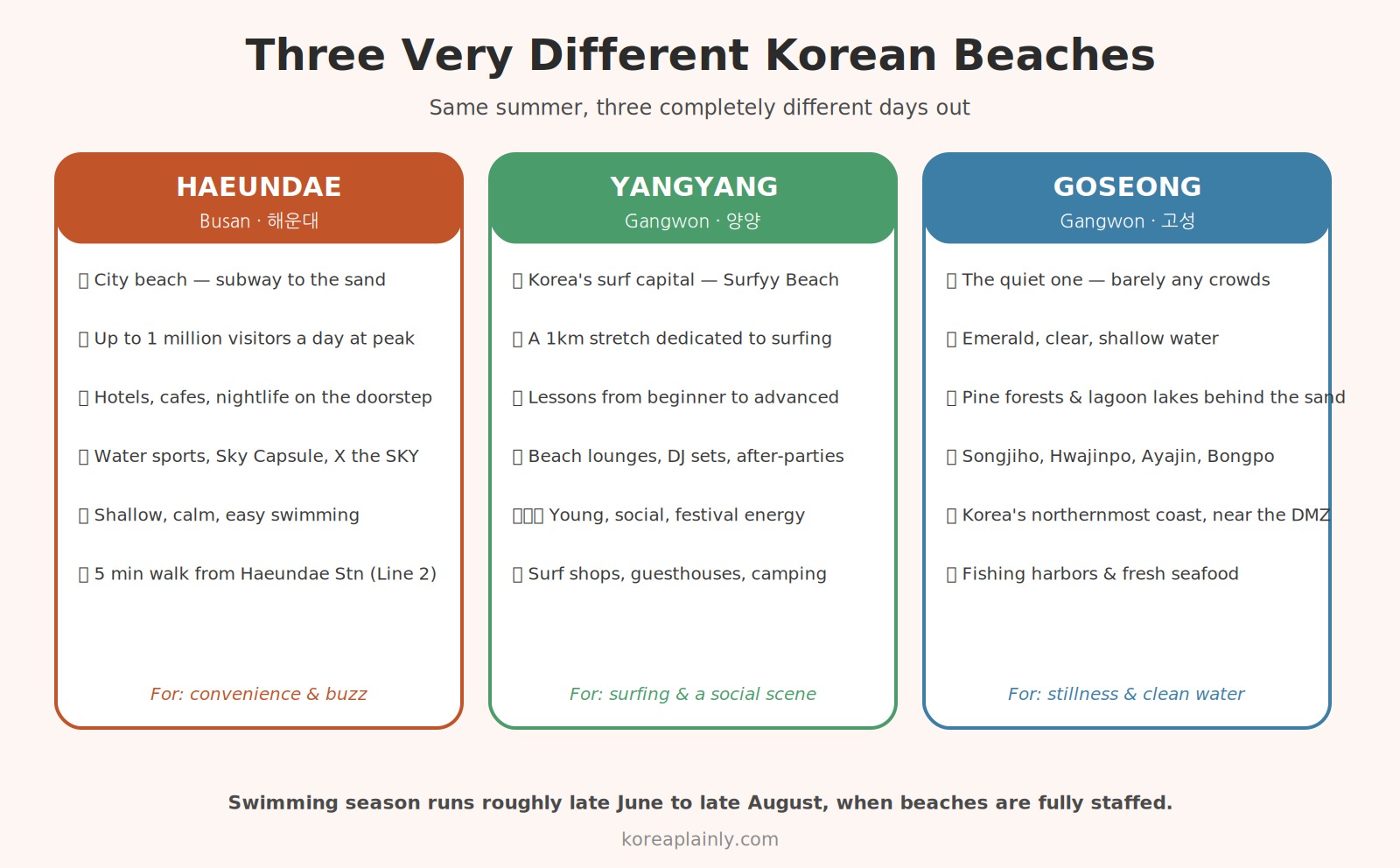
Haeundae is Korea’s most famous beach, and it earns the title. A long white sand shore sits directly beneath a wall of high-rises, which creates a skyline-over-the-sand view you won’t find anywhere else in the country. The water is shallow and calm, making it genuinely easy for swimming, and hotels, cafes, restaurants, and nightlife are all right at the sand’s edge.
The killer advantage is access: it’s the only one of these three you can reach without a car. Take the Busan Subway Line 2 to Haeundae Station, walk out Exit 3 or 5, and you’re on the beach in about five minutes. A marine leisure zone runs along the shore for banana boats and jet skis, and Busan X the SKY observatory, the Haeundae Blueline Park sky capsule, and the pine-and-camellia trails of Dongbaekseom are all within walking distance.
There is exactly one downside, and it’s a big one: at peak season Haeundae draws up to a million visitors a day. Parasols carpet the sand. If that reads as festival energy, this is your beach. If it reads as a nightmare, keep going.
2. Yangyang — Korea’s surf capital
Over the past decade, Yangyang in Gangwon-do has become the center of Korean surf culture. The anchor is Surfyy Beach, a one-kilometer stretch within Hajodae Beach set aside specifically for surfing, with lessons running from complete beginner to advanced. Surfing and swimming areas are kept separate, there are beanbag and hammock zones for doing nothing at all, and after sunset the beach lounges turn into DJ sets and parties.
If you’ve never surfed, this is a good place to start. The waves are manageable for beginners (nearby Ingu Beach is also a beginner hub), and surf schools and rental shops are clustered densely enough that you can simply show up and learn. The atmosphere is young, social, and festival-like — one of the few Korean beaches where arriving solo feels completely normal.
If you want a quiet family holiday, this is not it.
3. Goseong — the quiet one
Goseong is the northernmost county on Korea’s east coast, and that’s exactly what makes it special: it’s the farthest from Seoul, and the distance filters the crowds. It stays calm even in August. The water is unusually clear, shallow, and emerald, backed by pine forests and coastal lagoon lakes.
Rather than one big beach, Goseong is a string of them along the coast:
- Songjiho — a 2km white sand beach with the small rocky island of Jukdo floating offshore, which makes for a beautiful composition. Behind it sits Songji Lake, one of the east coast’s classic lagoons. The pine forest campsite rarely fills, even in August.
- Hwajinpo — golden sand facing Hwajinpo Lake, with the preserved former holiday villas of Kim Il Sung and Syngman Rhee nearby, adding a layer of modern history to a beach day.
- Ayajin, Bongpo, Cheonjin — smaller and quieter still, known for the color of the water.
Goseong is also a scuba diving destination (the rocky Neungpadae area is well known for clear water and marine life), and does sea rafting and windsurfing. Fishing harbors like Geojin put genuinely fresh seafood a short walk from the sand. And because this is the northern tip, the Goseong Unification Observatory and DMZ Museum pair naturally with a beach day — one of the few places you can combine swimming with a serious look at the peninsula’s division.
The trade-off: you really want a car. The beaches are spread out and public transport is sparse.
So which one should you choose?
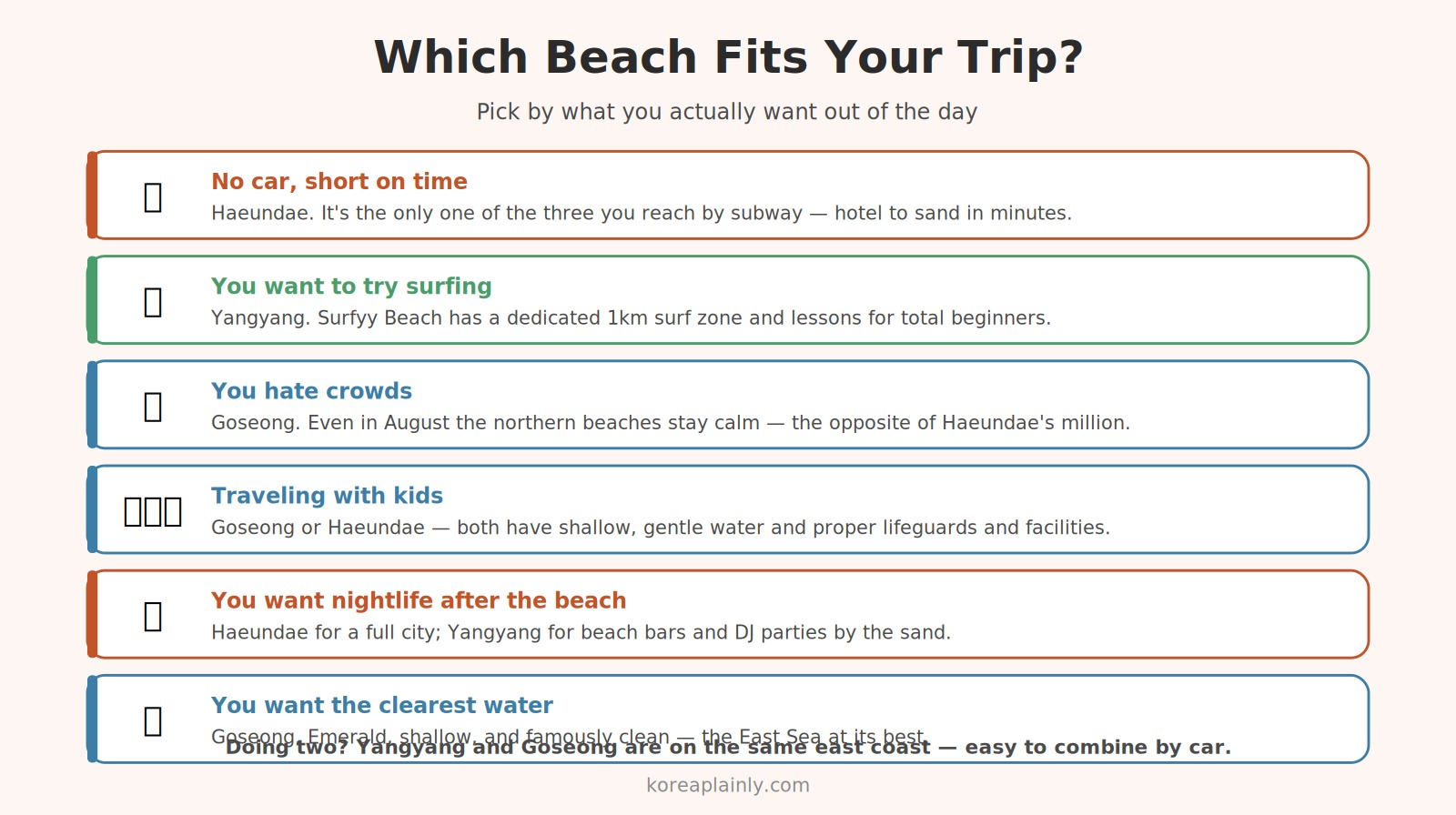
- No car, short on time → Haeundae. The only one reachable by subway.
- You want to try surfing → Yangyang. A dedicated surf zone and beginner lessons.
- You hate crowds → Goseong. The opposite of Haeundae’s million.
- Traveling with kids → Goseong or Haeundae; both have shallow, gentle water plus lifeguards and facilities.
- You want nightlife after the beach → Haeundae for a whole city, Yangyang for beach bars and DJs by the sand.
- You want the clearest water → Goseong, comfortably.
Worth knowing: Yangyang and Goseong are on the same east coast, so they’re easy to combine by car — a surfing day and a quiet day back to back.
Getting there, and a few practical notes
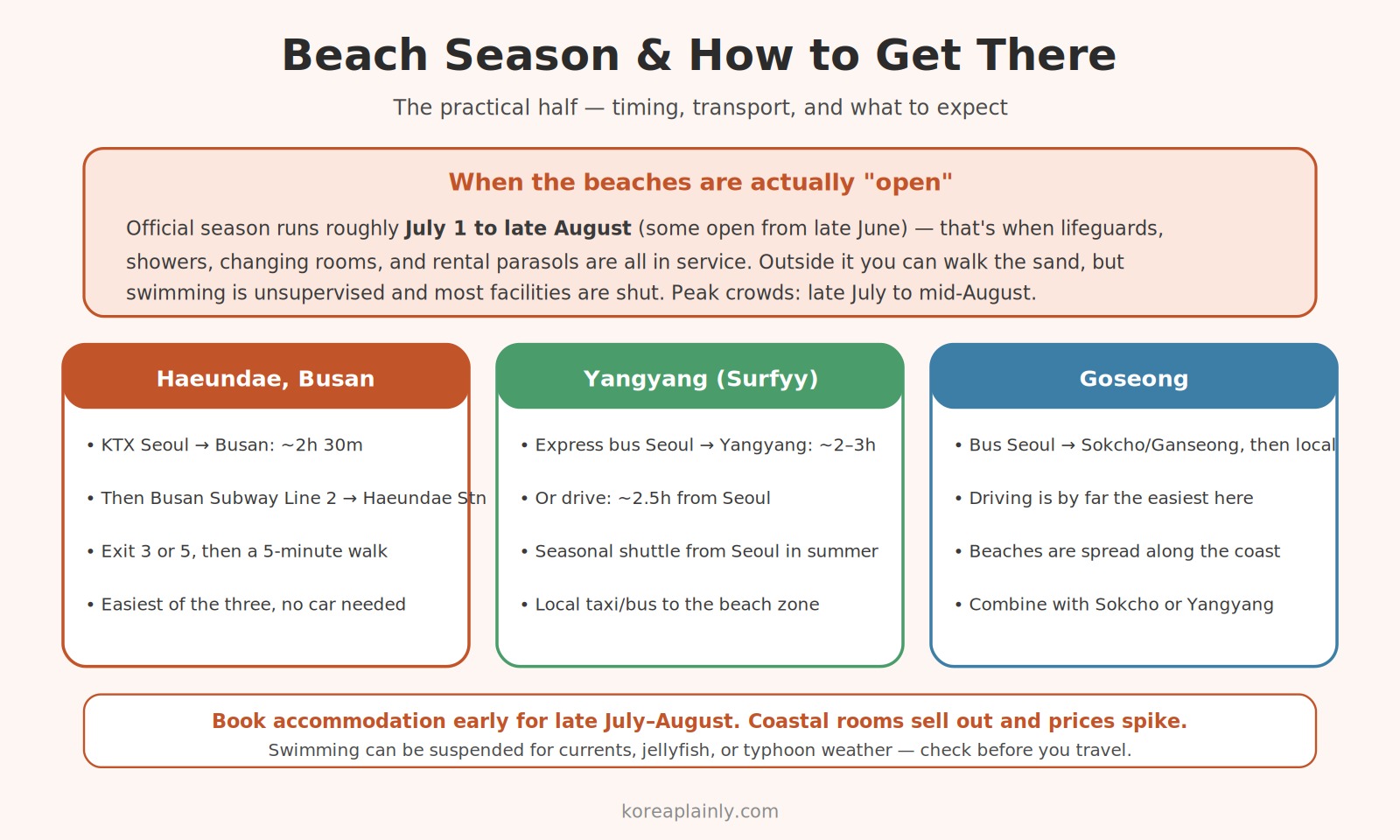
Haeundae is the simplest: KTX from Seoul to Busan takes about 2 hours 30 minutes, then Line 2 to Haeundae Station. Yangyang is roughly 2–3 hours from Seoul by express bus or about 2.5 hours driving, with seasonal shuttles running in summer. Goseong is best done by car; otherwise take a bus toward Sokcho or Ganseong and connect locally.
A few things that will make the trip better:
- Book accommodation early for late July and August. Coastal rooms sell out and prices spike.
- Don’t pack beach gear. Parasols, tubes, and mats are all rentable on site.
- Swimming can be suspended for strong currents, jellyfish, or typhoon weather — check conditions before you travel.
- You’ll see people swimming in T-shirts or rash guards. There’s no rule about it; it’s sun protection. Wear whatever you like.
Don’t spend August hiding from Seoul’s humidity indoors. Two hours by train or bus, and you get a completely different summer.